The fastest quadruped isn’t automatically the right industrial choice. Industrial quadruped robots can provide inspection coverage five times faster than manual walkdown crews, but the strongest fit depends on payload, speed, battery life, operating conditions, and autonomous navigation.
That’s why one headline specification rarely settles the decision. A robot designed to carry heavier equipment may make different trade-offs from one built for longer patrols or challenging terrain.
This comparison explains the capabilities that shape real-world performance, helping you match platform characteristics to inspection tasks, site conditions, and operating priorities. Use the decision guidance to weigh trade-offs and focus on the requirements that matter most.
Key Takeaways
- Match payload and mobility to the inspection equipment and terrain your site requires.
- Compare battery endurance and operating conditions against the length and demands of each route.
- Assess how navigation and SLAM support repeatable movement through changing industrial environments.
- Use a side-by-side capability comparison to prioritize the platform characteristics that best fit your inspection goals.
Payload, speed, battery life and operating environment
Industrial quadruped robots must balance carried equipment, travel pace, runtime, and site conditions. Key considerations include battery endurance, payload-related performance trade-offs, and whether the terrain and environment are within the robot’s design limits.
Payload and Speed Specifications
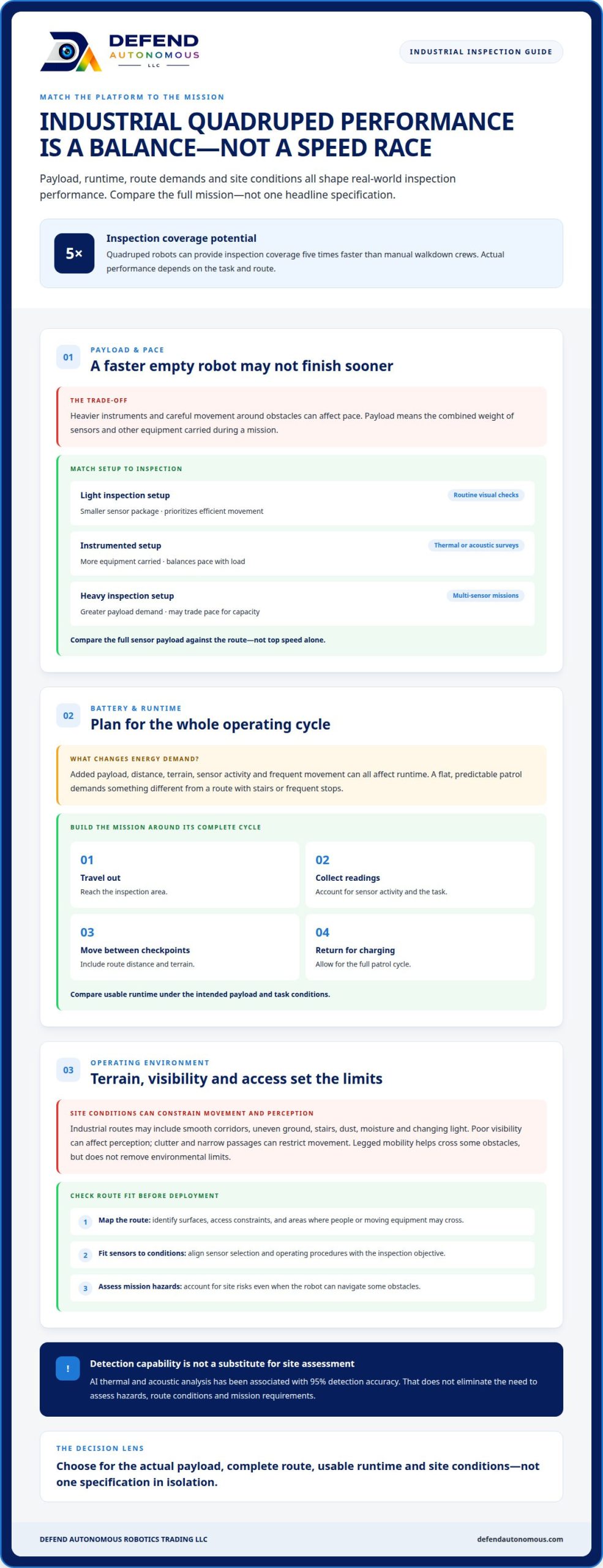
Payload is the combined weight of the sensors and other equipment carried during a mission. Speed matters, too, but a faster empty robot may not finish an inspection sooner if it carries heavier instruments or must move carefully around obstacles. Quadruped robots can provide inspection coverage five times faster than manual walkdown crews, though actual performance depends on the task and route.
| Platform profile | Payload | Speed | Typical fit |
|---|---|---|---|
| Light inspection setup | Smaller sensor package | Prioritizes efficient movement | Routine visual checks |
| Instrumented setup | More equipment carried | Balances pace with load | Thermal or acoustic surveys |
| Heavy inspection setup | Greater payload demand | May trade pace for capacity | Multi-sensor missions |
Match the full sensor payload to the route instead of comparing top speed alone.
Battery Life and Runtime
Runtime is how long a robot can perform its planned work before recharging or changing its battery. Added payload can increase energy demand, as can distance, terrain, sensor activity, and frequent movement. A flat, predictable patrol places different demands on a battery than a route with stairs or frequent stops.
Plan a mission around its complete operating cycle: travel to the inspection area, collect readings, navigate between checkpoints, and return for charging. For example, a long route with continuous thermal sensing may need a different schedule from short visual checks near a charging point. Compare usable runtime under the intended payload and task conditions.
Operating Environment and Risks
Industrial sites range from smooth indoor corridors to uneven outdoor ground, stairs, dust, moisture, and changing light. Sensors and autonomous navigation need to suit those conditions: poor visibility can affect perception, while clutter or narrow passages can restrict movement. A quadruped’s legged mobility can help it cross some obstacles, but it does not remove environmental limits.
Before deployment, map the route and identify surfaces, access constraints, and areas where people or moving equipment may cross. Then align sensor selection and operating procedures with the inspection objective. AI thermal and acoustic analysis has been associated with 95% detection accuracy, but detection capability doesn’t eliminate the need to assess site hazards and mission conditions.
What is a quadruped robot?
A quadruped robot is a four-legged mobile platform that carries sensors through industrial environments. In field robotics, it can gather inspection data in locations where fixed equipment or wheeled machines have limited access.
Compared with wheeled robots, quadrupeds can step over uneven ground and some obstacles. Drones can inspect overhead or hard-to-reach areas, while human inspectors can interpret conditions directly and handle tasks that require judgment or intervention.
Robot-assisted inspection can shift people from routine data collection to reviewing findings and planning follow-up work. A thermal camera can identify heat patterns, an acoustic sensor can capture equipment sounds, and visual cameras can document surface conditions. Gas sensors can measure atmospheric conditions along a route, supporting inspection work in plants, utilities, and other industrial facilities.
Confined-space inspection is one safety application. In 2025-2026, quadruped robot deployment is associated with 80% fewer confined-space entries. That reduction can limit the need for people to enter certain spaces, but it doesn’t eliminate human oversight, site planning, or hazard controls. Inspectors still define the mission, assess results, and decide what action findings require.
In the United States, applicable workplace safety requirements depend on the robot’s design, task, and operating environment. Align deployment with facility procedures for worker interaction, access control, emergency response, and confined-space work.
How much do quadruped robots cost to buy, lease, or operate? Purchase, lease, and operating costs depend on the platform, sensor package, deployment, and maintenance. A project-specific price is provided after a quote request.
For example, a facility inspecting pumps could use visual and acoustic sensors for routine checks, then have human inspectors review unusual readings. This approach combines mobile coverage with human assessment and ties each inspection to a defined operational decision.
Autonomous navigation and SLAM
SLAM means simultaneous localization and mapping. A robot uses sensor input to build a map while estimating its position within it. On an inspection route through a warehouse, this lets the robot associate each reading with a mapped location rather than relying only on continuous remote steering.
Navigation combines the map with a planned route and live observations. The system compares expected surroundings with current sensor data, then adjusts movement when a pallet, door, or person changes the path. A quadruped can step over some obstacles that stop wheeled platforms, but its route still depends on terrain, clearance, and perception.
SLAM can support repeatable inspections. First, map the intended route and mark relevant checkpoints, such as a pump or valve. Next, run the robot along the route and associate collected readings with locations. Then review the map and inspection record together. This helps teams identify where a reading was captured and plan a focused return visit.
Autonomy describes how much of a task the robot completes without direct commands. A remote operator may start or supervise a mission while onboard navigation handles routine movement between mapped points. More complex conditions can require operator intervention, especially if a passage is blocked or the environment differs from the recorded map.
Assess navigation against the facility’s actual operating pattern:
- Route stability: Compare fixed corridors with areas where equipment or stored materials move.
- Localization: Check whether the robot can maintain its position when familiar visual features change.
- Obstacle response: Observe how it pauses, reroutes, or requests assistance around unexpected objects.
For example, a scheduled patrol can follow mapped checkpoints while a remote supervisor monitors exceptions. Compare mission completion, map maintenance, and recovery behavior, not just whether a platform advertises autonomous navigation. A well-defined route and clear response steps make performance easier to assess in operating conditions.
Industrial quadruped robot platform comparison
A useful comparison starts with the inspection mission, not a headline specification. For industrial quadruped robots, payload, runtime, sensor integration, terrain access, and navigation need to work together on the same route.
To evaluate, pilot, and deploy a platform, define a repeatable inspection task and test it under facility conditions. Compare results with operational requirements, tracking route completion, data quality, operator interventions, and workflow impact before scaling deployment.
| Platform profile | Payload capacity | Route and runtime priority | Best suited to |
|---|---|---|---|
| Sensor-focused | Supports the selected inspection instruments | Checkpoint coverage and data collection | Repeatable visual or condition surveys |
| Extended-route | Balances equipment load with mission needs | Longer patrol paths and scheduled checks | Facilities with broad inspection routes |
| Access-focused | Favors a compact mission setup | Movement through constrained areas | Routes with stairs or uneven terrain |
These profiles describe comparison priorities, not specific manufacturers or models. A sensor-focused setup may suit a fixed equipment survey, while an access-focused setup prioritizes route conditions over carrying more instruments. The comparison helps teams weigh carrying additional equipment against reaching more challenging locations.
Use a structured pilot to expose trade-offs before deployment:
- Define the task: Select an inspection route, required readings, and the equipment each mission needs.
- Test the route: Run the intended workflow, including turns, access points, changing obstacles, and return to the start.
- Review outcomes: Compare collected data, route completion, operator interventions, and battery use against task requirements.
- Plan deployment: Document procedures, staff responsibilities, charging arrangements, and escalation steps for exceptions.
Choose a platform that can complete the required inspection with the right sensor payload and manageable operator involvement. For example, industrial quadruped robots used on refinery patrols may prioritize thermal readings and access to inspection points, while warehouse surveys may emphasize movement around changing obstacles. The best fit is the system whose strengths align with the mission, not the longest feature list.
To assess a platform against your inspection objectives, discuss your quadruped robot requirements.
Defend Autonomous Robotics Trading: AMR & AGV Automation Solutions
Defend Autonomous Robotics Trading supplies industrial quadruped robot solutions for organizations assessing legged robots for inspection and field operations. Its AMR & AGV Automation Solutions address a different need: moving materials autonomously through suitable workflows. Establishing whether the priority is mobile inspection, goods movement, or both helps clarify which technology fits the facility.
Turn to Defend Autonomous Robotics Trading when translating evaluation criteria into an automation requirement. Share the task, site conditions, payload needs, and navigation priorities to frame a solution around operational demands. For broader automation planning, the company also offers CNC and advanced manufacturing solutions, commercial EV charging solutions, and AI Coffee & Beverage Robots.
Contact Defend Autonomous Robotics Trading to discuss your automation requirements.
Turn the Evaluation Into an Operational Plan
Move from platform comparison to a clear deployment decision. Define who owns the inspection workflow, how findings reach maintenance teams, and how operations will respond when a robot flags an issue. These decisions connect the technology to daily work instead of treating deployment as a standalone equipment purchase.
For organizations considering industrial quadruped robots, the next step is to build a repeatable process that supports future automation decisions. Set operational priorities, align stakeholders, and establish how success will be reviewed after deployment begins. A disciplined approach helps teams move forward clearly while keeping the technology tied to facility needs.
Continue the conversation with Defend Autonomous Robotics Trading LLC and take the next step toward a more capable operation.
Frequently Asked Questions
Looking for these?
If you’re looking for a quadruped platform, start with the inspection task rather than a model name. Identify the equipment to monitor, the route, the required sensors, and how findings will reach the team responsible for action. This turns a broad technology search into a defined operational requirement and makes platform comparisons more useful.
What are industrial quadruped robots and how do they work?
Industrial quadruped robots are four-legged mobile systems that carry sensors or other inspection equipment. Onboard sensing and navigation software help them interpret their surroundings, locate themselves on a map, and follow routes. For example, LiDAR and laser SLAM support mapping and localization, while safety scanners and intelligent navigation software help calculate routes through a facility. Operators can review inspection data and decide on follow-up actions.
Which manufacturers and models are available in the US?
A useful US shortlist depends on the inspection mission, not a universal brand ranking. Compare models by documented payload, sensing options, navigation performance, operating conditions, and support for the intended workflow. A facility prioritizing perimeter surveillance, for example, may value different capabilities from a team inspecting production equipment. Define the task and route before comparing manufacturers.
What industrial applications and inspection tasks use quadruped robots?
Industrial security robots support facility inspection and surveillance, particularly on routes with complex or hazardous terrain. A site could use one to collect visual records during equipment rounds, monitor defined areas, or capture sensor readings for later review. The practical application depends on the inspection objective, the equipment carried, and how staff use the resulting information in maintenance or security workflows. For patrol applications in the UAE, see this guide to security patrol and quadruped robots in the UAE.
What payload, range, runtime, speed, and terrain capabilities are available?
Capabilities vary by platform and mission configuration. Payload describes the equipment carried; range concerns how far a mission can cover, while runtime concerns how long the robot can operate. Assess speed and terrain performance under the intended load and route conditions. Compare specifications using the same mission assumptions, since an unloaded test may not represent a sensor-equipped inspection workflow.
What sensors, software, and connectivity options are available?
Industrial platforms can use sensors such as LiDAR and safety scanners, alongside laser SLAM and intelligent navigation software. Together, these support mapping, localization, and route calculation. Assess connectivity through the workflow: how operators supervise missions, access inspection records, and pass findings to relevant teams. Define the required data handoff and operating setup before comparing system configurations.