The most capable ROV is not automatically the right choice. A useful ROV solution comparison starts with the mission: control requirements, inspection area, operating environment, duration and available infrastructure all affect which system fits. There is no universal cost or configuration for every operation.
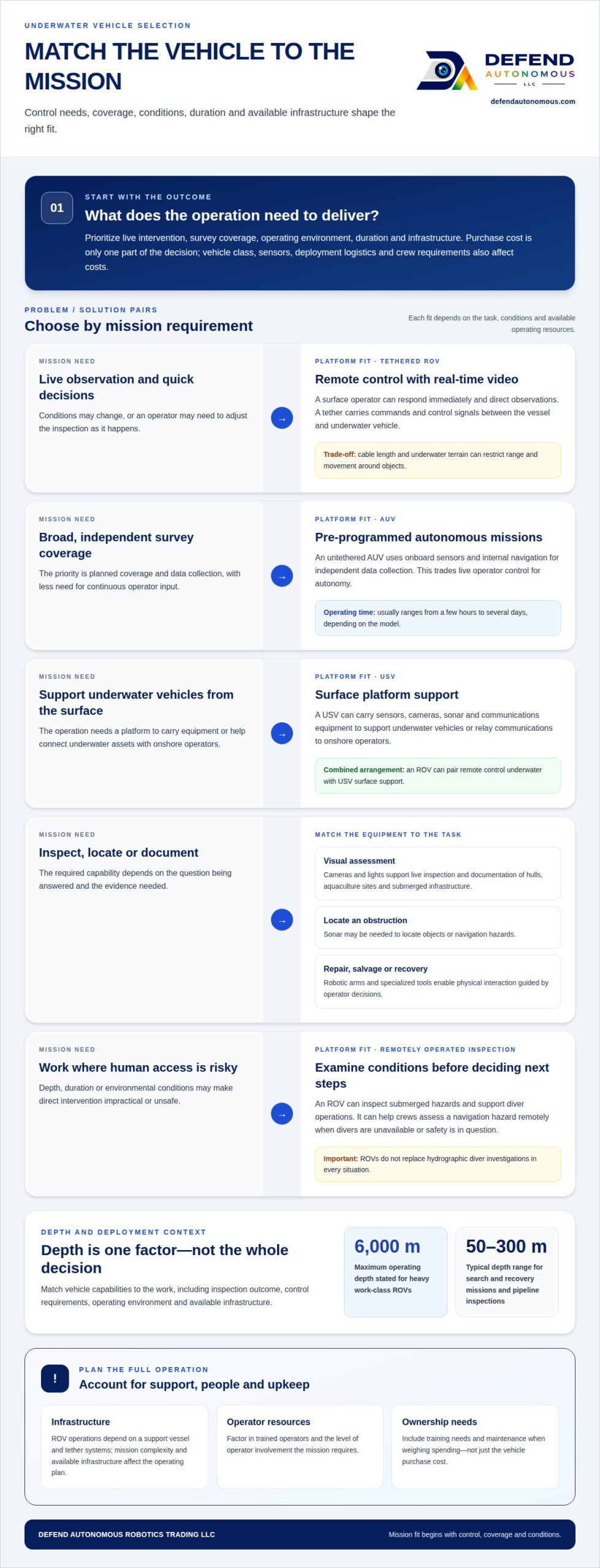
Purchase cost is only one part of the decision. A tethered ROV provides live control and lets operators respond as conditions change, while an autonomous vehicle can suit longer-range surveys where continuous operator input is less important. Costs depend on vehicle class, sensors, deployment logistics and crew requirements, rather than a universal rate.
This guide compares ROV and AUV control, operating environments and inspection uses, then outlines how to weigh mission requirements. It explains when real-time intervention is important, when autonomous coverage may suit the task, and how to match vehicle capabilities to the work.
Key Takeaways
- Compare vehicle types by the control they require, the area they must cover, and the conditions in which they’ll operate.
- Match inspection and maintenance tasks to the capabilities they demand, such as live visual assessment or underwater physical interaction.
- Weigh mission duration, environment, available infrastructure, and operator involvement before selecting a vehicle.
- Plan for more than the vehicle: account for operating resources, training needs, and maintenance in your spending decision.
Vehicle control and operating location comparison
For U.S. operations, regulatory obligations and industry standards depend on the asset, worksite, contract and inspection scope. Match the vehicle’s control method and operating platform to the mission before deployment.
Tethered Remote-Controlled ROV Operation
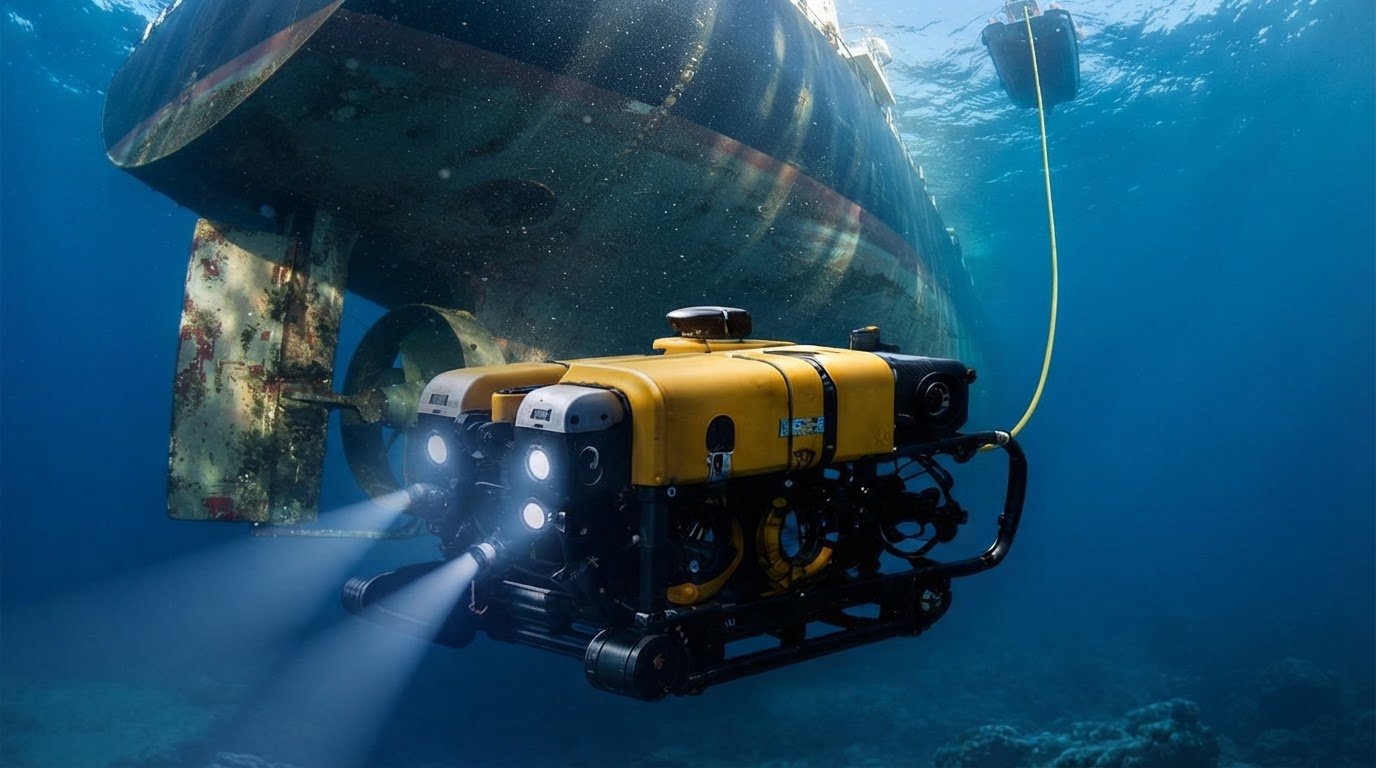
A tethered ROV is operated remotely from a surface vessel, with cables carrying commands and control signals. The connection supports real-time video and immediate operator responses, unlike an AUV that follows a pre-programmed mission without a tether. Tethered power can support long-duration work, but cable length and underwater terrain can restrict range and movement around objects.
Matching ROVs to Operational Scenarios
Choose an ROV when the mission requires live observation, remote control or a rapid response to changing conditions. An AUV may suit broad survey coverage when onboard navigation and independent data collection fit the task. A surface USV can carry sensors, cameras, sonar and communications equipment to support underwater vehicles or relay communications to onshore operators.
| Option | Control | Operating location | Best-fit mission |
|---|---|---|---|
| ROV | Live, remote operator control | Underwater, tethered to vessel | Inspection needing immediate decisions |
| AUV | Pre-programmed autonomy | Underwater, untethered | Wide-area survey and data collection |
| USV | Surface platform support | Water surface | Carrying sensors or relaying communication |
| ROV with USV | Remote control with surface support | Underwater and surface | Coordinated sensing and communication |
Collaboration changes the operating arrangement: a USV can support an underwater vehicle with communications equipment and sensors. By contrast, an ROV’s tether connects it to a surface vessel. ROV operations generally cost more because they require a support vessel, trained operators, and complex tether systems; mission complexity and infrastructure affect the overall operating plan.
Prioritize live intervention, survey coverage, operating environment, duration and available infrastructure when comparing platforms.
Underwater inspection and maintenance use cases
ROVs support marine inspection when direct human access is impractical or risky, including deep water and submerged hazards. Operators can conduct hull inspections, identify navigation hazards, and document underwater conditions from a surface vessel. Unlike autonomous vehicles collecting survey data independently, remotely operated vehicles let crews adjust observations as conditions change.
For inspection, cameras, lights, and sonar help operators examine structures and locate objects. Live video supports focused assessments of vessel hulls, aquaculture sites, and submerged infrastructure. The required capabilities depend on the question: visual documentation calls for clear observation, while locating an obstruction may require sonar. Environmental monitoring and scientific documentation also benefit from observations directed by an operator.
Maintenance and recovery demand more than viewing. Robotic arms and specialized tools allow an ROV to interact with underwater equipment, making it suitable for repair, salvage, and other tasks requiring human decisions and physical interaction. An operator can guide the vehicle toward a target, assess its position, and adjust the intervention. This differs from autonomous survey work, which prioritizes planned coverage over immediate manipulation.
ROVs can also support diver operations where depth, duration, or environmental conditions make human intervention risky. They don’t replace hydrographic diver investigations in every situation; they can be used when divers are unavailable or safety is in question. For example, a submerged navigation hazard can first be examined remotely, helping crews understand the condition before determining the next inspection step.
Underwater ROV dynamics modeling offers another way to study vehicle behavior. One ROV underwater 3D model was built using 3Ds Max, Blender, and the Vortex dynamic engine. Such modeling is distinct from a field inspection: it represents vehicle dynamics, while a deployed ROV gathers imagery or interacts with real objects. The comparison should therefore start with the deliverable, whether monitoring data, visual evidence, or physical intervention.
Mission factors for choosing an underwater vehicle
The main ROV limitations are tether constraints, restricted mobility in complex terrain, and dependence on a support vessel, trained operators, and tether systems. AUVs avoid the tether but trade live operator control for pre-programmed, independent missions. Choose against the mission’s control needs, coverage, environment, duration, and available infrastructure.
Start with the required inspection outcome. For visual documentation of a hull or submerged asset, an operator may need live video and the ability to respond to changing conditions. For broad, independent survey coverage, an AUV may be more appropriate. The key distinction is whether the operation prioritizes immediate observation or autonomous data collection.
Next, match the environment and navigation demands. ROVs suit work requiring real-time control and physical interaction, while their tethers can limit movement around complex underwater terrain. AUVs use onboard sensors and internal navigation systems; GPS can support navigation at the surface. Their operating time usually ranges from a few hours to several days, depending on the model.
Mission depth also shapes the choice. Heavy work-class ROVs can operate at depths of up to 6,000 meters. Search and recovery missions and pipeline inspections typically take place between 50 and 300 meters deep. These examples show why depth alone doesn’t determine the right vehicle: task, control, operating conditions, and infrastructure must also align.
Finally, compare mission frequency with total operating demands. AUVs have a higher upfront cost, but can be more cost-effective for frequent or long-range data collection without constant human supervision. ROV operations require vessel and operator support, making them more costly to operate. For recurring mapping, assess coverage and autonomy; for inspection requiring immediate responses, prioritize live control and vessel support.
How do ROV solutions compare for ease of use, training, and maintenance?
Operating requirements depend on the vehicle and the task. An ROV deployment requires coordination of the vehicle and its tether. An AUV follows a pre-programmed mission independently, reducing the need for continuous operator input during its survey. Either way, crews need to understand the controls, mission plan and operating environment.
For an ROV, build operator preparation around the actual vehicle and task. Crews need to coordinate remote control with the tether and interpret imagery from cameras, lights, or sonar. If the mission includes manipulation, robotic arms add another control function. An AUV shifts emphasis toward mission programming, onboard sensors, and internal navigation systems, since it carries out its survey without operator intervention.
Maintenance planning should reflect the equipment and deployment model, not a generic checklist. For an ROV, include the tether, camera, lights, sonar, and any robotic arm in pre- and post-operation inspections. A damaged or tangled tether can constrain movement, while a camera issue can undermine visual inspection. For an AUV, focus on the onboard sensors and navigation systems used for independent data collection.
- Before deployment: confirm the ROV’s controls, tether path, and required observation or manipulation tools.
- After recovery: inspect the tether and mission equipment, then record any damage or irregular operation.
- For an AUV mission: review the programmed route, sensors, navigation plan, and expected return location.
The practical difference is where operational effort sits: an ROV needs continuous piloting and tether coordination; an AUV needs careful mission preparation and autonomous navigation. Compare the crew’s existing skills, mission frequency, vehicle components, and support requirements before committing resources. Discuss ROV operational requirements in relation to your inspection, survey, or maintenance task.
Defend Autonomous Robotics Trading LLC
Defend Autonomous Robotics Trading LLC provides marine, subsea and ROV solutions for organizations assessing underwater inspection requirements. Start with the asset, inspection objective, operating environment and available infrastructure. These factors clarify which sensors and vehicle type the mission calls for, while deployment logistics and crew requirements shape the operating plan.
When moving from a vehicle comparison to an automation plan, Defend Autonomous Robotics Trading LLC also offers AMR & AGV Automation Solutions, CNC & advanced manufacturing solutions, and EV charging & sustainable energy solutions. For an underwater inspection, keep the decision grounded in the asset, required evidence and deployment conditions.
Contact Defend Autonomous Robotics Trading LLC to discuss your operational requirements and next steps.
Turn the comparison into an operational plan
Use an ROV solution comparison as a planning tool, not a standalone purchasing decision. Define the inspection outcome first, then identify the vehicle, sensors and deployment requirements needed to achieve it. This gives technical and business teams a shared basis for evaluating options and planning resources.
Defend Autonomous Robotics Trading LLC provides ROV solutions for organizations assessing underwater inspection requirements. Its broader portfolio also includes AMR & AGV Automation Solutions, an AI Coffee & Beverage Robot, and CNC & advanced manufacturing solutions. For an ROV decision, focus on the underwater mission, required evidence and operating model.
Move forward with a clear brief covering the task, working environment, operator involvement, and intended outcomes. Contact Defend Autonomous Robotics Trading LLC to discuss your requirements and next steps. A focused plan gives your team a stronger foundation for putting the right capabilities to work.
Frequently Asked Questions
How Much Should I Spend on an ROV?
There is no universal cost for an ROV. Costs depend on vehicle class, sensors, deployment logistics and crew requirements, rather than a universal rate. Build the plan around the evidence needed, such as visual footage, sonar for limited visibility or measurement tools for material-integrity assessment, then account for vessel and crew arrangements. An ROV solution comparison is most useful when it starts with the inspection requirements, not a headline price.
Which ROV Is Right for Me?
Choose an ROV type to match the asset, inspection objective and access conditions. A compact observation unit may suit visual documentation, while a larger work-class system may fit more demanding tasks. For an FPSO hull, pipeline or subsea cable, determine whether the inspection requires cameras, lights, sonar or measurement tools. Depth ratings vary by vehicle design and pressure-rated components, so match the selected ROV’s operating limits to the inspection location.
Which ROV solutions are available and what are their key features?
ROV options range from compact observation units to larger work-class systems. Inspection configurations can include cameras for visual evidence, lights for illumination, sonar for limited visibility, and measurement tools for material-integrity assessment. Select capabilities according to the asset and inspection scope. Entanglement, restricted access, poor visibility, and changing conditions can limit an ROV inspection, so equipment selection must account for the worksite.
How do leading ROV solutions compare in performance and capabilities?
Compare systems by the inspection evidence they can capture, rather than by a general performance label. Cameras support visual documentation, sonar helps operators examine areas with limited visibility, and measurement tools support material-integrity assessment. Depth ratings vary by vehicle design and pressure-rated components; match the selected ROV’s operating limits to the inspection location. The practical limit also depends on tether management, currents, visibility and access around the structure.
Which ROV solution is best for different use cases and industries?
The right configuration depends on the asset and task. Inspections of FPSO hulls, ballast tanks, platforms and rigs require evidence suited to those structures; pipeline and subsea cable inspections may involve different access and monitoring needs. Entanglement, restricted access, poor visibility and changing conditions can limit an ROV inspection. An ROV does not replace coordination of underwater work and operational hazards.
What equipment, software, and support do ROV solutions require?
Equipment depends on the inspection and may include cameras, lights, sonar and measurement tools. Operations also require a suitable vehicle, tether management, vessel arrangements and trained operators. Software requirements depend on the selected system and mission; not every ROV uses the same platform. Defend Autonomous Robotics Trading LLC provides marine, subsea and ROV solutions, with technical support and maintenance for deployed systems.