A fleet’s charging bottleneck is often the time its vehicles are parked, not just the distance they travel. Commercial EV charging solutions match charger type and site capacity to vehicle schedules: Level 2 charging supports longer parking periods, while DC fast charging serves vehicles that need a quicker turnaround. Workplace vehicles are often parked for several hours, making charging speed and dwell time central to planning.
Choosing commercial EV charging solutions takes more than selecting equipment. Account for fleet use, electrical capacity, permitting, and installation so charging supports operations without avoidable disruption.
This guide explains what commercial EV charging involves, how permitting and installation fit into a project, and how Level 2 and fast charging serve different fleet needs. You’ll also see how to assess site requirements and plan a practical path from charging goals to installed infrastructure.
Key Takeaways
- Match charger type and placement to fleet schedules, parking duration, and site capacity to support vehicle availability.
- Plan permitting, equipment procurement, and electrical work as connected stages of an installation project.
- Use Level 2 charging for longer dwell times, and assess fast charging where vehicles need a quicker turnaround.
- Evaluate a turnkey approach around operational requirements, infrastructure readiness, and the path to scaling charging access.
What is commercial EV charging?
Commercial EV charging solutions combine electric vehicle chargers, site infrastructure, and network tools for workplaces, fleets, and public locations. The right configuration depends on vehicle schedules, parking patterns, payment needs, and whether the site serves employees, customers, or retail centers.
Charging software and network management
Charging management software connects networked stations to an operating system for monitoring sessions, setting access rules, processing billing, and reviewing usage analytics. A fleet manager, for example, can compare charging activity across depots and identify where vehicles charge most. Assess network connectivity, reporting, payment records, and outage handling. Key risks include unauthorized access, unavailable chargers, unclear responsibility, and failed transactions. Access controls, maintenance processes, and payment reconciliation help manage them.
Charger types and smart features
Basic chargers deliver power without the connected management features of networked equipment. Networked chargers can support remote monitoring, access controls, and payment functions. OCPP-compliant models use an open communication protocol to support interoperability between charging hardware and management software. Compare the features needed at each site before selecting equipment. Smart charging can schedule sessions around fleet demand and available site capacity, while payment features can serve public users at retail centers. Fast chargers may suit locations where faster vehicle turnover matters.
Ownership and service models
With an owned model, a business funds and controls the charging equipment and its operation. Leasing spreads equipment payments across an agreement, while charging-as-a-service combines charging access with a service arrangement. Compare control, capital planning, maintenance responsibility, and expected demand. The right fit depends on who manages billing and operations, how the infrastructure will be maintained, and whether the business prefers direct ownership or a service-based arrangement.
Network scale and performance
Plan a charging network around site locations, vehicle dwell times, electrical capacity, and anticipated use. Track session completion, charger availability, energy delivered, and peak demand to identify constraints as the network grows. These analytics can help direct infrastructure investment and assess potential revenue at public charging locations. Incentives also affect project planning: according to the Internal Revenue Service, the US federal Alternative Fuel Infrastructure Tax Credit is capped at $100,000 per property. State and utility incentives depend on location and program terms, so assess those alongside site plans and equipment requirements.
Permitting, equipment procurement, and installation
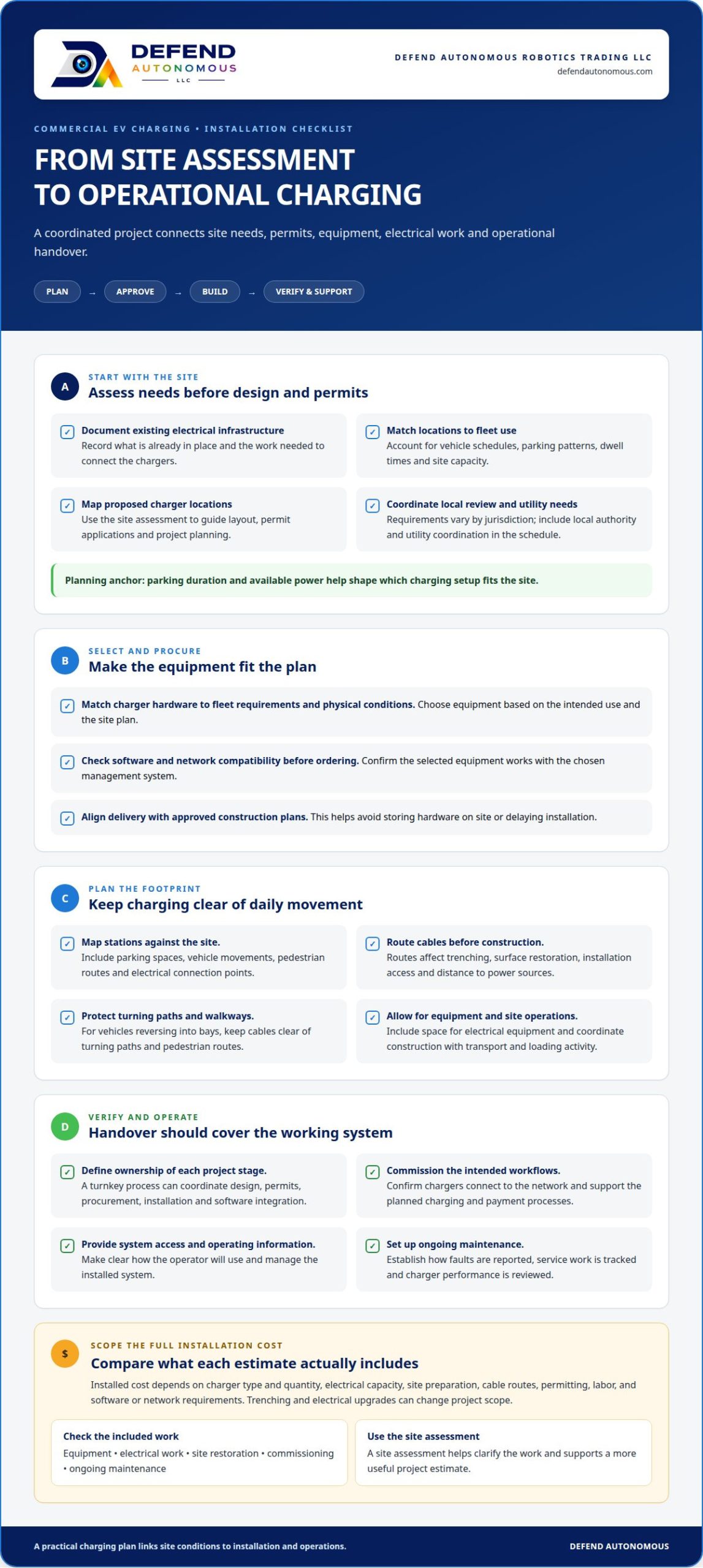
Installation brings site planning, permits, charger hardware, and electrical work into one coordinated project. Early decisions about vehicle parking and power capacity shape station layout, procurement, and integration.
Permitting and equipment procurement
Start with a site assessment documenting existing electrical infrastructure, proposed charger locations, and the work needed to connect equipment. Use those details to prepare permit applications and coordinate with the relevant local authorities and utility. Requirements vary by jurisdiction, so account for local review and utility coordination in the project schedule.
Procurement follows the site plan. Match charger hardware to fleet requirements, physical conditions, and the selected software and network. Check compatibility before ordering, then align delivery with approved construction plans to avoid storing hardware on site or delaying installation.
Site footprint and installation planning
Map each charging station against parking spaces, vehicle movements, pedestrian routes, and electrical connection points. For example, at a depot where vehicles reverse into bays, position cables clear of turning paths and walkways. Include space for electrical equipment and future site operations in the layout.
Plan cable routes before construction begins. The route affects trenching, surface restoration, installation access, and the distance between chargers and power sources. Coordinate construction with transportation and loading activity so daily fleet movements can proceed with minimal conflict.
Turnkey installation and operational support
A turnkey process coordinates design, permitting, equipment procurement, installation, software integration, testing, and handover. Define who manages each stage and how the operator will receive system access and operating information. Commissioning should confirm that chargers connect to the network and support the intended charging and payment workflows.
Ongoing maintenance keeps operational needs in view after installation. Establish a process for reporting faults, tracking service work, and reviewing charger performance. A coordinated EV charging infrastructure plan can connect site installation with software integration and day-to-day operations.
Installation costs
In the United States, total installed cost depends on charger type and quantity, electrical capacity, site preparation, cable routes, permitting, labor, and software or network requirements. Trenching and electrical upgrades can change the project scope, making a site assessment central to a useful estimate.
Project pricing is provided after a quote request. Compare estimates by checking which equipment, electrical work, site restoration, commissioning, and ongoing maintenance are included. Comparing the full scope shows what the installation budget covers, including the work required to make the hardware operational.
Commercial Level 2 charging power and range added per hour
Commercial Level 2 stations suit workplaces and fleet sites where vehicles remain parked during shifts. In North America, they operate on a 208–240-volt AC supply and add around 10–20 miles of range per hour.
This charging approach supports predictable top-ups without requiring every vehicle to use a fast charger. Businesses can scale stations across employee parking, depots, or customer areas as demand grows. The added flexibility can help workplaces attract drivers, support customer visits, and inform site energy planning.
Choose charging speed, connector compatibility, and power capacity based on vehicle inlets, daily travel, parking duration, and site electrical capacity. Assess how many vehicles may charge at once, then size infrastructure to meet demand without exceeding available power.
Level 2 delivers AC power for longer stops; DC fast charging supplies power more quickly for vehicles with shorter dwell times. Use Level 2 for vehicles parked through a workday, and reserve fast chargers for routes or schedules that require faster turnaround.
For a named example, assess the Schneider Charge Pro Level 2 station against fleet vehicle compatibility, electrical capacity, installation requirements, and management needs. Compare its documented specifications with the operating requirements of the site rather than selecting equipment by name alone.
Charging networks and hardware providers vary in how they fit site requirements and fleet operations. Compare network coverage at intended locations, charger compatibility, payment options, management software, and reporting. Choose hardware that integrates with the network and vehicles you plan to support.
Measure return on investment by tracking charger utilization, energy delivered, operating and maintenance costs, and charging revenue where applicable. For a workplace fleet, compare these costs with the fuel and operating expenses the charging program is intended to replace. For a retail site, consider how charging access relates to customer visits, while keeping utilization and energy costs central to the assessment.
Turnkey commercial fast-charging solutions
A turnkey fast-charging project coordinates site planning, equipment, installation, network integration, and operating processes. For corporate properties, the goal is a working charging operation aligned with parking patterns, driver demand, and site capacity.
Begin with an operating brief: identify who will charge, when vehicles arrive, and how long they can park. A fleet depot with short vehicle turnarounds differs from a workplace serving employees during longer shifts. Use these requirements to assess electrical infrastructure, charger locations, traffic flow, and the potential to expand the site.
Next, align equipment selection and installation with the site plan. Coordinate permits, electrical work, charger procurement, and software integration as connected workstreams. Include network access, payment handling, user access, and monitoring in the deployment plan. This helps connect installed hardware with the operational tools drivers need to start and manage sessions.
Before launch, test the full charging journey. Confirm that each station connects to the network, users can access the intended payment or fleet process, and operators can review charging activity. Set responsibilities for maintenance, fault reporting, and service coordination so site teams have a clear response path when a charger needs attention.
Fast charging can also support public-facing properties, where location and utilization influence the business case. Commercial DC fast chargers in high-traffic areas can generate up to $2,640 per month. That figure is not a project forecast: operators should assess demand, operating costs, charging availability, and the site’s ability to serve drivers consistently.
For a fleet, workplace, or public site, define success measures before deployment, such as completed sessions, charger use, and operational fit. A coordinated plan connects physical infrastructure with daily workflows, monitoring, and future expansion. Plan a turnkey charging deployment around your site’s operational requirements.
Defend Autonomous Robotics Trading: AMR & AGV Automation Solutions
Defend Autonomous Robotics Trading offers EV charging and sustainable energy solutions for organizations planning commercial charging infrastructure. Turn to this offering when you need to translate fleet, workplace, or site requirements into an EV charging project. Start with operational needs: vehicle use, charging locations, site capacity, and how infrastructure should support daily activity.
If charging is part of a broader automation strategy, AMR & AGV Automation Solutions may also support facility operations. Treat charging infrastructure and automation as distinct needs, then define how each fits the operating plan. This keeps equipment decisions focused and establishes a clear project direction.
Contact Defend Autonomous Robotics Trading to discuss your EV charging and sustainable energy requirements.
Turn Charging Plans Into Operational Capability
Make charging part of your operating roadmap, not an isolated equipment decision. Define how vehicles, facilities, and energy infrastructure should support your organization’s priorities, then align the project with those outcomes. A phased approach can help teams coordinate site readiness, internal responsibilities, and future expansion while keeping day-to-day operations in view.
Commercial EV charging solutions can form part of a broader modernization plan. Defend Autonomous Robotics Trading LLC also offers AMR & AGV Automation Solutions, an AI Coffee & Beverage Robot, and CNC & advanced manufacturing solutions for organizations evaluating connected operational investments. Tie each initiative to a clear business requirement, with ownership and success measures established from the outset.
Start a focused discussion about your fleet and infrastructure priorities. Contact Defend Autonomous Robotics Trading LLC to explore a practical next step, and move your charging plan forward with confidence.
Frequently Asked Questions
Can Businesses Charge Drivers to Use EV Chargers?
Yes. Businesses can offer paid charging access when their charger network supports payment processing. A public parking facility might charge drivers per session, while an employer could reserve chargers for staff or set different access arrangements for visitors. Before launch, define how drivers see fees, pay, and receive session records. Clear pricing information and a consistent payment process help prevent confusion at the station.
What Is a Level-2 EV Charger?
A Level 2 charger supplies AC power to an electric vehicle through charging equipment installed at a business or workplace. The vehicle converts that AC power for its battery, and the charging rate depends on the charger, vehicle, and available electrical capacity. For example, a workplace can use Level 2 stations for vehicles parked during employees’ regular shifts, then manage access through its charging network.
What Types of Commercial EV Charging Solutions Are Available for Businesses?
Businesses can deploy Level 2 or DC fast chargers, with networked or basic equipment depending on operating needs. A workplace may prioritize employee access, a fleet depot may use controlled charging for assigned vehicles, and a public-facing site may add payment-enabled stations. Consider who will use each charger, when they arrive, how access is managed, and whether charging activity needs centralized reporting.
How Do Level 2 and DC Fast Chargers Compare for Commercial Use?
Level 2 charging fits vehicles that can remain parked longer, while DC fast charging serves shorter stops and faster fleet turnaround. For example, a workplace can assign Level 2 stations to employee parking, while a delivery operation with brief vehicle returns may evaluate fast charging. The operational choice depends on vehicle dwell time, route schedules, electrical capacity, and the required daily availability of each vehicle.
What Ongoing Operating and Maintenance Costs Should Businesses Expect?
Ongoing expenses can include electricity, utility demand charges, network software, payment processing, inspections, repairs, and replacement parts. Costs depend on charger type, usage, utility tariffs, network services, and the site’s maintenance approach. Track energy consumption, completed sessions, service incidents, and payment fees separately. This operating record helps identify cost drivers and informs decisions about charger utilization and future expansion.
What U.S. Codes, Permitting Requirements, and Accessibility Rules Apply to Commercial EV Chargers?
Applicable requirements depend on the project location and the authorities responsible for permits, electrical work, and site access. Account for local building and electrical review, utility coordination, fire-safety considerations, and accessible routes and parking in the site design. Because jurisdictions apply requirements differently, include permitting and accessibility review early in project planning, before equipment selection.