Autonomous delivery is only useful when the handoff is controlled. Healthcare logistics robots can move medication and supplies along defined hospital routes, while secure, compliant operation depends on how access, cargo handling, delivery records, and existing procedures are configured. In a hospital logistics comparison, the robot group’s delivery time on two key routes was approximately 32% to 36% lower than the manual group’s, according to Shaanxi Provincial People’s Hospital.
Speed matters, but it does not remove the need for accountability. Medication and supply workflows must protect the right items, deliver them to the right destination, and maintain clear handoffs between departments. A robot is one part of that system, and its role and operating controls must fit the facility’s processes.
This article explains how healthcare logistics robots transport materials, how cargo compartments can support different delivery needs, and how inventory data can help teams respond to stock-outs. It also covers security and compliance considerations, helping healthcare leaders assess where automation can strengthen logistics and where human oversight remains essential.
Key Takeaways
- Map delivery routes and handoff points to identify where autonomous transport can reduce routine movement and support clinical teams.
- Match cargo compartment configuration to the items, departments, and handling workflows the system must serve.
- Connect inventory visibility to replenishment decisions so teams can identify supply gaps earlier and respond more systematically.
- Assess provider and model fit through workflow integration, access controls, operational safety, and the facility’s deployment requirements.
Autonomous mobile robots for medication and supply delivery
The real-world hospital case discussed here is Shaanxi Provincial People’s Hospital in China, not a U.S. hospital. Its comparison offers a measured example of robot-assisted hospital logistics. U.S. facilities can assess similar delivery workflows against their own routes and handoffs.
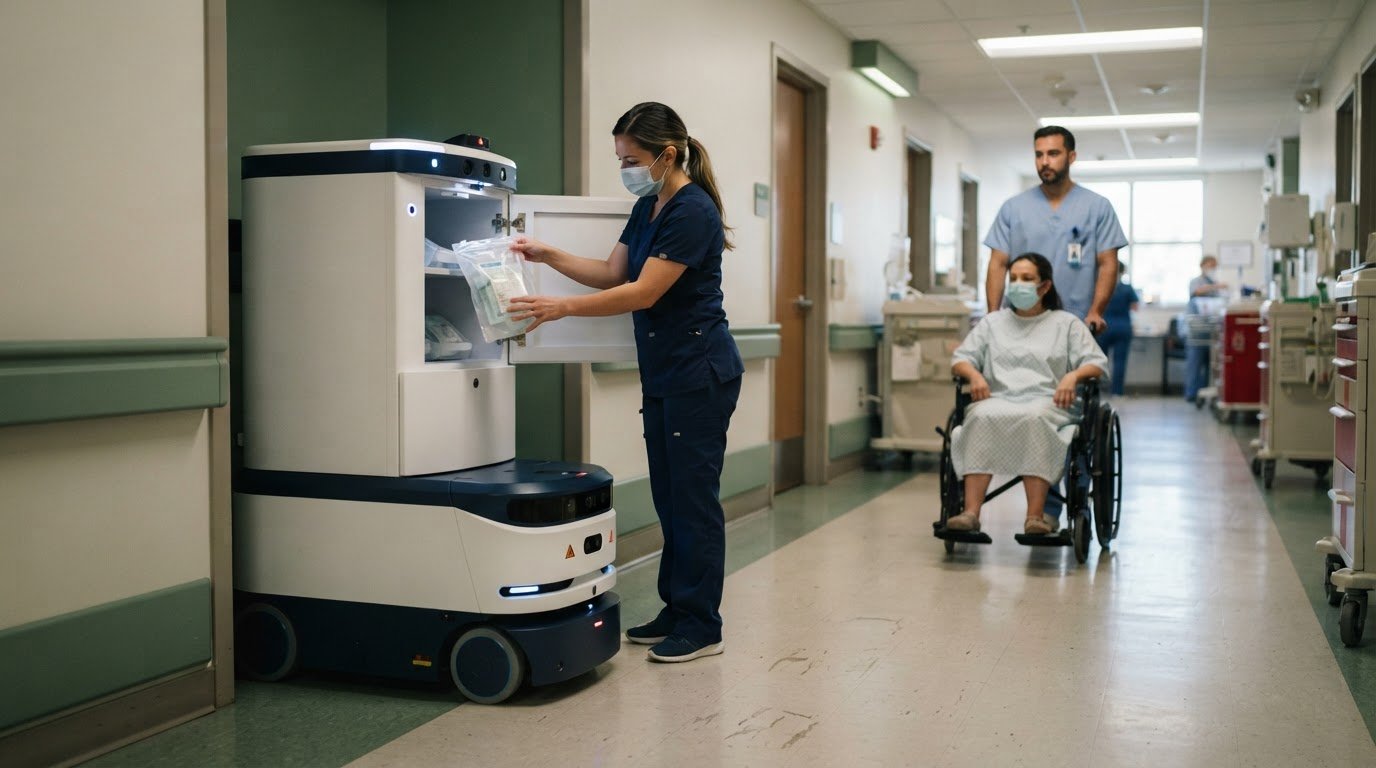
Situation: Medication and supply requests move between locations such as a pharmacy, a supply area, and clinical departments. Staff may need to leave their assigned work to complete these transfers. A route-based robot workflow transports items between defined pickup and delivery points, while clinical staff remain responsible for the medication or supplies and the handoff.
Action: In a hospital deployment, the workflow starts by identifying recurring transport routes and delivery points. The robot carries assigned cargo between those locations, and staff receive and handle the items according to facility procedures. Separating transport from clinical handling clarifies responsibilities. Route selection should reflect actual movement patterns, including pickup locations and the teams receiving deliveries.
Result: In the study’s hospital logistics comparison, the robot group’s delivery time on two key routes was approximately 32% to 36% lower than the manual group’s, according to Shaanxi Provincial People’s Hospital. Delivery time was significantly lower for the robot group than the manual group, with p < 0.001, according to Shaanxi Provincial People’s Hospital. Nurse and patient satisfaction scores were significantly higher for the robot group than the manual group, with p < 0.05, according to Shaanxi Provincial People’s Hospital. These findings connect route performance with reported experience, but they describe that study’s hospital comparison, not a U.S. deployment.
For U.S. hospitals, a useful starting point is evaluating specific delivery tasks, such as recurring pharmacy-to-department transfers, and defining who receives each item. Healthcare logistics robots support transport; facility procedures still govern medication handling, destination confirmation, and clinical use.
Hospital logistics robot design and modular cargo compartments
A hospital robot’s body and cargo layout should reflect the items it carries and the routes it serves. One hospital logistics robot system offered six types of standardized cargo compartments for configuration by department. That gives designers a way to separate workflows, such as pharmacy orders and general clinical supplies, without treating every delivery as identical.
Start with the cargo. Map item dimensions, handling needs, pickup points, and receiving departments, then match compartment configurations to the workflow, including how staff load and retrieve deliveries. For example, pharmacy and central supply may need separate compartments or assignment rules. Clear separation supports organized handoffs, but compartment choice does not determine medication-handling procedures.
Compared with automated guided vehicles, autonomous mobile robots can be configured to navigate changing shared spaces, while guided vehicles typically follow defined routes. Pneumatic tube systems move compatible items through fixed tubes; mobile robots carry cargo through corridors and can serve delivery points tubes do not reach. The right comparison depends on the cargo, destination, route, and workflow.
Integrating elevators, doors, inventory systems, and hospital IT requires site-specific planning. Identify the access points the robot must use, then coordinate the relevant interfaces with facilities and technology teams. Inventory connections can support item and destination information, while hospital IT planning addresses system access and data exchange. Design these connections around existing systems and security processes.
For a U.S. hospital evaluation, provide representative floor plans, delivery routes, cargo profiles, receiving locations, and current handoff procedures. Involve facilities, clinical operations, pharmacy, supply chain, and IT stakeholders in workflow decisions. Together, the hospital and deployment team can map access points, identify integration requirements, and define which delivery tasks the robot should support.
Hospital supply-chain inventory and stock-outs
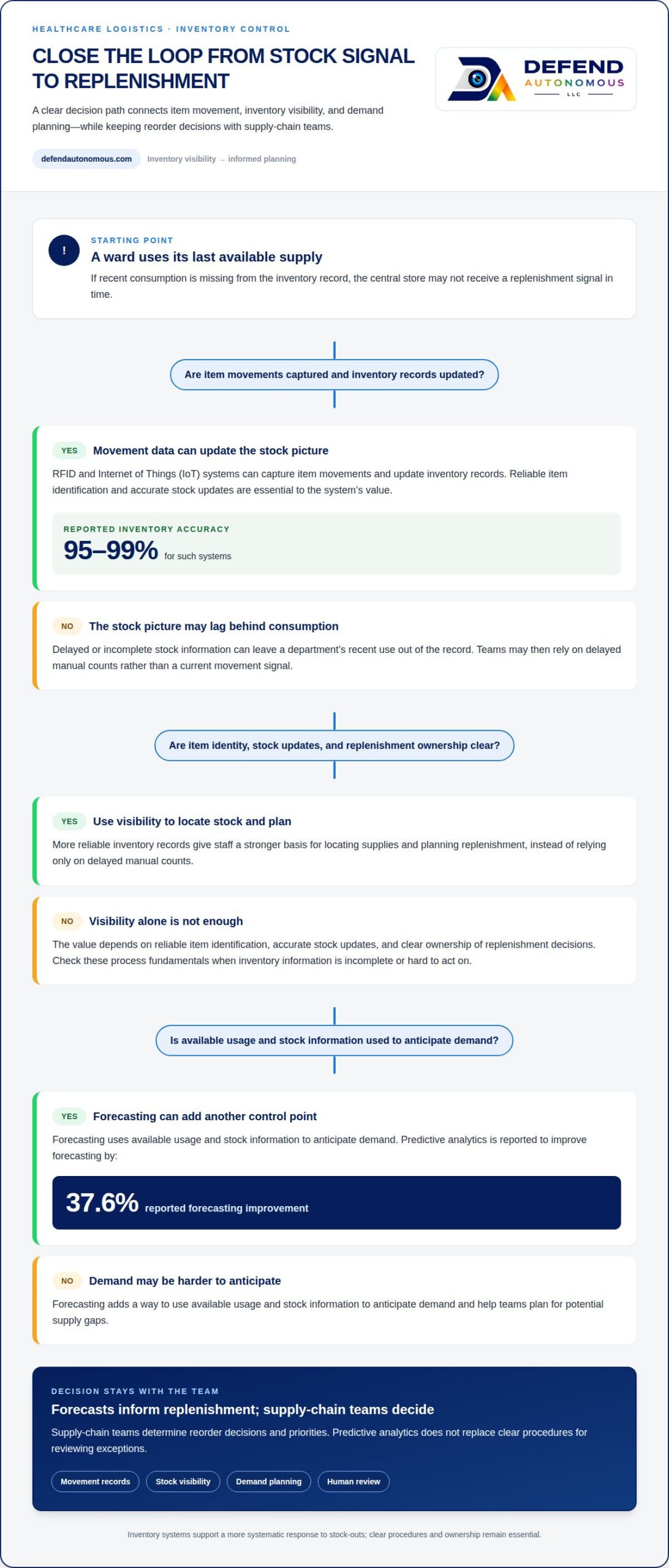
Inventory gaps can start with delayed or incomplete stock information. A clinical unit may use its last available supply before the central store receives a replenishment signal. Connected inventory records can make item movement more visible, while delivery robots can support planned transfers between storage areas and departments. The system’s value depends on reliable item identification, accurate stock updates, and clear ownership of replenishment decisions.
Situation: A ward requests a frequently used supply, but the inventory record doesn’t reflect recent consumption. Action: RFID and Internet of Things (IoT) systems can capture item movements and update inventory records. Such systems are reported to enable 95-99% inventory accuracy. Result: Staff gain a stronger basis for locating stock and planning replenishment, rather than relying only on delayed manual counts.
Forecasting adds another control point. Predictive analytics is reported to improve forecasting by 37.6%. In practice, forecasting uses available usage and stock information to anticipate demand, while supply-chain teams determine reorder decisions and priorities. Better forecasts can help direct replenishment before a department reaches a critical gap. They don’t replace clear procedures for reviewing exceptions, recording urgent requests, or resolving inaccurate data.
Situation: An essential item is unavailable at the point of use. Action: Inventory visibility can flag low stock, and delivery workflows can move available supplies from a designated store. Result: Hospital supply-chain robotics are reported to reduce stock-outs by 60-80%, while order fulfillment rates are reported to increase by 20-30%. These figures describe reported outcomes, not a guaranteed result for every facility.
For a practical deployment, connect stock records to replenishment workflows and define how exceptions reach staff. Decide which supplies are suitable for automated transport and which need separate handling procedures. A robot can move an assigned item, but accurate inventory still depends on correct scans, timely updates, and disciplined receiving. Together, these controls give hospital teams a clearer view of what is available, where it is, and what needs attention.
How can U.S. hospitals choose a healthcare logistics robot provider and model?
Start with the operational problem, not a preferred machine. A hospital moving pharmacy orders between departments has different capacity and handoff needs from one transporting linens or general supplies. Define the cargo, pickup and receiving points, route conditions, and staff responsibilities. This scope gives Defend Autonomous Robotics Trading LLC a practical basis for discussing a suitable model and system configuration.
Assess the proposed model against the facility’s physical environment. Evaluate corridor access, shared spaces, elevators, doors, loading points, and delivery locations. Discuss how the system handles route changes and interruptions, and how staff can interact with it safely. These details help establish whether the design fits the hospital’s day-to-day movement patterns.
Integration needs equal attention. Identify the hospital systems involved in task assignment, inventory records, access permissions, and delivery status. Include IT, facilities, pharmacy, supply chain, and clinical operations in design discussions. Their input can reveal interface dependencies and workflow constraints before deployment planning advances.
Use a structured evaluation process:
- Define the use case. Document representative items, origin points, destinations, and handoff steps.
- Review the site. Map routes, access points, shared areas, and operational interruptions.
- Specify integration. Identify relevant hospital systems, data exchanges, and access controls.
- Set evaluation criteria. Agree how the hospital will assess delivery completion, workflow fit, and exception handling.
- Plan deployment. Align staff training, operating procedures, technical coordination, and ongoing support.
A provider should explain how its proposed model addresses each requirement, including operational limits and system dependencies. The hospital can then assess the design against its actual use case, rather than relying on a generic demonstration. For a professional discussion of hospital delivery workflows and system fit, discuss healthcare robot deployment requirements.
Defend Autonomous Robotics Trading LLC
Defend Autonomous Robotics Trading LLC helps organizations explore automation solutions aligned with operational workflows and system requirements. For healthcare teams assessing delivery robotics, its AMR & AGV Automation Solutions provide a relevant starting point for discussing how autonomous mobility may fit facility logistics. The evaluation can focus on delivery tasks, movement through shared spaces, and the operational processes that must work alongside the system.
Bring the intended use case, representative routes, cargo needs, and integration priorities to the discussion. These details help shape a practical solution around facility requirements rather than a generic automation concept. If your organization is assessing autonomous delivery, contact Defend Autonomous Robotics Trading LLC to discuss the opportunity.
Turn a Defined Need Into a Practical Next Step
Make the next decision operational: identify the priority delivery workflow, the teams it affects, and the facility requirements a solution must meet. This creates a focused basis for evaluating healthcare logistics robots and aligning automation with clinical priorities, system constraints, and day-to-day procedures.
Defend Autonomous Robotics Trading LLC offers AMR & AGV Automation Solutions, AI Coffee & Beverage Robots, and CNC and advanced manufacturing solutions. This broader automation portfolio supports organizations planning technology investments across operational environments.
Use your workflow priorities to frame a practical conversation about the right direction for your facility. Contact Defend Autonomous Robotics Trading LLC to discuss your automation requirements and take the next step with clarity.
Frequently Asked Questions
Are robotic systems secure and compliant?
Robots can support secure workflows when technical access controls and hospital governance are designed together. Hospitals should define who can assign tasks, access operational data, and manage system permissions, as well as how activity is recorded and reviewed. Compliance depends on applicable requirements and facility procedures, so deployment planning should involve IT, security, and clinical stakeholders.
Can robotics help reduce nurse burnout?
Robotics can reduce some repetitive transport tasks that take nurses away from clinical responsibilities. For example, automating routine supply transfers between a central store and a ward can reduce interruptions and unnecessary trips. This may ease one source of workload, but it does not address every cause of burnout. Staffing, workload design, and clinical support remain important parts of the broader response.
How do hospital robots reduce staff burden?
Hospital robots carry assigned items along operational routes, leaving staff to receive, handle, and use them. For example, scheduled replenishment deliveries can reduce the need for a staff member to leave a unit for each request. Teams still manage exceptions, confirm handoffs, and prioritize urgent needs, keeping clinical judgment with people.
How is AI enhancing robotic logistics systems?
AI can help coordinate route planning, interpret operational data, and support demand forecasts. For example, a system could use task information to organize deliveries around destinations and changing priorities. Multimodal systems combining robotics, AI, and IoT are reported to deliver 28-37% better efficiency. The practical value depends on how well the system’s data and automated decisions fit hospital workflows.
How quickly can hospitals realize ROI from robotics?
Most institutions are reported to achieve a return on investment from robotics within 15 to 24 months. This timeframe is not a guaranteed outcome for an individual hospital. The business case depends on which workflows are automated, how consistently the system is used, integration needs, and the operational changes that follow deployment. Hospitals should define their own measures of value before implementation.
What future trends are shaping hospital logistics automation?
Connected systems are shaping hospital logistics by linking mobile robots with AI and IoT data to coordinate movement and improve operational visibility. Predictive analytics can help teams anticipate demand instead of responding only after shortages emerge. Future deployments will depend increasingly on integration across hospital workflows, clear human oversight, and designs suited to different cargo, routes, and departmental requirements.