Hospital logistics depend on more than people and carts. Medical delivery robots use autonomous mobile robot technology to move medication and medical supplies through healthcare facilities, following mapped routes or using computer vision to navigate. They can support routine transit while clinical teams focus on patient care.
Reliable delivery depends on fitting the technology to real hospital workflows. Routes, handoff points, staff training, maintenance, and interactions with people all matter.
This article explains how healthcare robotics supports medication and supply transit, how social navigation helps robots operate in shared spaces, and what to consider when planning an autonomous mobile robot deployment. You’ll see how delivery tasks fit into the wider role of healthcare service robots, and how workflow integration shapes a practical implementation.
Key Takeaways
- See how healthcare robotics can support logistics beyond delivery, including supply management and routine restocking.
- Understand why social navigation matters when robots share busy hospital spaces with staff, patients, and visitors.
- Identify medication and supply transit tasks that may suit autonomous mobile robots, and how these tasks fit into care workflows.
- Assess the operational factors that shape implementation, including workflow integration, staff training, and ongoing maintenance.
What Is Robotics in Healthcare?
Healthcare robotics uses automated machines for clinical and operational tasks. In hospitals, mobile robots can move supplies and medication along planned delivery routes.
Hospital Logistics and Supply Runs
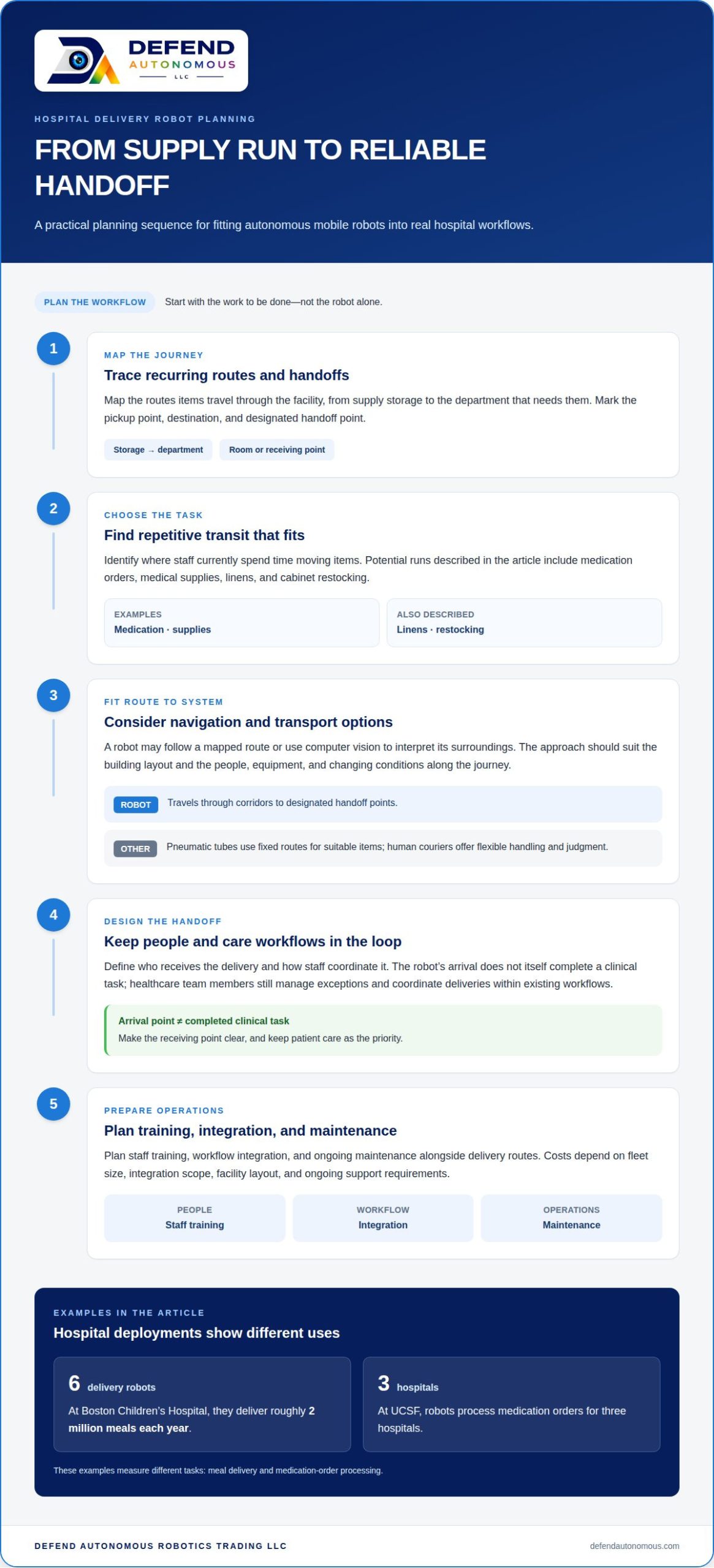
Hospital logistics connect supply storage, inventory management, and delivery to the departments that need materials. A supply run might move linens, restock a cabinet, or carry a medication order between locations. Start by mapping recurring routes and handoff points, then identify where staff currently spend time moving items. Healthcare team members still manage exceptions and coordinate deliveries within existing workflows.
Delivery Tasks and Applications
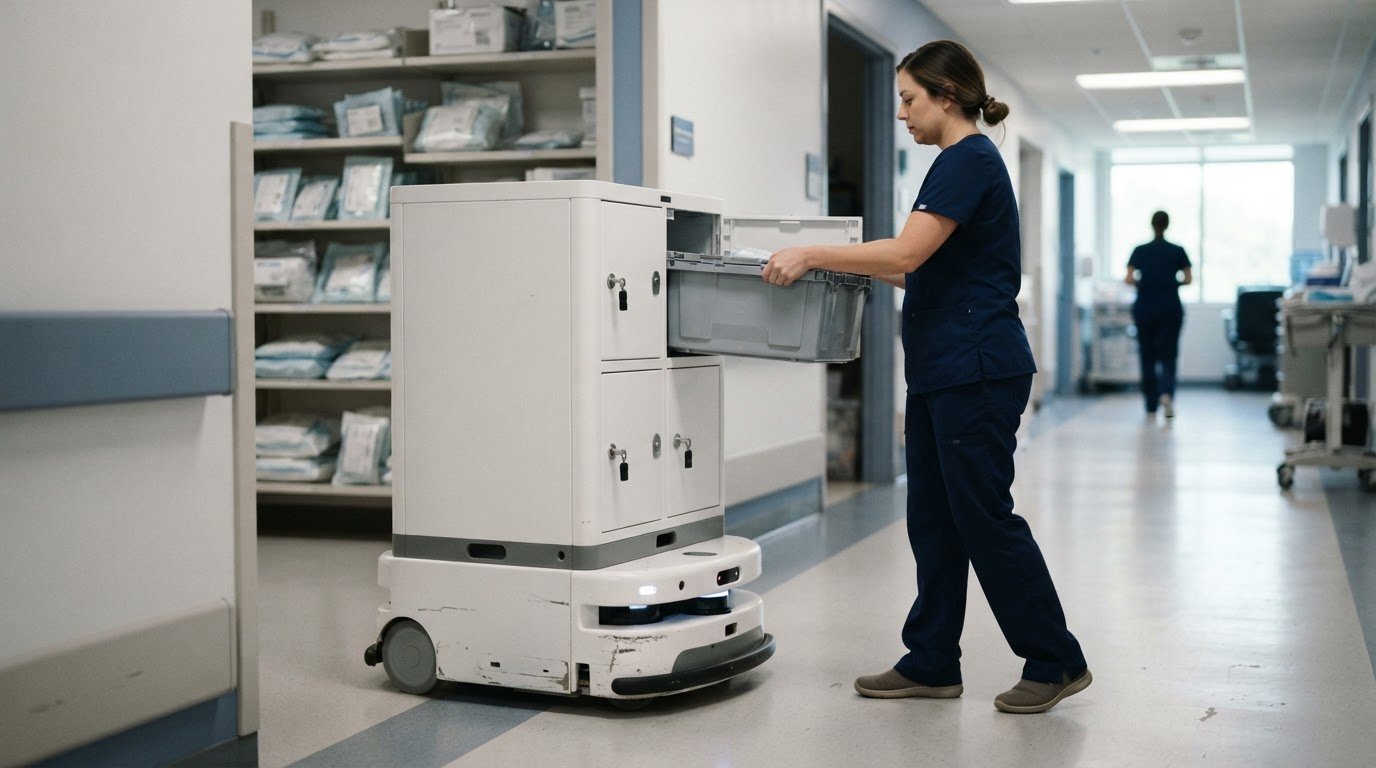
Medical delivery robots can transport medication and medical supplies through hospital corridors. Healthcare service robots can also support supply tracking, cabinet restocking, purchase orders, and linen transport. At the University of California, San Francisco, robots process medication orders for three hospitals. These examples show how delivery applications can connect with broader logistics tasks, rather than operating as isolated trips.
Benefits and System Comparisons
Robots can take on repetitive transit, giving staff more time for duties that require direct attention. Six delivery robots at Boston Children’s Hospital deliver roughly 2 million meals each year. Pneumatic tube systems move suitable items through fixed routes, while robots can travel through corridors to designated handoff points. Human couriers provide flexible handling and judgment. The best fit depends on the item, route, handoff, and workflow.
Costs and Hospital Results
Purchase, lease, and maintenance costs depend on fleet size, integration scope, facility layout, and ongoing support requirements. Pricing is determined by the case and provided after a quote request. Hospital results also depend on the task being measured: Boston Children’s Hospital reports meal deliveries, while UCSF’s example involves medication-order processing across three hospitals. For implementation, plan staff training, workflow integration, and ongoing maintenance alongside delivery routes. These steps help align the system with day-to-day hospital operations.
Approximately 800 hospitals use disinfecting robots. Some use ultraviolet light, hydrogen peroxide vapors, or air filtration. On any given day, approximately 1 in 31 U.S. hospital patients has a health care-associated infection.
Social intelligence and navigation
A hospital corridor is shared space, not an empty route. A mobile robot must navigate around staff, patients, visitors, and equipment as it travels to its destination. Its navigation system needs to account for people and changing conditions in active care environments.
Navigation in Shared Hospital Spaces
Autonomous mobile robots can use computer vision or mapping to navigate to patients in exam or hospital rooms. A mapped route gives the robot a planned path; computer vision can help it interpret the surroundings along that journey. For example, a robot delivering supplies may need to adjust its movement when a person enters the corridor. The system’s navigation approach should suit the building layout and the interactions expected during each trip.
Wayfinding also depends on clear destinations and handoffs. A delivery route can identify a department, room, or designated receiving point, while staff handle the transfer. This distinction matters in hospitals, where a robot’s arrival does not itself complete a clinical task. Patient care remains the priority, and navigation should support established routines rather than create extra steps for staff.
Social Robots and Patient Interaction
Delivery robots and social robots serve different purposes. A delivery unit transports items; a social robot can engage with a patient. Social robots may help patients follow treatment regimens and provide cognitive engagement, connecting interaction with patient care rather than material transit.
Each function calls for different measures of success. For a delivery robot, assess whether it reaches the intended handoff point as part of the workflow. For a social robot, assess whether its interaction supports a defined need. If a robot collects patient data, protecting personal health information must be part of system design from the outset.
Facilities assessing social navigation can map routes, identify busy shared areas, and define handoff points before deployment. Those operational choices help clarify how robots should move and interact within the hospital. Explore medical delivery robot solutions as a next step for planning hospital transit.
Autonomous mobile robots for delivery of medication and medical supplies
Autonomous mobile robots connect a delivery request with a destination inside a healthcare facility. Their value depends on matching the task, route, and handoff to clinical workflows.
Robot Types and Delivery Uses
U.S. hospitals use autonomous mobile robots to transport medication and medical supplies. These robots may navigate using computer vision or mapping, then travel to a patient’s exam or hospital room. Healthcare robots also support disinfection and telepresence, but those functions differ from material delivery. Select a system according to its intended task, delivery route, and receiving point.
Distinguish available systems by how they navigate, what they carry, and how they fit into hospital workflows. A medication delivery route, for example, may need a different handoff process from a supply run. Define the transit task and staff responsibilities at pickup and arrival. These criteria help teams compare systems without treating every hospital robot as interchangeable.
Safety and Data Risks
FDA, OSHA, HIPAA, and other U.S. requirements should be considered in relation to the robot’s intended use, workplace interactions, and data handling. The relevant assessment depends on what the system does and what information it processes. Healthcare robots that collect patient data must protect personal health information.
Operational risks include contact with people or equipment, interruptions on busy clinical routes, and failures at handoff points. Infection control also matters when a robot moves between hospital areas or carries supplies. Define cleaning procedures and delivery boundaries as part of the workflow. For cybersecurity and privacy, examine what data the robot collects, how it moves through the facility, and who can access its data. These checks help teams identify risks before routine deployment while preserving human oversight.
What are medical delivery robots and what tasks do they perform?
Medical delivery robots are mobile systems that transport items or support operational work inside healthcare facilities. Autonomous mobile robots can deliver medication and medical supplies, support disinfection, and assist with telepresence. Each application serves a distinct workflow, so the task should guide the deployment plan.
For delivery, define the item, pickup location, destination, and handoff before assigning a route. A medication order may travel to a hospital department, while supplies may move from storage to a clinical area. Mapping or computer vision can help an autonomous robot navigate to patients in exam or hospital rooms. Staff remain part of the process at pickup, receipt, and exceptions.
- Medication transit: Move orders between designated locations, with a clear receiving handoff.
- Supply delivery: Carry medical materials to clinical areas according to recurring operational needs.
- Other support: Disinfection and telepresence are separate healthcare robot applications, not delivery tasks.
Integration depends on how deliveries connect to existing work. Identify recurring routes, receiving points, and the staff responsible for each handoff. Include training and ongoing maintenance in implementation planning. This helps teams define the role medical delivery robots can play without replacing clinical judgment or human coordination.
Define the operational purpose clearly: will the system transport medication, move supplies, or perform another specific task? The route should suit the facility layout and avoid unnecessary steps for staff. Maintenance planning supports continued operation, while workflow integration aligns robot movements with hospital routines. These decisions give medical delivery robots a practical role in hospital logistics and a clear basis for evaluating deployment.
Nurses spend up to 30% of their time on non-value added tasks. That figure provides a reason to examine whether routine transport work can be organized more consistently, while keeping the robot’s role limited to the defined delivery workflow. Teams can consider which recurring trips involve staff time and whether the pickup, travel, and handoff steps are suitable for mobile delivery. The figure alone does not establish that a robot will save time; facilities still need to assess local routes, coordination, and how staff handle exceptions. Any deployment should be judged against the work it is intended to support.
Defend Autonomous Robotics Trading: Medical & Delivery robot solutions
Defend Autonomous Robotics Trading provides Medical & Delivery robot solutions for healthcare organizations considering automated medication and supply transport. Its AMR & AGV Automation Solutions can support wider autonomous movement needs. Consider these solutions when assessing how mobile automation could serve specific delivery routes and handoffs.
Start by defining the items to move, their origin and destination, and how staff will receive each delivery. These details clarify the robot’s role and how the solution should fit existing hospital workflows. A focused scope helps align automation with clinical and logistics priorities.
Contact Defend Autonomous Robotics Trading to discuss medical and delivery robot solutions for your hospital transit needs.
Shape the Next Stage of Hospital Automation
Define the operational change you want medical delivery robots to support. Identify the priority route, the teams involved, and the handoff that matters most. A clear scope gives clinical, facilities, and operations teams a shared basis for assessing how automation could fit into hospital transport.
Then connect the use case to the wider automation environment. Defend Autonomous Robotics Trading LLC offers warehouse autonomous robotics, an AI Coffee & Beverage Robot, and CNC & advanced manufacturing solutions. These offerings address autonomous mobility and other automation applications, while medical delivery robots focus on hospital medication and supply transport.
For a conversation about applying medical delivery robots to your operational priorities, contact Defend Autonomous Robotics Trading LLC. A well-defined next step can move your hospital toward a more deliberate automation plan.
Frequently Asked Questions
How do hospital delivery robots navigate and integrate with elevators and doors?
Robots can use mapped routes or computer vision to navigate hospital spaces, while elevator and door access depends on compatible building interfaces. Planning should identify required floors, secured entrances, and receiving points. Teams can then test those transitions and define who responds if an elevator is unavailable or access is interrupted. This makes route planning account for building systems, not just corridors.
What evidence shows that these robots improve hospital efficiency or patient care?
Evidence of use does not, by itself, establish improved efficiency or patient care. Hospitals can evaluate medical delivery robots by tracking completed handoffs, delays, interrupted trips, and staff time spent on transport. Compare those measures before and after deployment, noting workflow changes that could affect the results. Assess patient care separately using outcomes relevant to the specific clinical task.
How can a hospital assess, select, and implement a delivery robot system?
Begin with a defined use case, such as moving supplies from a central store to a treatment area. Document the route, item, handoff, access needs, and staff responsibilities. Then assess medical delivery robots against those workflow requirements and plan integration, testing, installation, training, and maintenance. A staged evaluation can reveal route or handoff problems early and help teams judge operational fit before expanding deployment.