An autonomous ship is not simply a vessel without a crew. It uses automated systems and remote oversight to carry out some or all navigation and operational tasks, while marine autonomous systems also include surface craft and underwater vehicles designed for specific maritime missions. At present, no commercially operating SOLAS cargo ships trading internationally operate autonomously or by remote control.
It’s reasonable to ask whether marine autonomous systems can improve safety and efficiency without creating new operational risks. Their value depends on the mission, the level of human oversight, and how potential hazards are managed.
This article explains what autonomous ships and underwater vehicles do, how autonomy can affect operating costs and environmental performance, and how maritime risks are assessed. It also covers where these systems fit today, what shapes their practical deployment, and how marine and subsea solutions support work on and beneath the water.
Key Takeaways
- Understand why autonomous vessels and unmanned conversions are more likely to complement conventional ships than replace them outright.
- Assess potential operating-cost savings alongside the energy use and environmental effects that depend on mission and system design.
- See how underwater vehicles combine planned routes with real-time detection of obstacles, and where marine and subsea solutions fit into operational needs.
- Use a structured risk assessment to examine hazards throughout a vessel’s operation and understand the role of the IMO’s non-mandatory MASS Code.
Will autonomous ships take over conventional ones?
Autonomous vessels can perform maritime tasks with less direct crew involvement, but conventional ships remain central to international cargo operations. In the near term, autonomous vessels are more likely to complement crewed ships through targeted missions and conversions of existing vessels.
Autonomous and Crewed Vessel Comparisons
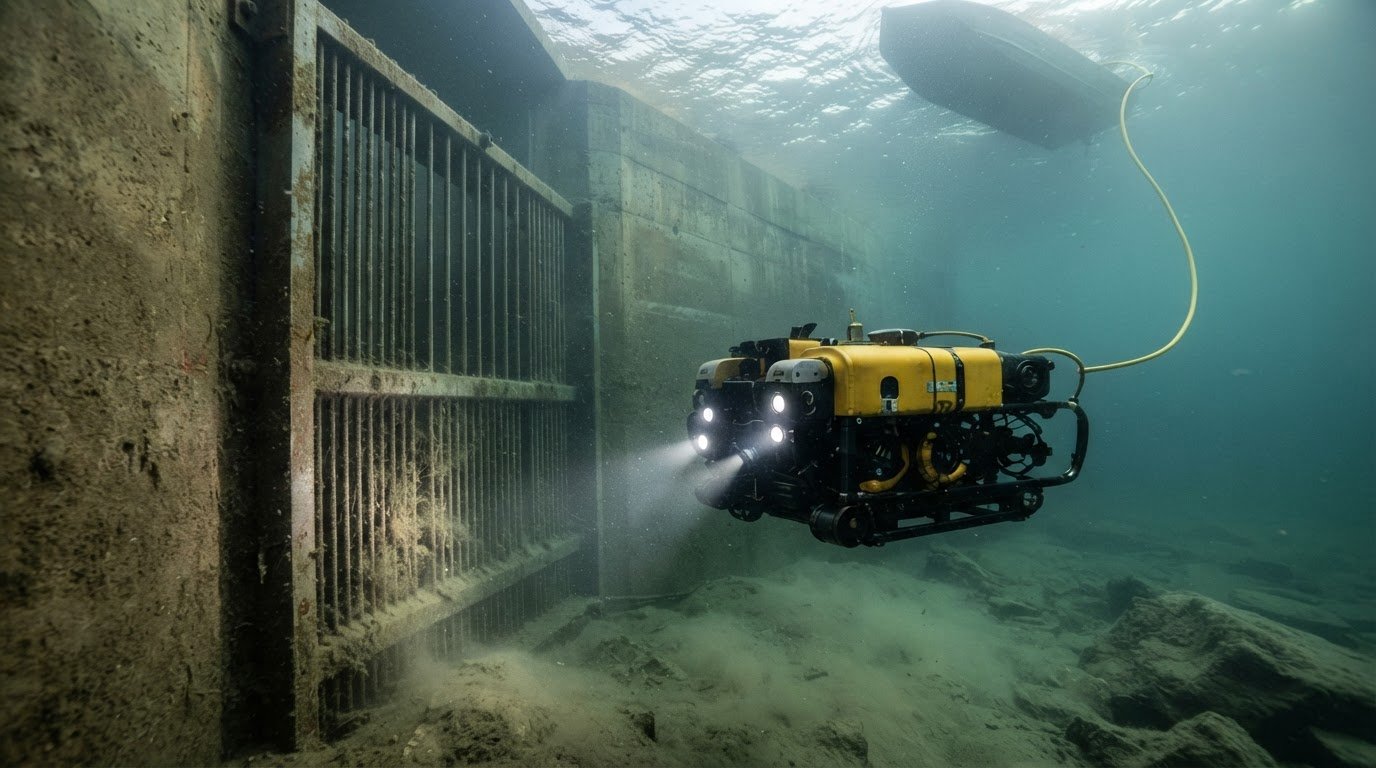
Compared with crewed vessels, autonomous craft shift navigation and monitoring tasks to onboard automation, while human oversight can remain remote. A remotely operated vehicle, or ROV, receives instructions from an operator; an autonomous vehicle follows programmed goals and makes decisions onboard. This distinction shapes mission design. Crewed ships carry people aboard, while an uncrewed surface vessel performs designated tasks without an onboard crew.
Surface Vehicle Types and Conversions
Autonomous surface vehicles travel on the water without continuous onboard control, while uncrewed surface vessels (USVs) are craft that operate without crew aboard. Some missions use purpose-built platforms; others convert existing vessels by adapting their control and monitoring systems. The right approach depends on the vessel and task. At Mendums Pond, an autonomous surface vehicle was tested, illustrating how trials can assess operation in a defined setting.
Surface and Subsea Coordination
Coordinated operations can link autonomous surface craft with underwater vehicles, allowing each to support a wider maritime mission. The University of New Hampshire is developing a network of unmanned marine vehicles that includes surface and underwater platforms. A surface vehicle can serve as a mobile coordination point while an underwater vehicle gathers information below the surface. The operational plan must align assigned tasks, routes, communications, and responses to changing conditions.
Navigation, Sensors, and Communications
Autonomous navigation combines route planning with awareness of nearby vessels and hazards. Navigation and sensing systems can draw on different kinds of information to help a vessel detect its surroundings. Communications carry status information and control instructions between a vessel and remote operators when a connection is available. Deployment involves defining the task, selecting a platform, integrating navigation and sensing systems, testing operation, and monitoring performance during missions.
Marine autonomy’s economic and environmental impacts
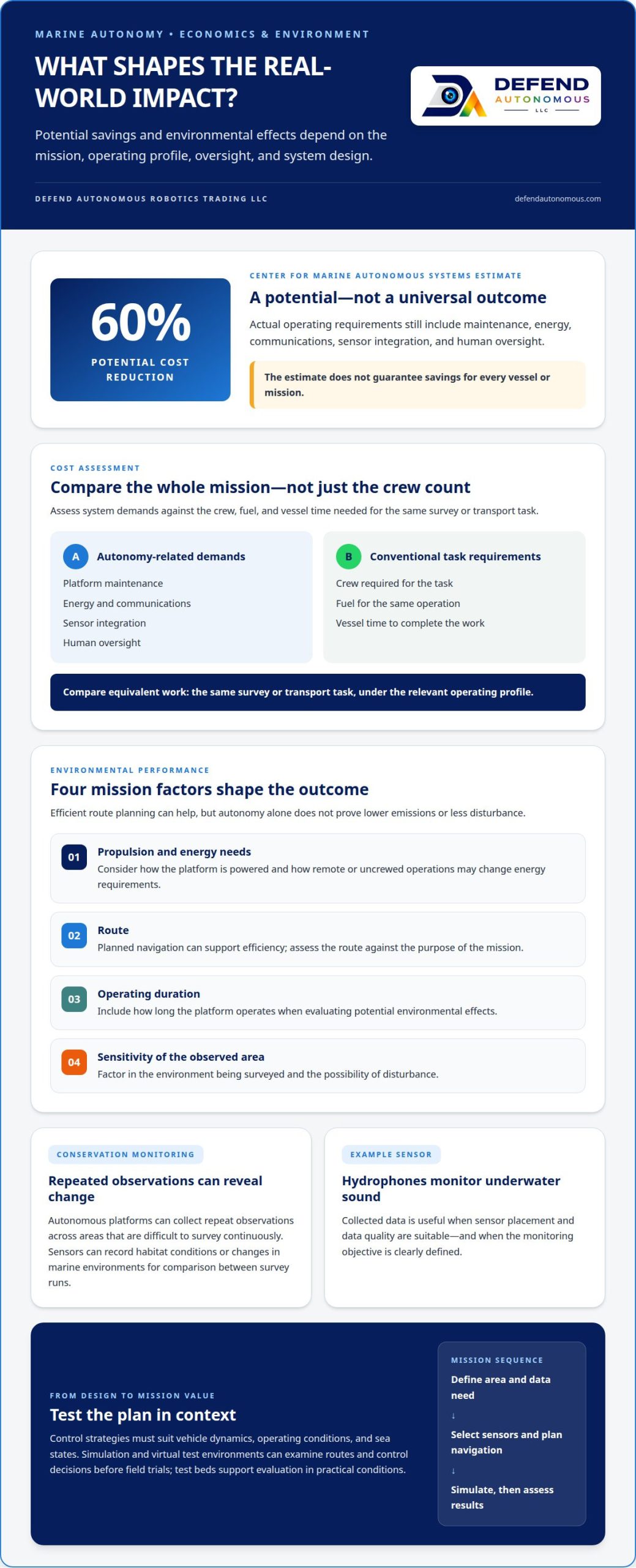
Economic gains depend on the mission, operating profile, and level of human oversight. The Center for Marine Autonomous Systems estimates that marine autonomy could reduce ship operating costs by 60%. That estimate is a potential, not a universal outcome. Actual operating requirements still include platform maintenance, energy, communications, sensor integration, and oversight. A useful assessment compares these demands with the crew, fuel, and vessel time required for the same survey or transport task.
Environmental performance depends on how a mission is engineered. Autonomous navigation can support efficient route planning, while remote or uncrewed operations may change a vessel’s energy needs. Neither capability alone proves lower emissions or less disturbance. A marine survey plan, for example, should account for the platform’s propulsion, route, operating duration, and the sensitivity of the area being observed. These factors help assess potential environmental effects alongside operational benefits.
For conservation, autonomous platforms can collect repeated observations across areas that are difficult to survey continuously. Sensors can record information about habitat conditions or changing marine environments, allowing comparisons between survey runs. Hydrophones, for example, monitor underwater sound. The data can inform environmental awareness, but its value depends on sensor placement, data quality, and a clear monitoring objective. A defined survey question helps determine what the vehicle should measure and where it should operate.
Vehicle dynamics must also suit the aquatic environment. University of New Hampshire researchers work with NUWC Keyport and NAVSEA on robust, reliable control across different aquatic environments and sea states. Their work highlights why a platform’s response, operating conditions, and control strategy must be considered together. Simulation and virtual test environments can help engineers examine planned routes and control decisions before field trials, while test beds support evaluation in practical conditions. For a rapid environmental assessment, teams can define the area and data need, select suitable sensors, plan navigation, simulate the mission, and assess the collected results. Each step connects technical capability to mission value.
Autonomous underwater vehicles
An autonomous underwater vehicle (AUV) carries out an underwater mission using onboard control, sensors, and a planned task. Unlike a remotely operated vehicle, it can follow its mission without continuous piloting from the surface. Engineers select a platform to suit the task: a hydrographic survey needs reliable seabed observations, while mine countermeasures require a different search plan. The mission determines the vehicle’s route, sensing needs, and method for reporting collected data.
Underwater navigation presents a control challenge because an AUV may have limited ways to change direction or position. A vehicle is described as underactuated when it cannot directly control every axis of movement. Data-driven control uses observations from the vehicle and its environment to adjust control decisions. It can help engineers account for vehicle dynamics and changing conditions, while planned operating boundaries guide the system’s response to unexpected obstacles.
University of New Hampshire research combines global and local path-planning methods for marine vehicles. The approach draws on prior knowledge of an aquatic area, vehicle dynamics, and real-time detection of unmapped obstacles and hazards. Global planning sets a route toward the mission objective; local planning adapts when the vehicle encounters conditions that differ from the map. This layered method is relevant to AUV operations, where seabed information and obstacles can change along the route.
Underwater gliders offer another option for extended observation missions. Rather than using the same movement profile as a powered AUV, a glider changes buoyancy to move through the water and collect environmental data. The right choice depends on the required coverage, maneuverability, sensing, and communications with the surface vehicle. For an international hydrographic survey, teams can define the area, select a vehicle and sensors, plan navigation, and review the returned data. A controlled trial can show whether the selected platform meets the mission’s operational needs before wider deployment.
Maritime autonomous systems assurance, safety and risk
For U.S.-linked international cargo operations, the relevant global framework includes the International Maritime Organization’s non-mandatory MASS Code. The IMO adopted the code in May 2026, and it came into effect on 1 July 2026; it applies to cargo ships covered by SOLAS Chapter I, generally ships over 500 GT on international voyages. The IMO recommends applying it, as far as practicable, to MASS below 500 gross tonnage.
Assurance begins with the mission and tests how the vessel and its operating model manage hazards. According to the International Maritime Organization, operators must identify potential risks and show how they will manage them throughout a vessel’s operation. The assessment should consider navigation, communications, control authority, equipment performance, and responses to changing conditions. A robust process links each identified hazard to a defined control, an accountable operator, and a method for reviewing performance.
Commercial and defense missions have different operating demands, but both require clear oversight. The U.S. Navy’s Combined Task Force 59 is the first U.S. Navy task force dedicated to integrating unmanned maritime systems and artificial intelligence within the Navy’s 5th Fleet area of operations. Its role illustrates naval interest in combining autonomous capabilities with operational command. Commercial applications, such as survey work, instead prioritize mission objectives, vessel operations, and coordination with surrounding maritime traffic.
Regulatory development continues alongside trials. The IMO approved interim guidelines for trials of maritime autonomous surface ships in June 2019 and completed a Regulatory Scoping Exercise in 2021. Its roadmap schedules development of a mandatory MASS Code for 2028, with adoption expected by 1 July 2030 and entry into force on 1 Jan 2032. These milestones give operators a framework for planning system assurance without treating trial guidance as the future mandatory code.
For security missions, define operating boundaries, escalation procedures, and human decision authority before deployment. Then test navigation, communication loss, and hazard response against the intended application. Discuss maritime autonomy requirements to connect mission needs with marine and subsea capabilities.
For U.S.-linked international cargo operations, the relevant framework described here is the IMO’s non-mandatory MASS Code, which applies to qualifying SOLAS cargo ships on international voyages. The IMO’s interim guidelines cover trials of maritime autonomous surface ships.
Defend Autonomous Robotics Trading: Marine & Subsea Solutions
Defend Autonomous Robotics Trading provides Marine & Subsea Solutions for organizations assessing underwater operations, remotely operated vehicles, or marine technology requirements. This offering suits projects that need subsea capabilities matched to a defined inspection, survey, or operational mission. ROV technology can support underwater work where remote operation is appropriate. Because autonomous and remotely operated platforms have different control needs, the mission should guide the selection.
For organizations integrating maritime technology with wider industrial operations, Defend Autonomous Robotics Trading also offers AMR & AGV Automation Solutions and CNC & advanced manufacturing solutions. These offerings address distinct operational requirements and are not substitutes for marine systems.
To discuss marine and subsea requirements, contact Defend Autonomous Robotics Trading.
Turn Mission Requirements into Operational Readiness
Make the next decision about the mission, not the autonomy label. Define the operating environment, required data, platform interfaces, and role of human oversight. These parameters give engineering teams a practical basis for shaping system design and assessing how it will work alongside existing maritime operations.
Before selecting a platform, document what the operation must accomplish, where human authority remains, how information should flow, and what response is needed when conditions change. Treat these as connected design decisions, not isolated procurement questions. This approach clarifies whether marine autonomous systems should operate independently, alongside crewed assets, or as part of a coordinated surface and subsea operation. It also gives trials meaningful acceptance criteria, so testing reflects mission demands rather than technology in isolation.
Bring those requirements into the next planning conversation. Contact Defend Autonomous Robotics Trading LLC to discuss your marine and subsea objectives, and take the next step with clarity.
Frequently Asked Questions
What is an autonomous ship?
An autonomous ship uses onboard systems to perform navigation or operational tasks with varying levels of human supervision. The key distinction is how decisions are made: a remotely controlled vessel follows an operator’s instructions, while an autonomous vessel can make operational decisions onboard. For example, a vessel might follow a planned route and adjust its navigation using sensor inputs, with human oversight defined for the mission.
What is the MASS Code?
The MASS Code is the International Maritime Organization’s framework for maritime autonomous surface ships. The code offers a non-mandatory framework for addressing maritime autonomous ship operations. It applies to cargo ships covered by SOLAS Chapter I, generally ships over 500 GT on international voyages. It provides a structured reference for addressing autonomy in covered ship operations.
What work on MASS is continuing in the FAL, MEPC and LEG Committees?
The Joint MSC-LEG-FAL Working Group on MASS has held three meetings to date. Its cross-committee format brings maritime safety, legal, and facilitation considerations into discussions of autonomous ships. The IMO roadmap also schedules development of a framework for the MASS Code’s Experience-Building Phase at MSC 112 in December 2026. This work supports continued review of operational experience and regulatory frameworks as autonomy develops.
What types of autonomous marine vehicles are used today?
Common categories include autonomous underwater vehicles (AUVs), underwater gliders, and uncrewed surface vessels (USVs). AUVs perform underwater missions using onboard control, while gliders gather observations by changing buoyancy. USVs operate on the water without crew aboard. Remotely operated vehicles, or ROVs, are another subsea platform, but they are controlled remotely rather than operating autonomously.
What are the main applications of marine autonomous systems?
Applications include hydrographic surveys, underwater research, environmental monitoring, offshore inspection, and naval operations. A survey team might use an underwater vehicle to collect seabed data, while an ROV can capture visual evidence of submerged assets. The task determines the suitable platform, sensors, and control method. Security and environmental monitoring missions also require clear objectives and operational boundaries.
How much do autonomous underwater vehicles and unmanned surface vessels cost?
There is no universal rate for an AUV or USV. Costs depend on vehicle class, sensors, deployment logistics and crew requirements, rather than a universal rate. A system configured for a hydrographic survey may need different equipment and support arrangements from one designed for environmental observation. The mission profile, operating location, and required data shape the configuration and its overall cost.