A welding robot is only as effective as the system that brings it into production. Robotic welding machines and automation in the UAE combine a programmed robot, welding equipment and control systems to perform repeatable welds, while operators manage setup and monitor the process. Depending on the application, vision sensors can also help guide the robot.
Consistent welds, a controlled production flow and less exposure to repetitive welding tasks are valuable goals for manufacturers. But choosing automation involves more than selecting a robot: the cell must suit the parts, welding process, facility and production requirements.
This guide explains what automated welding robots do, the operational benefits and industries they serve, and the factors that shape system selection. It also outlines what to expect from equipment delivery, installation, commissioning, and after-sales support, so you can assess the full path from purchase to production.
Key Takeaways
- Understand how a welding robot, controller, and supporting systems work together, and what consultation and system design involve.
- Assess how automation can support weld consistency, production flow, and workplace safety while factoring downtime into operational planning.
- See how automotive, aerospace, construction, and metal fabrication applications shape the choice of welding system.
- Plan for the full deployment journey, from equipment delivery and installation to commissioning and after-sales support.
What Are Automated Welding Robots?
A robotic welding cell combines a programmable arm, welding equipment and digital controls. Its design connects the welding process to the part, production sequence and facility.
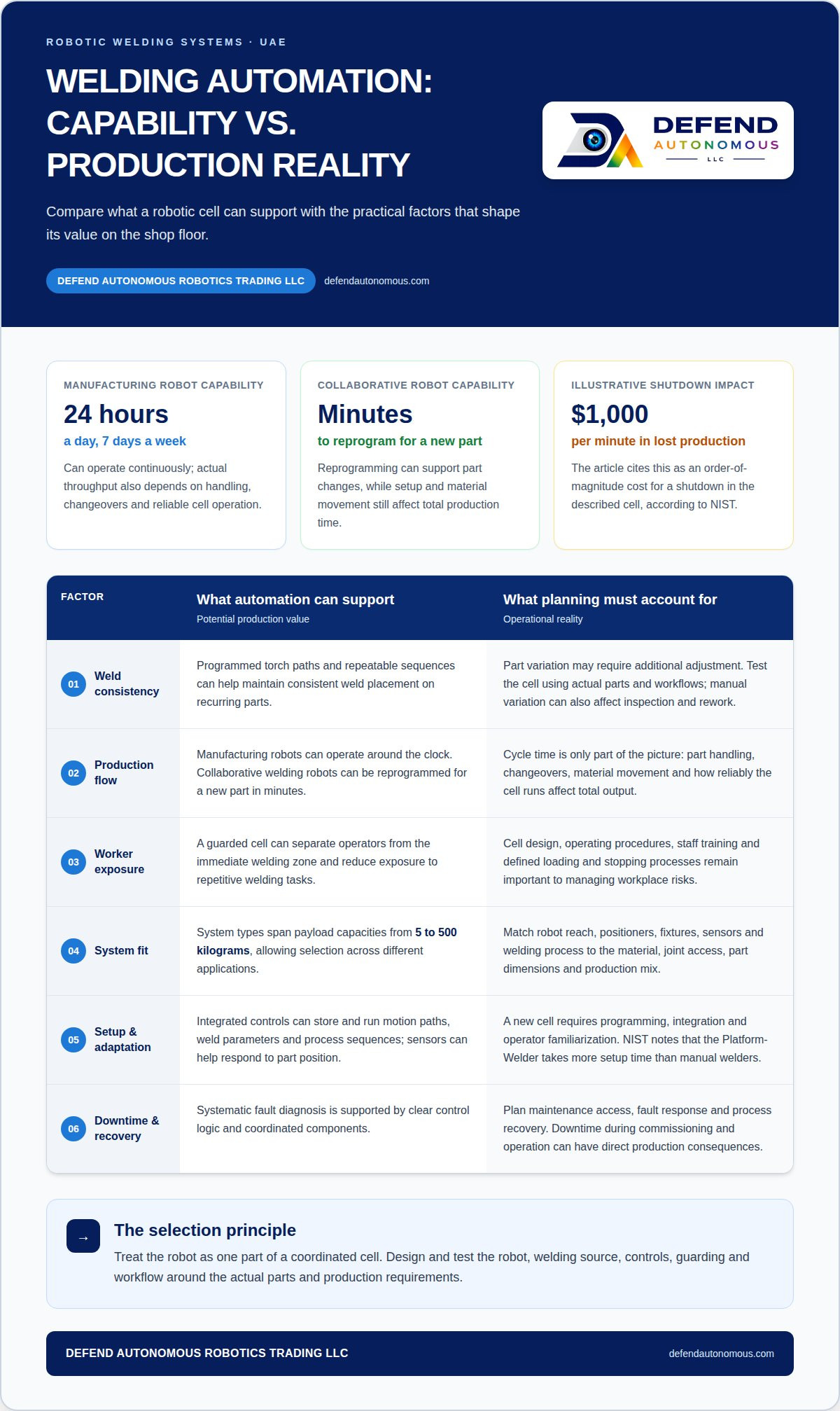
During operation, the controller directs the robot along a programmed path while the welding machine supplies the process. Sensors, including vision systems, can help locate parts or guide the torch. Payload capacities vary by system type, from 5 to 500 kilograms. A structural steel component, for example, may require different positioning and reach than a small repeated assembly.
In the UAE, applicable requirements depend on the facility’s jurisdiction and the installation’s machinery, electrical and workplace-safety scope. Planning should identify the requirements that apply to the site and document how the robot, welding source, guarding and commissioning address them.
System Design and Installation
Consultation establishes the workpiece material, joint geometry, weld sequence, part variation and expected production flow. These inputs guide decisions about robot reach, positioners, fixtures, sensors and welding process. System integration connects the robot, welding machine, controls and safety equipment into a coordinated cell. During installation, the team places and connects the equipment, checks communication between components and tests programmed movements on representative parts.
Robot Controls and Welding Equipment
An integrated digital controller stores and runs motion paths, weld parameters and process sequences. The welding machine provides the selected process, while sensors can help the robot respond to part position. Assess how operators will select programs, adjust parameters and manage changes between parts. Clear control logic supports repeatable operation and more systematic fault diagnosis.
Automation also has limits. A new cell needs programming, integration, and operator familiarization; unusual part variation can require extra adjustment. The National Institute of Standards and Technology (NIST) notes that the Platform-Welder takes more setup time than manual welders. For UAE businesses, the key risks are mismatched equipment, inadequate cell planning, and downtime during commissioning, so design and testing should reflect actual parts and workflows.
Precision, productivity, safety, and cost benefits
Automation can make repeat production more controlled, but its value depends on the task. In Dubai and across the UAE, assess precision, output, operator exposure and downtime together.
Precision and Safety Benefits
Programmed torch paths and repeatable sequences help maintain consistent weld placement on recurring parts. This can benefit assemblies with repeated joints, where manual variation may increase inspection and rework. A guarded cell can separate operators from the immediate welding zone, while defined loading and stopping procedures structure daily work. Cell design, operating procedures and staff training remain essential to managing workplace risks. For a broader look at robotics in hazardous response settings, see this guide to firefighting and fire rescue robots in the UAE.
Productivity and Production Times
Production gains depend on cycle time, part handling, changeovers, and how reliably the cell runs. Manufacturing welding robots can operate 24 hours a day, seven days a week, while collaborative welding robots can be reprogrammed for a new part in minutes. Those capabilities can help maintain throughput across repeated jobs, but setup and material movement also shape total production time.
Downtime has direct operational consequences. In the described welding cell, a shutdown could cost on the order of $1,000 per minute in lost production, according to the National Institute of Standards and Technology. Planning maintenance access, fault response, and process recovery therefore matters alongside the robot’s welding speed.
Welding Automation Products
Robotic welding systems for UAE and Dubai manufacturers can include robotic arms, welding power sources, positioners, fixtures and protective cell equipment. The right combination depends on the welding process, material, joint access, part dimensions and production mix. Match equipment to the task rather than treating an advanced robot as a complete solution on its own.
For example, a cell handling varied assemblies may need flexible fixtures and accessible program changes. A repeat structural component may place greater emphasis on consistent positioning and a stable sequence. These factors help define the welding solutions suited to each production requirement. To explore an application-focused approach, review robotic welding automation solutions.
Automotive, aerospace, construction, and metal fabrication
Robotic welding serves industries with repeated joints, complex assemblies or demanding production sequences. In the UAE, the application determines the fixtures, access and welding process a cell needs.
Automotive assembly involves many coordinated welds. Automation can support repeatable joining across recurring components, but cell design must account for part positioning, joint access and the sequence linking each assembly stage. These details affect how well the equipment fits into existing production.
In aerospace manufacturing, components can have complex shapes and restricted access points. Automation can follow programmed paths for repeat tasks, while fixtures hold parts in stable positions. The material, joint design and inspection process guide setup. A suitable configuration supports consistent execution without assuming every aerospace weld uses the same method.
Steel construction is another potential application. For shear connectors, the system must position the welding tool accurately against the beam and connector. Part presentation, surface condition and access along the structural member all shape cell design. Construction teams should consider how components arrive at the station and how completed assemblies move onward.
Construction equipment welding can involve large frames, buckets or support structures. Their size and geometry affect robot reach, workpiece positioning and fixture requirements. A production plan should distinguish joints that repeat from those requiring different orientations. This helps determine whether automation can cover a useful part of the welding sequence.
Metal fabrication and shipbuilding also involve varied parts and long structural seams. A fabrication cell may suit repeated brackets or frames, while shipbuilding can require a different approach to component access and movement. Before selecting equipment, map the part range, weld locations, assembly flow and changeover needs. This links automation choices to practical output, not just robot capability.
Equipment delivery, installation, and after-sales service
Equipment delivery marks the transition from system design to a working production cell. In the UAE, an effective deployment plan connects shipment coordination, site preparation, engineering, installation and support. Each stage affects commissioning, accuracy and production readiness. Clear ownership of handover tasks helps prevent avoidable delays.
Before dispatch, the project team aligns the equipment configuration with the approved cell layout, including the robot, welding source, fixtures, positioners, controls and safety equipment. The receiving site prepares access routes, floor space, power connections and installation areas. For example, a large robot cell may need a planned unloading route and an unobstructed path to its final position.
Installation proceeds through placement, mechanical assembly, electrical connections and system integration. Engineers connect the robot and welding equipment, configure communication between controls and test the operating sequence. During commissioning, representative parts help assess torch access, fixture alignment, weld program execution and safe movement. Document adjustments so production teams can follow the approved setup.
Operator handover is essential. Training should cover program selection, routine startup, safe loading, fault messages and escalation procedures. For example, a shift operator should recognize a fixture-position error before restarting the cell. Clear procedures help teams respond consistently and maintain process efficiency as production demands change.
After installation, planned maintenance and technical support help address wear, process faults, and changing production requirements. An AMC can structure ongoing maintenance, while 24/7 service and technical support provide a route for operational assistance. Scope and response arrangements depend on the agreed support plan. Keep service records, fault descriptions, and affected program details available for faster diagnosis.
For UAE manufacturers, the key takeaway is to evaluate the full deployment, not only the robot: delivery coordination, installation engineering, commissioning, operator handover, and ongoing support. Discuss robotic welding system support to plan these operational stages.
Defend Autonomous Robotics Trading LLC: Robotic Welding & Automated Welding Systems
Defend Autonomous Robotics Trading LLC offers Robotic Welding & Automated Welding Systems for manufacturers considering automation for repeatable welding tasks. The solution can be relevant when production requirements call for a system aligned with specific parts, joint access and workflow demands. Discussing the application helps frame the decision around operational needs, not robot capability alone.
Consider robotic welding when assessing how automation could fit existing manufacturing processes or support planned production changes. Defend Autonomous Robotics Trading LLC also offers CNC and advanced manufacturing solutions for broader manufacturing automation needs. Start by defining the parts, welding tasks and production objectives the system must address.
Shape the Next Stage of Your Production
The next step is to connect automation goals with your production environment. For UAE manufacturers assessing robotic welding machines and automation UAE, define the parts, workflow constraints and operational priorities that should guide project planning. A focused scope provides a sound basis for deciding how welding automation fits your manufacturing plans.
Defend Autonomous Robotics Trading LLC offers AMR & AGV Automation Solutions, an AI Coffee & Beverage Robot, and CNC and advanced manufacturing solutions. These offerings address different needs, from material movement to manufacturing processes. Consider them where they align with your operational goals, rather than treating every technology as part of a welding project.
Bring your production priorities into a direct discussion about the right next step. Contact Defend Autonomous Robotics Trading LLC to explore robotic welding systems for your operation. A clear objective can turn automation planning into purposeful progress.
Frequently Asked Questions
What types of robotic welding machines and automation systems are available in the UAE?
UAE buyers can consider robotic systems configured for arc, spot or laser welding. When assessing robotic welding machines and automation in the UAE, match the process to the material, joint, part geometry and production sequence. The cell may also integrate fixtures, positioning equipment and controls. Defend Autonomous Robotics Trading offers robotic welding and automated welding systems for manufacturing applications.
Which UAE suppliers and integrators offer robotic welding solutions?
Defend Autonomous Robotics Trading LLC offers robotic welding and automated welding systems, with engineering and system integration among its solution capabilities. Its workflow covers consultation, requirements analysis, system design, integration, testing, installation, commissioning and handover. A manufacturer planning a new welding cell can define the workpieces and production objectives, then develop a system around those needs.
What are the main robotic welding brands and models available in the UAE?
Robotic welding options are best understood by process and application: arc, spot and laser welding are the welding processes identified in the product information. Brand and model names are not interchangeable with these process categories. Selection depends on the workpiece, weld type, access and production requirements, as well as integration with the cell’s equipment and controls.
How do robotic welding systems compare with manual welding for productivity, quality, and cost?
Robotic welding suits repeatable tasks where programmed motion can maintain a stable sequence. Manual welding remains useful for varied work that requires direct operator adjustment. Productivity depends on part loading, changeovers, operating continuity and maintenance; quality depends on process setup and consistent workpiece positioning. Assess the complete cell and its operating needs, including integration, training, upkeep and the production volume it supports.
What industries in the UAE use robotic welding automation?
Manufacturers that fabricate repeated metal assemblies can apply robotic welding to suitable production tasks. Automotive, aerospace, construction and metal fabrication are common examples. The company also serves oil and gas, marine and offshore, and logistics industries. Across these sectors, a strong fit is a defined welding task with parts that can be positioned reliably for the planned process.
What facility, power, safety, and operator requirements are needed to install a robotic welding cell?
A cell needs a suitable installation area, clear equipment access and site power connections matched to the selected system. Engineering planning should also address guarding, safe operator access, part loading and movement of completed workpieces. Operators need training in normal operation, program selection, startup and fault response. For example, the layout should let staff load fixtures without entering the robot’s operating space.