The robot’s reach matters less than how the coating cell handles part geometry, application capacity, and color changes. Common coating robots use 6 axes, with an optional seventh axis that moves the complete robot on a linear axis. A powder-coating applicator covers 0.5 to 1.5 m² per minute, depending on conveying speed or required area output. For UAE manufacturers, the right robotic painting and powder coating systems are those configured around the production task, not simply the robot alone.
Choosing an automated coating setup means balancing throughput, finish consistency and the demands of each part. Gun configuration, conveyor movement and changeover needs all affect how well a system supports your production mix.
This guide compares manual, combined and fully automated powder-coating systems, and explains how robot configurations and application capacity relate to production volumes. It also covers practical selection factors, from part complexity and color-change frequency to powder application and curing. Use these considerations to plan an automation investment that supports reliable output and a controlled coating process.
Key Takeaways
- Match manual, combined, or fully automated coating to part repetition and production demand; recurring geometries can support multi-robot operation.
- Plan around color-change frequency and production variability to align automation with the way your product mix moves through the line.
- Use the applicator’s 0.5 to 1.5 m² per minute coverage range as a capacity-planning reference, then factor in conveying speed and required output.
- Assess robot reach and movement alongside gun configuration: common coating robots use 6 axes, with an optional seventh axis for linear travel.
Robot use in manual, combined, and fully automated powder-coating systems
Powder-coating automation ranges from robot-assisted tasks to complete production cells. Choose a configuration based on part repetition, production volume and coating variation.
Fully Automated Coating Systems
Several robots can coat recurring part geometries in 3-shift operation, coordinating application across a production line. Assess part presentation, robot access, and the transition between coating and curing. Offline 3D programming lets engineers model parts, generate robot paths, and review reach or collisions before production. Automatic program generation can streamline repeatable paths, while manual adjustments address complex surfaces.
Industries and Coating Applications
Automotive plants use painting robots for vehicle bodies and custom parts, where repeatable paths matter across similar surfaces. Aerospace applications involve large, complex components that require planned robot access. Electric vehicle production adds varied parts and finishes, while furniture manufacturing may combine recurring panels with custom designs. Assess geometry, coating coverage and production mix before selecting robot reach and programming methods.
UAE safety requirements depend on the facility and coating process. Evaluate ventilation, fire protection, electrical equipment and worker safeguards in line with applicable local requirements.
System cost depends on robot quantity, booth scope, guns, conveyor integration, and programming. A project quote establishes pricing against these requirements.
For installations in the UAE, work with an industrial robotics suppliers UAE and coating-system integrator. Align the project scope with robot programming, application equipment and production-line integration.
Prepare the factory layout, part-flow routes and space for the coating cell. Plan utilities and environmental controls around the selected equipment and process.
Purchasing and commissioning progress through scope definition, system design, integration, installation and production trials. Plan these stages around equipment scope and site readiness.
Maintenance and training cover equipment inspection, cleaning, operating procedures, and fault response. After-sales support scope depends on the service arrangement.
Installation risks include access constraints, inconsistent part presentation and programming changes for complex geometry. Address these during cell layout and trial runs.
A robotic system automates the coating process and is intended to reduce workers’ exposure to harmful fumes or particles. It should be used alongside safeguards suited to the facility.
Frequent color changes and variable production volumes
Frequent color changes and uneven order volumes affect how a coating line should be organized. Plan powder handling, changeover sequences and robot workload around the actual product mix.
Managing Color Changes and Variable Volumes
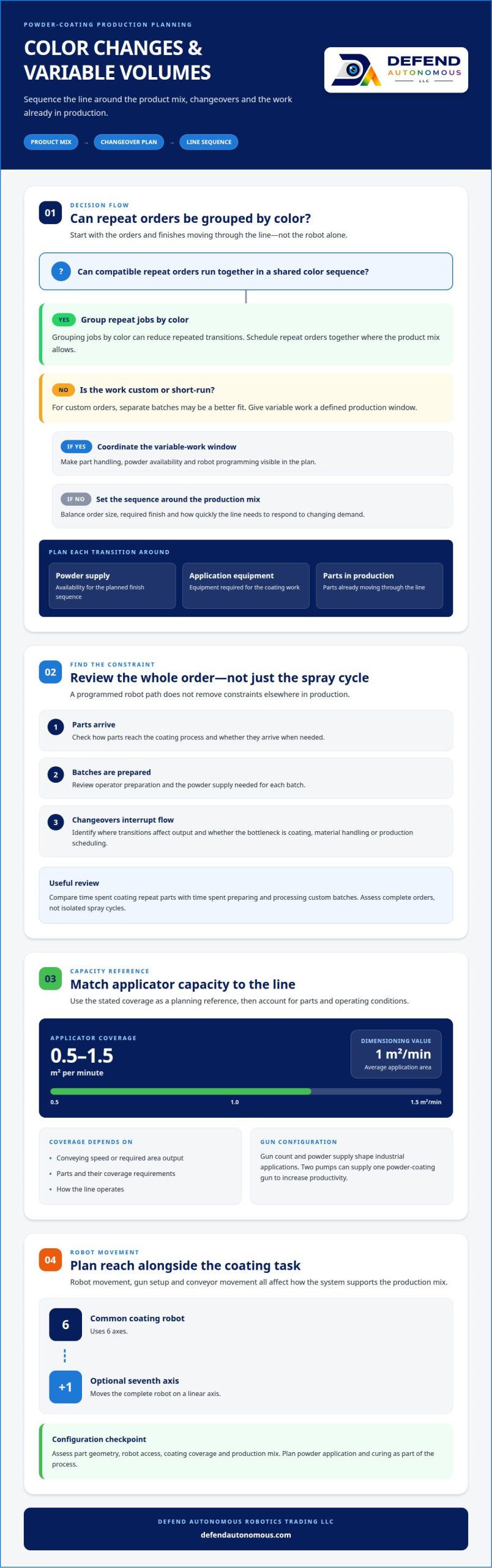
For a line switching between finishes, account for powder supply, application equipment and parts already moving through production. Grouping jobs by color can reduce repeated transitions, while separate batches may better suit custom orders. The right balance depends on order size, required finish and how quickly the line must respond to changing demand.
Map the production mix before setting the operating sequence. For example, a manufacturer coating standard enclosures alongside short-run custom components can schedule repeat orders together, then allocate a defined production window to variable work. This makes changeover needs visible in the plan and helps supervisors coordinate part handling, powder availability and robot programming without treating every order as identical.
Productivity and Operating Efficiency
Manufacturing productivity depends on more than robot movement. Track how parts arrive, how operators prepare each batch and where changeovers interrupt flow. A robot can maintain a programmed path, but missing parts or an unready powder supply can still constrain output. Reviewing these handoffs helps identify whether the bottleneck is in coating, material handling or production scheduling.
For a complex product mix, assess efficiency across complete orders rather than isolated spray cycles. Compare the time spent coating repeat parts with the time needed to prepare and process custom batches. This shows where automation supports predictable production and where manual handling remains part of the workflow. A structured review can also reveal whether combining compatible orders improves line utilization without compromising finish requirements.
When coating connects with broader factory workflows, coordinated advanced manufacturing solutions can help frame automation decisions around production and material flow. Start by mapping order patterns, color sequence, and handling points; use that process view to shape the system configuration.
Powder application capacity and gun configurations
Applicator capacity links conveyor movement, coating area and required throughput. Configure each gun around the parts’ geometry and the output the line must sustain.
A powder-coating applicator covers 0.5 to 1.5 m² per minute, depending on conveying speed or required area output. An average application area of 1 m² per minute can serve as a dimensioning value. These figures help frame capacity planning, but actual output depends on the parts, coverage requirements, and line operation.
Gun count and powder supply also shape industrial applications. Two pumps can supply one powder-coating gun to increase productivity. This setup may support greater application demand, while part shape and required coverage guide gun positioning and robot paths. Assess recessed areas, edges and exposed surfaces together to plan for uniform finishing across each component.
Robotic painting and dispensing applications can use different applicators for different materials. Powder guns apply dry coating material; liquid paint applicators atomize liquid coatings, while dispensing nozzles place material along a defined path. Select the applicator according to the material, surface and coating task. A broad panel and a narrow component, for example, require different path planning even when they share a production line.
Powder and liquid coating systems differ in application equipment and process requirements. Powder coating produces a tough, resilient surface, while liquid systems suit tasks that require liquid paint application. Cost depends on the robot configuration, applicator and gun count, booth, material handling, and curing equipment. The project price depends on the case and is provided after a quote request.
To plan capacity, start with the target area output, then map conveyor speed and part presentation. Next, assess whether one gun or multiple guns best serve the surfaces and throughput. This connects applicator selection with the required finish and production demand, rather than treating gun quantity as an isolated decision.
Robotic powder coating systems
Robotic painting and powder coating systems UAE manufacturers use can range from robot-assisted application to conveyor-integrated automated cells. Configuration depends on part geometry, production flow and the surface coverage each operation must deliver.
Common coating robots use 6 axes to orient the spraying gun around complex surfaces. An optional seventh axis moves the complete robot along a linear path, extending its working reach for long components or connected work zones. Robot repeatability varies by manufacturer from +/0.05 to 2 mm, so assess required path precision against the part and finish specification.
Conveyor speed also shapes cell performance. Powder-coating conveyors typically run up to 2 m/min, with speeds reaching 5 m/min depending on part complexity. A simple component may support a steadier spraying path, while a detailed assembly can require slower travel or additional robot movement. The line must coordinate part presentation, robot access, and the coating sequence.
After application, coating can be cured with heat or ultraviolet light. The selected curing method should align with the coating process and production layout. Review how parts move from spraying to curing, including whether racks or conveyors provide the required transfer. This connects the robot cell with downstream operations rather than treating spraying as an isolated task.
Automation can reduce dependence on manual painting for repeatable paths, while programmed robot movement supports consistent application across recurring parts. For custom geometry, programming must account for edges, recesses and changes in surface orientation. The key is coordinating reach, repeatability, conveyor movement and curing to achieve the required finish.
For UAE production lines, match robotic painting and powder coating systems to component dimensions, path complexity, and operating flow. Discuss robotic powder-coating automation to frame the requirements for your production application.
Powder coating produces minimal waste during application, a factor to include when assessing the process for a production line. Consider it alongside part shape, robot reach, movement and curing. The right choice reflects the application’s priorities, including waste during application.
Defend Autonomous Robotics Trading: Robotic Painting & Automotive Paint Booth Automation
Defend Autonomous Robotics Trading provides robotic painting and automotive paint booth automation for manufacturers planning to automate coating operations or integrate robotic application into an existing production flow. Its powder coating and surface finishing automation supports projects where application consistency, part geometry and production requirements shape system design.
Consider this offering when manual processes no longer fit the required workflow or a new line needs coordinated painting and booth automation. Define the parts, coating process, production pattern and integration needs to establish a practical project scope.
Discuss your coating automation project and production requirements with Defend Autonomous Robotics Trading.
Build the Next Stage of Your Automation Roadmap
For UAE manufacturers, planning robotic painting and powder coating systems is an opportunity to shape a wider production strategy, not just automate one task. Start by defining the role coating should play in your facility’s future workflow, then consider how it fits alongside other manufacturing priorities.
Defend Autonomous Robotics Trading LLC offers AMR & AGV Automation Solutions and CNC & advanced manufacturing solutions as part of its broader portfolio, which also includes an AI Coffee & Beverage Robot. These offerings address distinct automation needs as operational plans develop.
Share your coating objectives and production context with Defend Autonomous Robotics Trading LLC to explore a suitable next step. Contact Defend Autonomous Robotics Trading LLC and continue shaping a more capable, connected operation.
Frequently Asked Questions
What industries in the UAE use robotic painting and powder coating systems?
Automotive, aerospace, electric vehicle, furniture, metal and plastics manufacturing are relevant applications. The coating approach depends on the parts and finish required. A manufacturer producing several product families, for example, needs to consider how each family’s geometry and coating process affect robot access and programming. Robotic painting can be used across different materials, so system planning should reflect the actual production mix.
What production capacity and specifications should UAE buyers compare?
Compare capacity alongside the conditions used to define it. Assess the parts, coating material, required coverage, application equipment, conveying arrangement, curing process and expected product mix as one system. For example, a line processing both broad panels and detailed components needs capacity planning that accounts for both part types, rather than relying on a single headline throughput figure. Also assess how the configuration integrates with existing production operations.
What maintenance, training, and after-sales support do UAE coating-system suppliers offer?
Maintenance and training cover equipment inspection, cleaning, operating procedures, and fault response. After-sales support depends on the service arrangement.