
EV charging infrastructure for businesses combines commercial charging stations, electrical capacity, and site access for employees, fleets, tenants, or visitors. Commercial Level 2 chargers provide 3.3 kW to 19.2 kW, while DC fast chargers provide 50 kW to 500 kW. The right mix depends on how long vehicles stay parked and when they need to return to service.
Charging needs vary by setting. A workplace, retail destination, and fleet depot each have different parking durations, access patterns, and power demands. This guide explains how charger levels affect charging times and how accessibility, codes, zoning, and utility requirements shape a project, so businesses can plan infrastructure for employees, customers, and fleets.
With these factors in mind, businesses can assess which charging approach fits their operations and site. The sections below connect power and access decisions with practical deployment considerations, from employee charging to customer-facing and fleet applications.
Key Takeaways
- Separate equipment investment from ongoing electricity and demand costs to build a more complete project budget.
- Match charger output to vehicle capability and the site’s available electrical capacity to set realistic charging expectations.
- Address accessible site design, local requirements, and utility coordination as connected parts of project planning.
- Shape the charging model around how each business uses its parking, from fleet operations to employee or customer access.
What Is a Commercial EV Charging Station?
A commercial station supplies electricity to workplace, fleet, retail, or public vehicles. It forms part of EV charging infrastructure for businesses, connecting charger power, site capacity, user access, and operating costs.
For an electric fleet, charging shifts expenses from fuel purchases to electricity and infrastructure operations. Battery-electric vehicles produce no tailpipe emissions while driving, which can support sustainability goals alongside fleet planning. Operating costs depend on electricity use, charging schedules, and utility rates.
Capital costs include charger equipment, electrical work, and connections to the power source. Installation complexity, charger features, and the distance from the electrical panel all affect project scope. Per-charger capital costs may decline as a site scales, with economies of scale peaking at four to six chargers.
Electricity Costs and Demand Charges
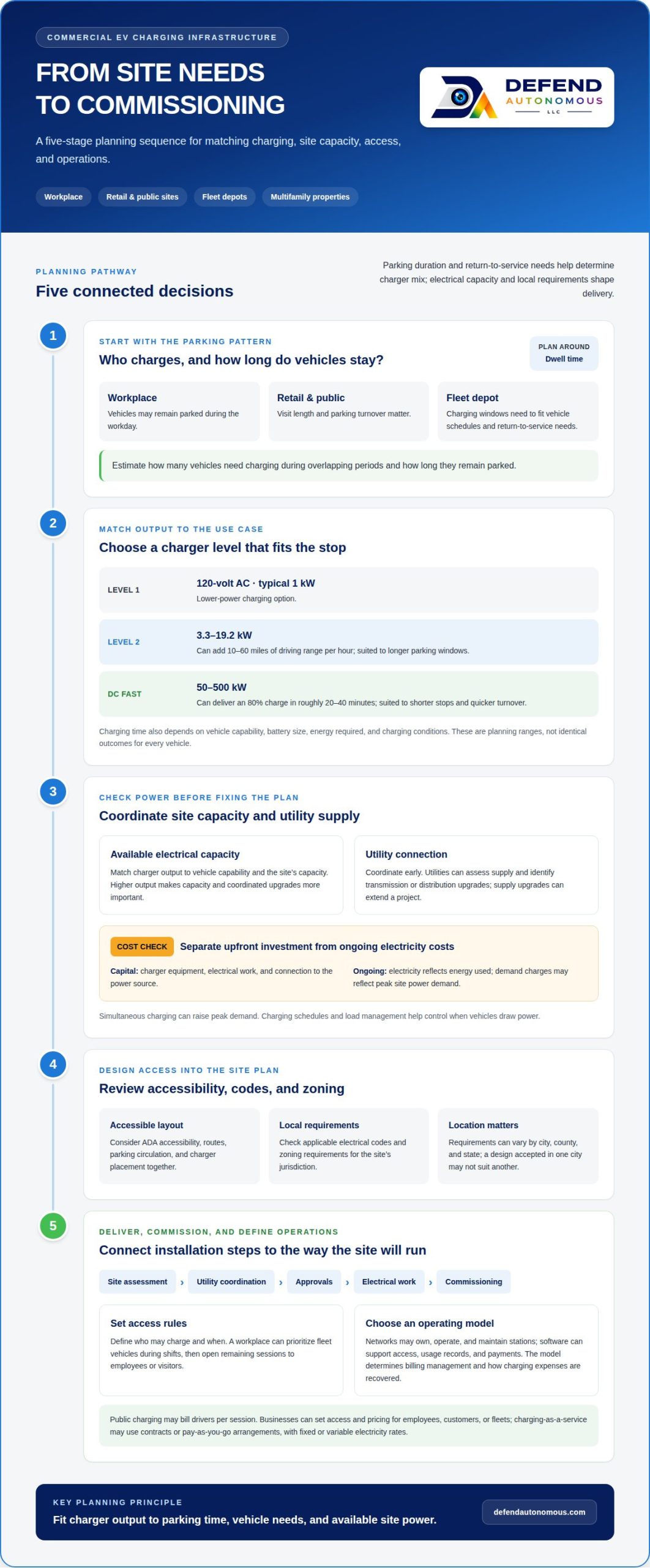
Electricity costs reflect the energy consumed, while demand charges may be based on a site’s peak power demand. Simultaneous charging can raise that peak and increase the utility bill. Charging schedules and load management help businesses control when vehicles draw power.
Charging Networks, Software, and Payments
Charging networks can own, operate, and maintain stations, while software supports access, usage records, and payment administration. Public charging may charge drivers per session; businesses can set access and pricing for employees, customers, or fleets. Charging-as-a-service may use contracts or pay-as-you-go arrangements, with fixed or variable electricity rates. The operating model determines who manages billing and how charging expenses are recovered.
Installation timelines vary. For EV charging infrastructure for businesses, site assessment, utility coordination, approvals, electrical work, and commissioning all shape the schedule. Utility supply upgrades can extend a project, so assess capacity early.
Businesses can manage access by defining who may use each station and when. A workplace, for example, can prioritize fleet vehicles during shifts, then open remaining charging sessions to employees or visitors. Clear access rules and a defined fee structure help match station use to traffic and operating priorities.
EV charger levels, power ratings, and charging times
Charger power affects how quickly vehicles gain range and how long parking spaces are occupied. Match the number and output of stations to vehicle demand, parking duration, and available electrical capacity.
To choose a suitable mix, estimate how many vehicles need charging during overlapping periods and how long they stay. Longer parking windows can accommodate more Level 2 charging; rapid turnover favors higher-power DC fast stations.
Charger Levels and Power Ratings
Charger levels distinguish power delivery, which affects both charging speed and site requirements. Level 1 uses a 120-volt AC source and has a typical power rating of 1 kW. Level 2 commercial chargers provide 3.3 kW to 19.2 kW, while commercial DC fast chargers range from 50 kW to 500 kW. Higher output can support faster turnover, but increases the importance of electrical capacity and coordinated upgrades.
Charging Times Across Charger Types
Charging time depends on charger output, vehicle capability, battery size, and the energy required. Level 2 chargers can add 10–60 miles of driving range per hour, making them practical when vehicles remain parked. Commercial DC fast chargers can deliver an 80% charge in roughly 20–40 minutes. These are planning ranges, not identical outcomes for every vehicle; actual charging varies with the vehicle and charging conditions.
Public Level 2 and Level 3 Charging
Public Level 2 stations serve drivers during longer stops, while Level 3 DC charging supports shorter visits and quicker vehicle turnover. At public sites, the distinction affects how long drivers occupy parking and how many sessions a station can serve. Businesses can align Level 2 with destinations where customers or employees stay, and DC fast charging with locations designed for brief stops.
Workplace and Multifamily Level 2 Charging
Level 2 charging fits workplace parking, fleet shifts, and multifamily properties where vehicles can remain parked for extended periods. Fleet managers can align charging windows with vehicle schedules, while workplaces can serve employees during the day. In multifamily housing, tenants can share infrastructure costs. Businesses planning site capacity can explore commercial EV charging solutions alongside power and parking needs.
Accessibility, electrical codes, zoning, and utility approvals
Commercial charging projects bring together site access, electrical capacity, local requirements, and utility coordination. In the United States, requirements can vary by city, county, and state, so the project scope depends on location.
Plan accessibility as part of the site layout rather than as a late adjustment. Commercial EV charging projects may need to meet ADA accessibility requirements. Consider accessible routes, parking circulation, and charger placement together. Review the electrical codes and zoning requirements that apply in the site’s jurisdiction, since a design accepted in one city may not suit another. Local and regional planning partners can help align a project with wider transportation plans and available funding.
Utilities help determine how chargers connect to the electric grid and whether the site can support planned demand. For larger installations, they can assess electricity supply and identify transmission or distribution upgrades. Coordinate early to understand how site capacity, charger output, and future expansion affect the connection plan. Facilities investing in several charging locations can also discuss network planning with regional partners.
Electric vehicle growth adds urgency to long-range capacity planning. The Edison Electric Institute projected 26.4 million EVs on U.S. roads by 2030. That projection makes expected demand relevant when businesses plan parking, power, and charging access, even if their initial installation is limited. Planning for expansion can reduce the need to redesign a site as use increases.
Fleet electrification assessments should bring together vehicle routes, operating schedules, parking windows, and charging requirements. Electric trucks with refrigeration units add another operational load: the site plan must account for refrigeration power as well as vehicle charging. Map where vehicles park between routes, when refrigeration must remain active, and how fleet schedules overlap. This helps determine whether the utility connection and charging layout can support daily operations. A depot with staggered return times, for example, has a different demand profile from one where trucks arrive together.
EV charging solutions by business sector
Charging needs depend on how each sector uses vehicles, parking, and customer access. A workplace, retailer, fleet depot, or municipality has its own operational priorities. Start with vehicle schedules and the purpose charging should serve, rather than applying the same station layout everywhere.
At workplaces, charging can support employee access and company fleet electrification. Where a facility has several tenants, shared infrastructure can distribute costs across businesses. Design around employee parking patterns, fleet shift changes, and how tenants will share access. Charging can also support an organization’s environmental strategy when it is coordinated with broader energy plans.
Retailers can make charging part of the customer visit. Grocery stores and shopping destinations may prioritize spaces near entrances, with access rules aligned to store hours. Some retailers offer charging without a direct fee to encourage longer visits and customer spending; others charge fees to recover operating expenses. The right approach depends on customer traffic, parking duration, and charging’s role in loyalty and repeat visits.
Fleet depots prioritize vehicle readiness over public access. Delivery operators can align charging availability with route schedules, vehicle return times, and dispatch windows. Depots serving growing electric fleets should plan for demand to change as vehicles are added. This connects charging infrastructure with fleet electrification assessments, daily energy use, and operational continuity.
Municipalities and businesses with visitor parking can host stations for employees and the public. Local planning partners can help connect projects with transportation plans and potential funding opportunities. Government and utility programs may also support infrastructure planning. Since relevance depends on project location and eligibility, consider funding pathways alongside site use and energy needs.
The practical takeaway is to fit the project to its sector: align access, station placement, and operating rules with the vehicles and people using the site. Map those needs before investing, then define how charging can support adoption, customer experience, or fleet operations.
Defend Autonomous Robotics Trading: AMR & AGV Automation Solutions
Defend Autonomous Robotics Trading offers EV charging and sustainable energy solutions for businesses planning commercial charging infrastructure. This offering is relevant when charger power, site capacity, and business operations need to be considered together. A clear picture of fleet schedules, workplace parking, and customer access can help shape a solution around the facility’s operating needs.
For organizations coordinating electrification with automation, the company also offers AMR & AGV Automation Solutions and CNC & advanced manufacturing solutions. These separate capabilities can support broader operational planning alongside EV charging, while allowing each facility’s needs to guide the approach.
Contact Defend Autonomous Robotics Trading to discuss EV charging and sustainable energy solutions for your business.
Build the Next Phase of Facility Readiness
Use your site’s operating priorities to make EV charging infrastructure for businesses a long-term facility decision. Map how charging access can support employees, customers, or fleet operations, then align the project with broader energy and modernization plans. This helps connect today’s infrastructure choices with future operational needs.
Defend Autonomous Robotics Trading LLC offers EV charging and sustainable energy solutions, alongside AMR & AGV Automation Solutions. Its wider portfolio also includes an AI Coffee & Beverage Robot and CNC & advanced manufacturing solutions. These capabilities let organizations consider charging alongside other facility technology requirements.
When you’re ready to discuss how commercial charging fits your operational goals, contact Defend Autonomous Robotics Trading LLC. A focused conversation can help move your facility planning forward with clarity and purpose.
Frequently Asked Questions
Can my business benefit from rebates or incentive programs?
Federal and state programs, along with local utility rebates, can cover up to 30% of business EV charger installation costs. Treat incentives as one part of the project’s financial plan, not as a substitute for assessing site needs. Compare the potential support with equipment, electrical work, and ongoing operating expenses to understand how it could affect the overall investment.
Electric vehicles and the charging infrastructure: a new mindset?
Yes. Electrification means planning vehicles and energy access as connected operational resources, rather than treating charging as an isolated parking amenity. For example, a delivery operation can consider vehicle routes, return schedules, charging access, and dispatch needs together. This approach helps leaders evaluate how charging affects day-to-day operations and where infrastructure fits into longer-term fleet planning.
Who are the stakeholders of EV infrastructure?
Stakeholders may include the facility owner or operator, fleet managers, employees, tenants, customers, the electric utility, and local or regional planning partners. Each brings a different perspective: fleet managers understand vehicle schedules, while utilities assess grid connections and supply needs. Planning partners can help align a project with wider transportation plans. Clear roles support coordinated decisions about site use, access, and operations.
What types of EV charging stations are best for businesses: Level 2 or DC fast charging?
Level 2 suits vehicles parked for longer periods, such as employee cars during a workday or fleet vehicles between shifts. DC fast charging better fits sites where drivers need shorter stops and parking spaces must turn over quickly. A business with both employee parking and customer traffic could combine charger types, matching each location to typical dwell time and vehicle use.
How much does it cost to install EV chargers at a business in the United States?
There is no fixed installation price for every U.S. business site. Project costs depend on the site and scope. Key factors include charger features, installation complexity, distance to the electrical panel, and any utility-related upgrades. A site with limited electrical capacity or challenging construction needs may require a different scope from a straightforward installation.
What ongoing costs and maintenance do commercial EV chargers require?
Ongoing costs can include electricity, demand charges, network or software services, billing administration, and equipment maintenance. The operating model determines who handles each task: a charging network can own, operate, and maintain stations, while a business-managed site needs clear responsibility for those functions. Reviewing usage and electricity demand helps facility teams understand operating patterns and manage charging expenses.