Automated storage is only as effective as the software coordinating it with the rest of the warehouse. Strong autonomous material handling connects mobile robots, warehouse and manufacturing systems, and storage and retrieval equipment so inventory and movement stay coordinated. The result is a warehouse flow strategy built around connected operations, not isolated machines.
That integration matters because adding vehicles alone will not resolve every bottleneck. A useful system accounts for facility layout, task priorities, existing workflows, and how equipment exchanges information with warehouse management software and other operational systems.
This guide explains how autonomous vehicles support transport, how software integration shapes performance, and where automated storage and retrieval can improve space utilization. It also covers labor planning and implementation, helping you assess how these technologies work together and what to evaluate before defining a warehouse automation approach.
Key Takeaways
- Match autonomous pallet stackers and reach trucks to the loads, routes, and handling tasks they need to perform.
- Include workforce turnover in labor planning: filling a warehouse position can cost 25% to 150% of that position’s salary.
- Choose between guided vehicles and autonomous mobile robots based on route flexibility, obstacle handling, and changing facility conditions.
- Map workflows, facility conditions, system connections, and change management needs before integrating robots with warehouse or manufacturing software.
- Assess automated storage and retrieval as a space strategy, while accounting for its implementation timeline and connection to material flow.
Autonomous pallet stackers and reach trucks
Autonomous stackers lift pallets for short moves; reach trucks access higher storage positions. Compared with manual handling, they automate repeated movement; unlike fixed automation, they can serve changing routes, while fixed systems such as storage and retrieval equipment can take as long as 18 months to implement.
Autonomous Forklifts and Pallet Stackers
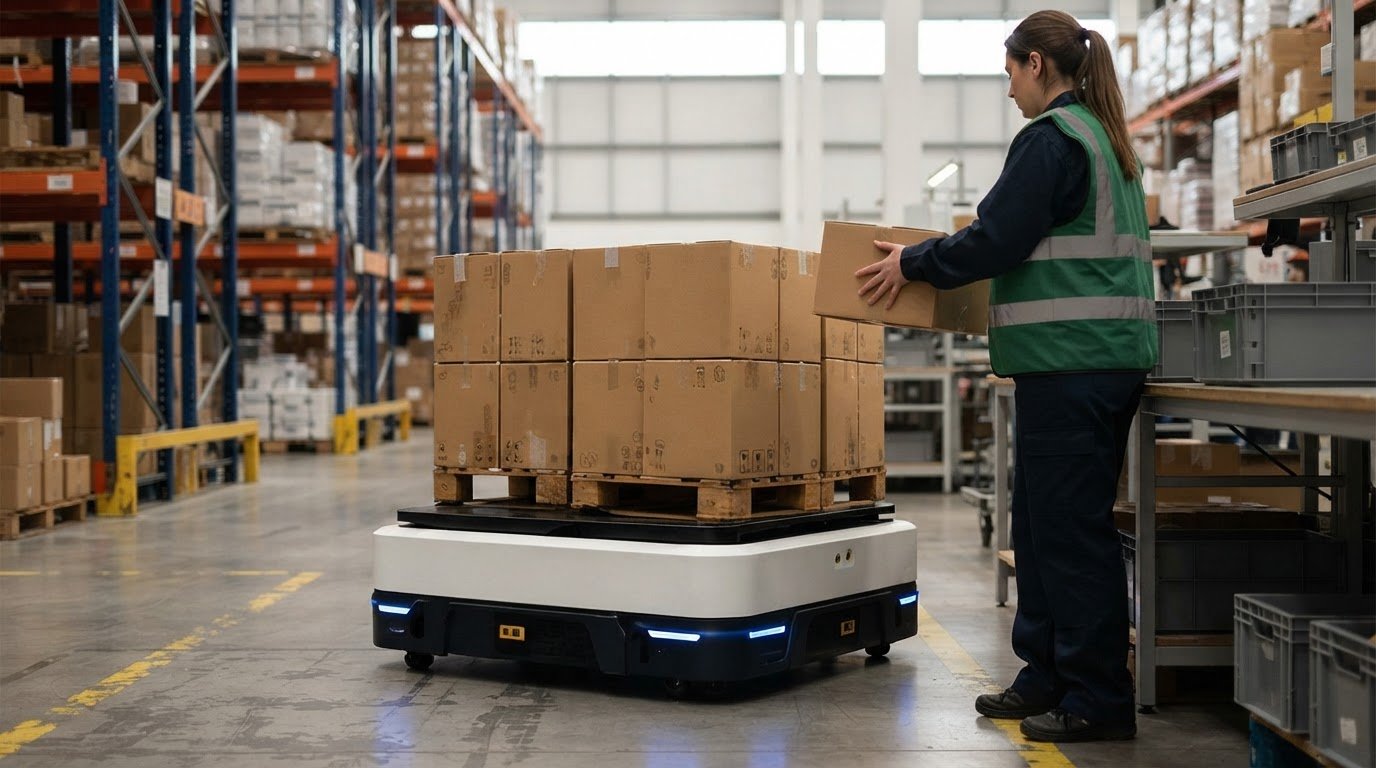
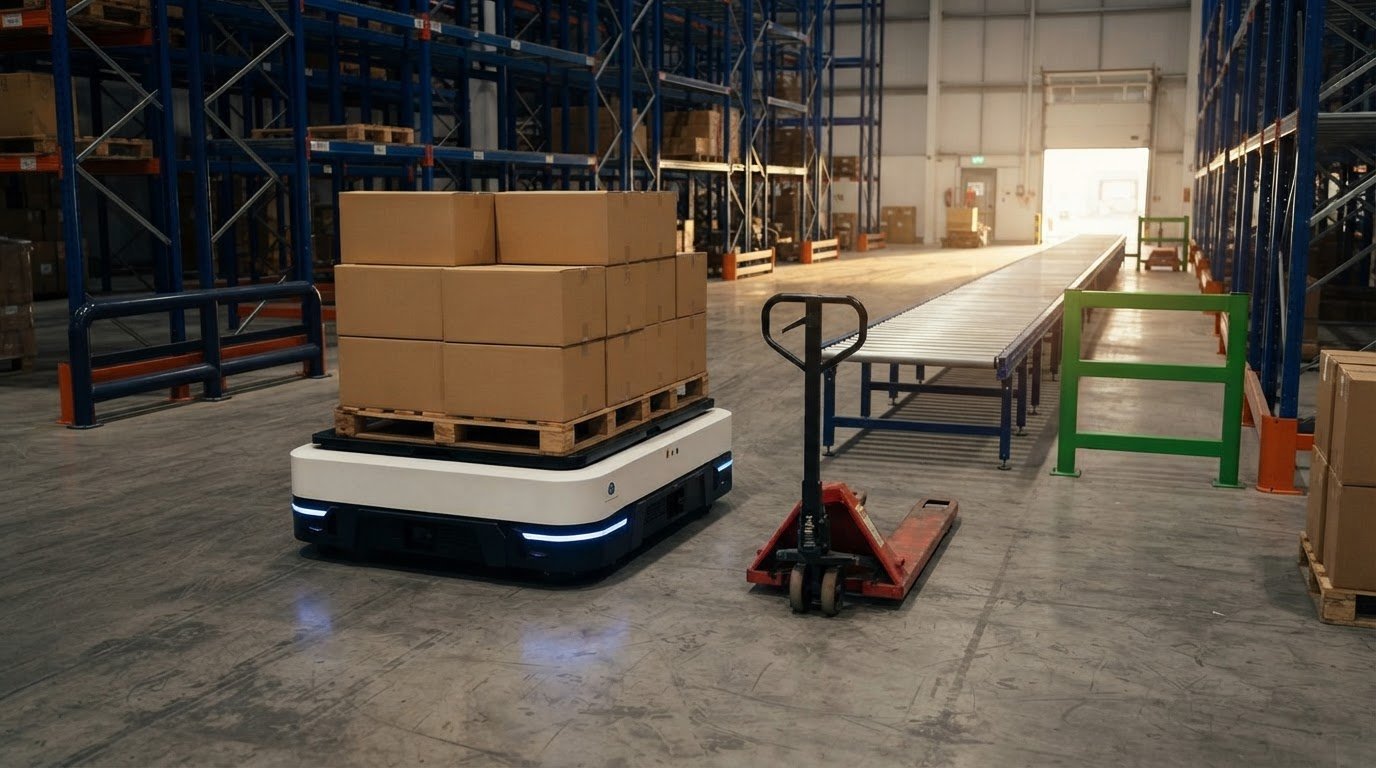
Autonomous forklifts and stackers move unit loads between receiving, staging, production, and storage locations. A stacker suits pallet pickup and placement at lower elevations, while a reach truck serves rack locations that require extended reach. Before assigning routes, compare each vehicle’s load dimensions and lift requirements, aisle clearances, and pickup points with the facility’s actual pallet flow.
Pallet Transport Applications
Common applications include moving pallets from receiving docks to staging, replenishing production lines, and taking finished goods to storage and retrieval areas. Map each transfer from origin to destination, including handoffs where conveyors or people interact with vehicles. For example, a route between a receiving lane and a production cell should account for crossing traffic and temporary staging.
Risks and Industry Suitability
Risks include blocked aisles, misplaced pallets, inconsistent loads, and routes that conflict with people or manual equipment. These conditions can interrupt movement or create collision exposure, so define traffic rules, load standards, and exception handling before deployment. Manufacturing plants, distribution centers, and high-volume warehouses are strong candidates when recurring pallet routes take up substantial operator time.
Pallet adapters and transfer heights need to match the load and each handoff. Check fork entry, pallet openings, load stability, and the height of racks, conveyors, and staging platforms. A mismatch can prevent pickup or make a transfer unstable. Record these details for each pallet type, then validate the vehicle’s approach and placement at every destination.
Palletizing and depalletizing extend automation beyond transport. A coordinated workflow might move an incoming pallet to a depalletizing station, transfer its cases to a process, then route completed goods toward palletizing and storage. Define the sequence, load presentation, and destination before assigning vehicle tasks. This distinguishes vehicle movement from handling steps performed at each station.
Use a practical review before selecting equipment: document pallet types, pickup and drop-off points, aisle conditions, and the frequency of each route. Average warehouse turnover is 36%, so recurring routes can also help clarify where consistent automation may reduce dependence on manual task coverage. The best fit is a workflow with repeatable transfers and clearly defined exceptions.
NIOSH reports that the collision risk profile of current autonomous haul-truck implementations appears to be lower than that of manual truck operations by an order of magnitude; this is a distinct benchmark, not a pallet-stacker result.
Separately, the global autonomous mobile robots for logistics and warehousing market is projected to reach USD 18.56 billion by 2032.
Labor costs and warehouse space utilization
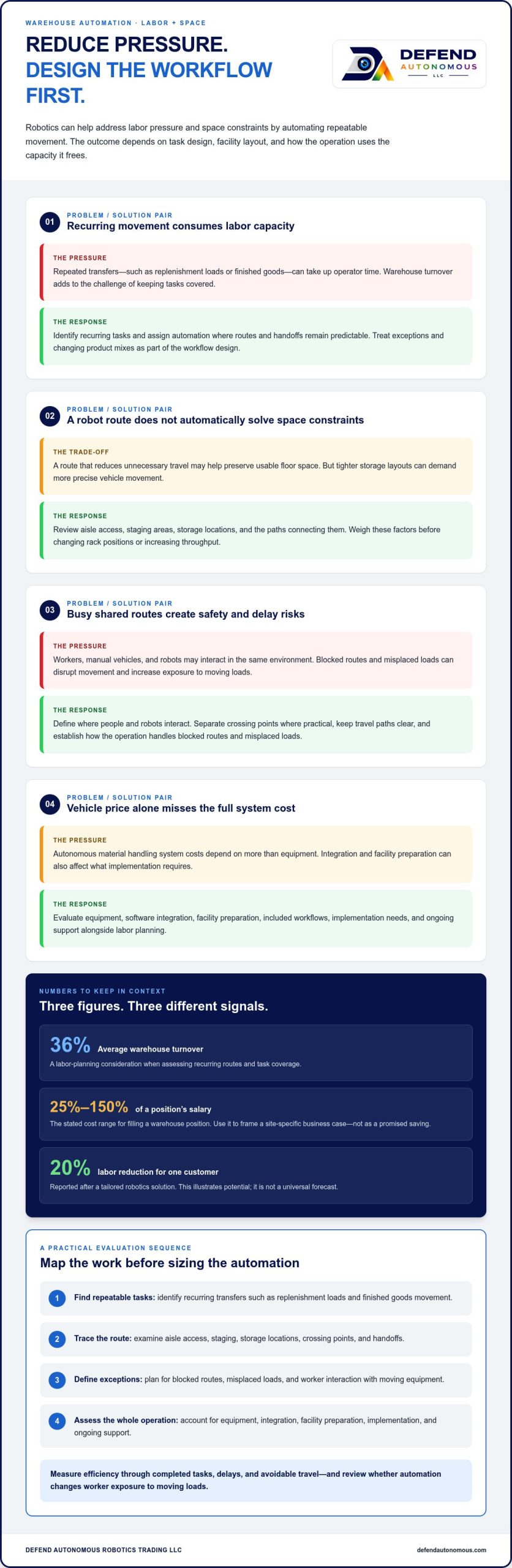
Warehouse robotics can address labor pressure and space constraints by automating repeatable movement. Results depend on task design, facility layout, and how the operation uses freed capacity.
Scaling Warehouse Operations
Robotics can scale repeatable workflows as order volume or product mix changes. Start by identifying recurring tasks, such as moving replenishment loads or transferring finished goods, then assign automation where routes and handoffs remain predictable. One customer reduced labor by 20% after implementing a tailored robotics solution. That result illustrates potential, not a universal forecast for every warehouse.
Space planning matters too. Review aisle access, staging areas, storage locations, and the paths connecting them. A robot route that reduces unnecessary travel can help preserve usable floor space, while tighter storage layouts may demand more precise vehicle movement. Weigh these trade-offs before changing rack positions or increasing throughput.
Warehouse Efficiency and Worker Safety
In busy environments, define where workers, manual vehicles, and robots interact. Separate crossing points where practical, keep travel paths clear, and establish how the operation handles blocked routes or misplaced loads. This makes safety part of workflow design rather than an afterthought.
In the United States, requirements depend on the equipment and workplace hazards involved. Safety planning should address traffic patterns, pedestrian access, load handling, and emergency procedures for the actual facility. Measure efficiency through completed tasks, delays, and avoidable travel, while reviewing whether automation changes worker exposure to moving loads.
System Costs
Autonomous material handling system pricing depends on equipment, software integration, facility preparation, and the workflows included; pricing is provided after a quote request. Evaluate the full operation, not just vehicle acquisition, by considering implementation needs and ongoing support alongside labor planning.
Labor costs offer one comparison point: filling a warehouse position costs between 25% and 150% of that position’s salary. Use these figures to frame a site-specific business case, not as a promised saving.
Autonomous Handling Technologies
Systems can combine mobile robots, sensors, onboard intelligence, fleet software, and connections to warehouse systems. Sensors help robots perceive their surroundings, while onboard intelligence supports movement decisions. Software coordinates tasks and routes, and system connections align robot activity with inventory and operational priorities.
For a practical assessment, map one workflow from task release through completion. Identify the information each component needs, such as destination, load status, and task priority. Then consider whether the selected automation solutions can adapt to changing routes or need a more structured operating environment.
A workflow review can clarify where technology may improve warehouse efficiency; explore warehouse flow planning as a next step.
Autonomous mobile robots and transport platforms
Autonomous mobile robots (AMRs) coordinate transport across changing warehouse and production routes. Their value depends on task fit, facility conditions, and safe interaction with people.
Automated Guided Vehicles (AGVs) follow predefined paths, while AMRs use obstacle and collision avoidance technology to compute routes, according to the Institute of Industrial and Systems Engineers. AMRs can adjust movement around obstacles and use dynamic paths based on facility layouts. That flexibility suits logistics operations where travel routes or priorities shift. For a closer comparison of navigation, obstacle handling, loads, costs, and ROI, see AMR vs AGV.
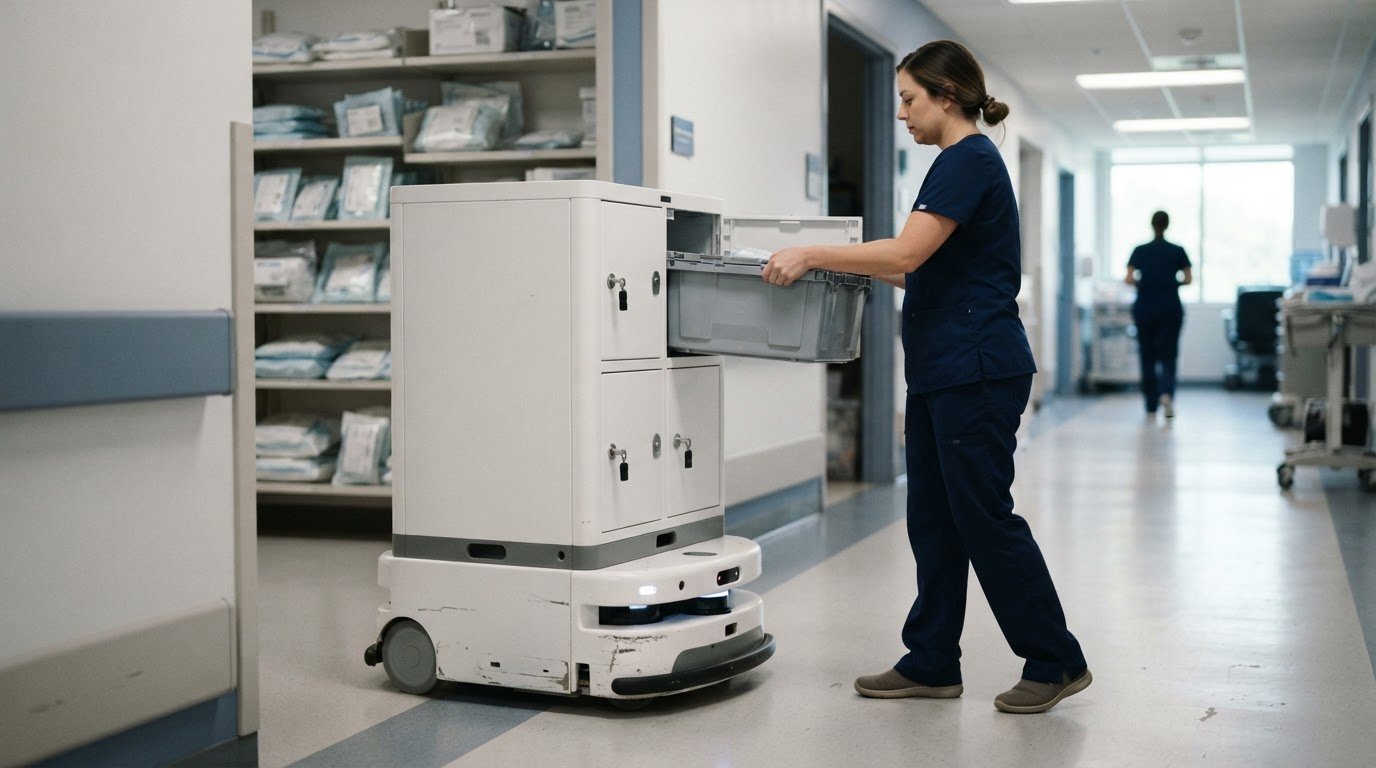
Start with a specific transfer, such as moving a tote from receiving to a packing station. Define the load, pickup point, drop-off point, and task trigger. Then identify traffic crossings, narrow aisles, and handoffs with conveyors or workers. This workflow map helps determine whether a mobile platform, lift-equipped robot, or guided vehicle suits the operation.
Robotic lift trucks and mobile platforms transport loads that need elevation or stable positioning. A lift truck can handle a transfer between floor-level staging and a conveyor interface, while a low platform can move carts between work cells. Cleaning equipment adds another mobile task: schedule floor-cleaning routes around production activity and keep them separate from critical material paths.
Machine tending connects mobile robots with production equipment. For example, a robot can deliver a component to a machine station, then move completed parts to a designated collection point. The process requires defined load presentation, machine access, and handoff signals. These details help prevent a transport task from creating a queue at the machine.
AMR scalability depends on fleet coordination and consistent task rules. A facility can start with a bounded workflow, then extend robot assignments to additional pickup points as operations evolve. Robotics as a Service (RaaS) is a commercial model that may package robotics access with supporting services. Evaluate its scope, operating responsibilities, and fit with long-term deployment plans.
TPV Displays Polska automates internal transport with 22 autonomous mobile robots. This example shows how a fleet can coordinate recurring movement across an operating facility. Some companies report achieving full return on investment from AMRs in under a year, although workflow volume, integration, and utilization shape the business case.
Mixed human-robot operations need clear traffic rules. Mark crossing zones, keep emergency access routes clear, and define how workers report blocked paths or damaged loads. For example, a robot waiting at a busy aisle should have a defined rerouting or escalation process. Review these exceptions during workflow design, not only after deployment.
Integration with MES, WMS and other systems
Plan integration by assessing workflow compatibility, facility mapping, system connections, and change management. This sequence aligns vehicle navigation with operational priorities and helps teams define how tasks move between software and equipment.
AGV and AMR Integration
AGVs follow defined routes, while AMRs calculate routes using onboard sensors and intelligence. Integration planning should account for both navigation methods, shared aisles, pickup points, and vehicle handoffs. For example, map where an AGV transfers a load to an AMR, then define how each system communicates task completion and handles a blocked route.
Build a shared task model before connecting vehicles. Specify load identity, destination, priority, and status for each transfer. Then test how vehicles respond when an aisle closes or a handoff point becomes occupied. These scenarios expose gaps between fleet control and facility operations before the workflow expands.
Planning and Implementation
Begin with one complete workflow, from task creation to delivery confirmation. Map facility conditions, document existing processes, identify integration needs, and prepare affected teams for operational changes. This assessment reveals whether the proposed automation fits current work patterns or calls for revised handoffs and responsibilities.
A phased implementation can validate the workflow before wider deployment. Use a defined pilot area to test task release, navigation, exception handling, and system status updates. Record where delays occur, then adjust route logic or task rules before extending the design to additional environments.
WMS and ERP integration connects inventory decisions with physical movement. A warehouse management system can provide the destination and task priority, while an enterprise resource planning system supports broader order or production planning. Define which system owns each data field, such as inventory status or delivery confirmation, to prevent conflicting records.
Manufacturing execution systems (MES) can connect production demand with material delivery. For example, a production cell can signal that a component is needed, and the task system can dispatch a vehicle. Agree on message timing, status definitions, and what happens when the component or destination is unavailable.
Select a systems integrator by examining its ability to coordinate vehicles, software, and facility processes. Ask for a clear integration plan covering system ownership, data exchange, navigation maps, testing, and operational handover. A useful plan identifies who is responsible for each interface and explains how teams will resolve exceptions during daily operation.
Before launch, test representative workflows with operators and system owners. Confirm that a task appears correctly in the WMS, reaches the fleet system, and returns an accurate completion status. This end-to-end check validates integration across software and vehicles rather than testing each component in isolation.
Automated storage and retrieval
Automated storage and retrieval systems connect inventory locations with equipment that stores and presents goods on demand. Their strongest role is coordinating storage density, access, and downstream movement, rather than simply replacing a forklift.
Start by identifying the inventory profiles that take up the most floor space or create repeated retrieval work. For example, reserve slow-moving stock in a dense storage zone and keep frequently requested items closer to outbound staging. The right design depends on product dimensions, handling requirements, order patterns, and how quickly loads must move between processes.
Common system designs include automated cranes serving rack aisles, shuttle systems moving loads within storage lanes, and vertical systems presenting items at operator stations. Each changes how goods enter, remain in, and leave storage. Compare load type, access pattern, and required handoffs with the warehouse’s existing routes before selecting equipment.
Automation can increase usable storage by reducing reliance on wide forklift aisles and manual access paths. That space benefit must be balanced against access needs, replenishment flow, and system interfaces. A dense layout may store more inventory, but poorly planned input and output points can create queues that delay picking or production supply.
Map the complete process before installation: receiving, identification, put-away, inventory updates, retrieval, and delivery to the next station. For example, a retrieved pallet may need to reach a packing line, staging area, or mobile robot transfer point. Clear ownership of each handoff helps prevent a storage system from becoming an isolated automation island.
Fixed automation has a different implementation profile from mobile equipment. Conveyors and storage and retrieval systems can take as long as 18 months to implement. That timeline makes early facility mapping, process definition, and interface planning essential. Teams should account for construction, equipment installation, software connections, and operational transition in the project sequence.
Design for exceptions as well as normal flow. Define what happens when a pallet is damaged, an inventory record conflicts with the physical load, or a retrieval location is unavailable. For instance, a controlled exception lane can prevent one unscannable unit from stopping routine storage and retrieval tasks across the facility.
Measure system performance using operational indicators such as retrieval accuracy, replenishment delays, blocked handoffs, and manual interventions. Compare these observations with the warehouse’s original process map. This review reveals whether automation improves access and space use or simply shifts a bottleneck from forklift routes to system entry points.
Connect storage design with your broader warehouse flow plan. Plan your warehouse automation strategy around storage, retrieval, and downstream movement.
Defend Autonomous Robotics Trading: AMR & AGV Automation Solutions
Defend Autonomous Robotics Trading provides AMR & AGV Automation Solutions for operations assessing automated transport, repeatable material movement, or changing warehouse workflows. Turn to this offering when you have mapped a use case and need automation aligned with facility routes, load handoffs, and existing systems.
A practical next step is to define the movement challenge: where loads start, where they need to go, and which operational constraints shape the route. That information helps focus the discussion on a relevant automation approach. For facilities also evaluating production equipment or energy infrastructure, the company offers CNC & advanced manufacturing solutions and EV charging & sustainable energy solutions.
Contact Defend Autonomous Robotics Trading to discuss your warehouse automation requirements.
Build the Next Stage of Warehouse Flow
Move from technology assessment to an operational roadmap. Identify the workflow that most needs improvement, define its starting conditions, and establish how teams will evaluate performance before expanding automation. A clear sequence helps keep autonomous material handling aligned with facility priorities and long-term capacity plans.
Defend Autonomous Robotics Trading LLC offers AMR & AGV Automation Solutions for automated movement, alongside an AI Coffee & Beverage Robot and CNC & advanced manufacturing solutions. These offerings address distinct operational needs, so begin with the warehouse challenge you want to solve and the systems or processes it touches.
Use that definition to guide the next discussion: describe the movement task, facility environment, and integration requirements. Contact Defend Autonomous Robotics Trading LLC to discuss your automation goals and identify a practical direction for the operation. A disciplined next step can turn a warehouse improvement priority into a clear path forward.
Frequently Asked Questions
Is there a robust software ecosystem?
Yes, a robust software ecosystem can connect fleet management with inventory, production, and order systems. The practical test is whether it supports clear task ownership, consistent data, and useful exception handling. For example, a short-picked order should not leave a robot waiting indefinitely or cause inventory records to diverge. Teams should define who resolves that exception and how the system records the final disposition.
What is a Robotic Pallet Mover?
A robotic pallet mover is a mobile machine designed to move palletized loads between defined locations with limited manual driving. Depending on the system, it may lift a pallet, tow a pallet carrier, or move beneath a compatible load. A useful assessment starts with pallet entry points, load stability, floor conditions, and the handoff location, such as a dock lane or production buffer.
What is autonomous material handling?
Autonomous material handling uses robotic equipment and control software to move, position, or manage materials with less direct human control. A practical example is a system receiving a replenishment task, transporting a container, and reporting its delivery status. People still define workflows, handle exceptions, and oversee safe operation. The technology automates selected movements, not every warehouse decision or activity.
What are the main applications of autonomous material handling in manufacturing and warehousing?
Common applications include delivering components to line-side stations, replenishing picking locations, moving finished goods, and transferring returns to inspection areas. In manufacturing, a timed component delivery can help keep a work cell supplied. In warehousing, an outbound order can trigger movement from reserve inventory to a packing zone. Select tasks by tracing where material waits, changes hands, or requires repeated transport.
What types of autonomous mobile robots and automated guided vehicles are available?
Available categories include mobile platforms for carts or totes, pallet-moving robots, lift-equipped vehicles, and guided vehicles that follow established paths. Each serves a different load and route profile. A cart mover may suit repeated transfers between work areas, while a pallet-capable vehicle handles unit loads. Compare payload form, pickup method, aisle access, and route variability to narrow the equipment type.
What safety standards and regulations apply to autonomous material handling in the United States?
In the United States, requirements depend on the equipment and workplace hazards involved. Safety planning should address traffic patterns, pedestrian access, load handling, and emergency procedures for the facility.