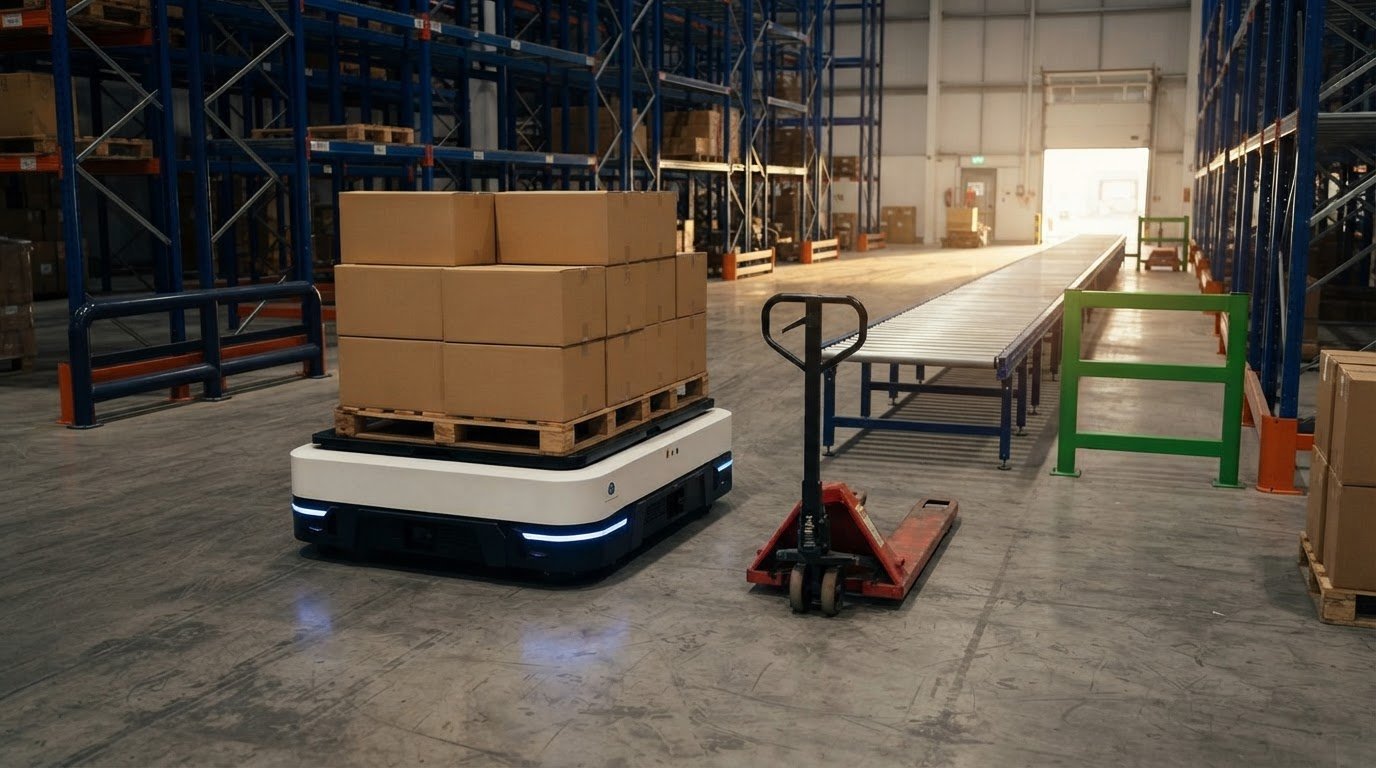
Factory-floor AMRs can use conventional docks for longer charging periods and wireless opportunity charging at recurring stops. Wireless opportunity charging stations for factory floor AMRs transfer power at selected points, allowing robots to recharge during manufacturing or warehouse workflows instead of relying on docks alone. Their value depends on where robots pause, how reliably they align, and whether charging fits the operation.
Charging speed and uptime matter, but the practical question is how charging fits the routes AMRs already travel. This article explains how wireless charging works, where recurring stops such as conveyor transfers, workcells, and staging areas may support it, and how alignment and system design affect performance. It also explains how wireless charging can complement conventional docks, helping operations teams assess which approach suits each part of the workflow.
Key Takeaways
- Use wireless charging at predictable pauses in the workflow, while retaining conventional docks for longer charging periods.
- Assess recurring stops such as handoff points and workcells for charging opportunities that fit material flow and facility layout.
- Evaluate coil alignment, charging distance, and electromagnetic interference because each can affect charging performance.
- Compare AMR compatibility and charging approaches against your operating requirements to identify a practical system fit.
Combining wireless charging with conventional docking
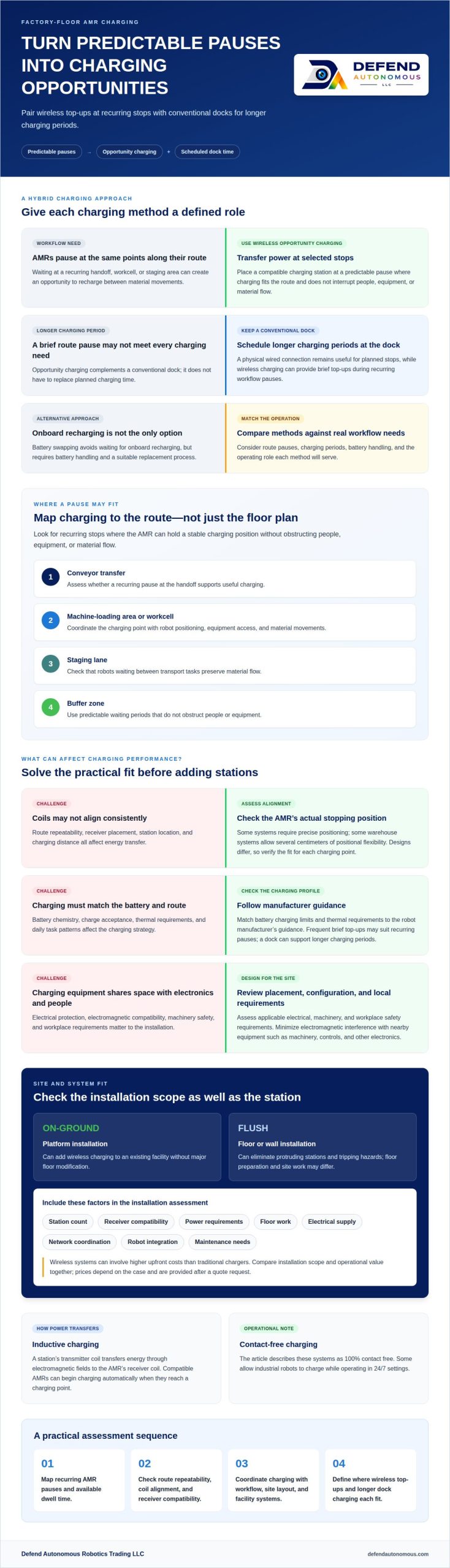
Pair scheduled dock charging with wireless charging at recurring pauses, such as conveyor transfers. This hybrid approach gives each method a defined role in the AMR’s operating cycle.
Wireless and Wired Charging Options
Wireless opportunity charging transfers power at selected stops. Wired docking uses a physical charging connection, while battery swapping replaces a depleted battery with a charged one.
Wireless charging can supplement a conventional dock rather than replace it. For example, an AMR can receive a brief charge during a predictable workcell pause, then use its dock for a longer charging period. This may reduce reliance on dedicated dock time, while wired docking remains useful for planned stops. Battery swapping avoids waiting for onboard recharging but requires battery handling and a suitable replacement process.
Industrial Wireless Power Safety
Industrial wireless charging safety involves electrical protection, electromagnetic compatibility, and safe integration with facility operations. These considerations matter because charging equipment shares space with AMRs, workers, and other electronics.
Assess the electrical, machinery, and workplace safety requirements that apply to the installation and jurisdiction. Wireless systems also need design measures to minimize electromagnetic interference with nearby electronic equipment. For example, a charging point beside control equipment calls for attention to electromagnetic compatibility during system design. Placement, equipment configuration, and surrounding workflows all shape the safety review.
Station and Installation Costs
Station and installation costs include charging hardware and the work needed to integrate it into an AMR operation. Wireless systems can involve higher upfront costs than traditional chargers, so assess the installation scope and operational value together.
Prices depend on the case and are given after a quote request; station count, receiver compatibility, power requirements, floor work, and integration scope affect the total. An on-ground platform may add wireless charging to an existing facility without major floor modification, while flush installation may require different site work. Long-term maintenance needs also matter, since wireless charging can reduce maintenance costs over time. Compare the installation scope and operating role, not hardware alone.
Wireless charging applications in manufacturing and warehousing
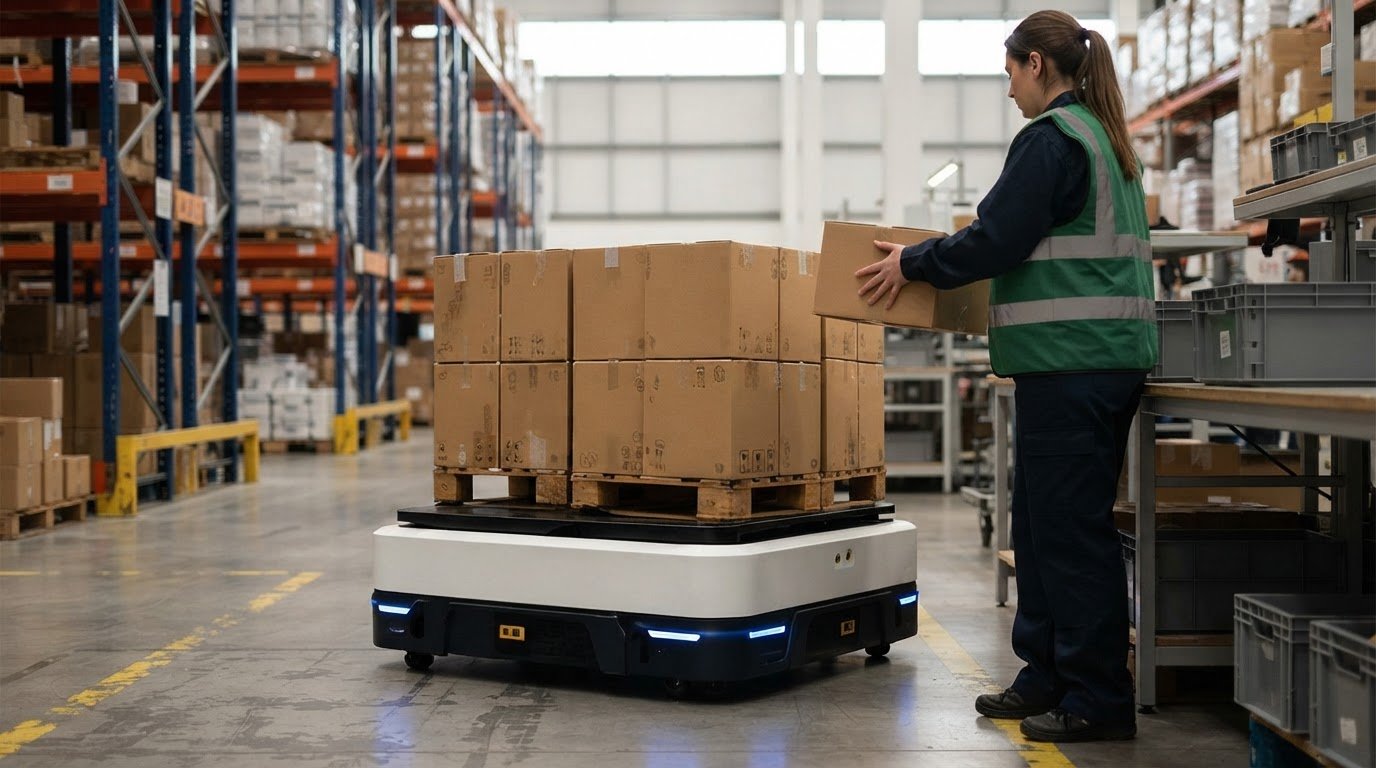
Wireless charging is most useful where an AMR pauses predictably along its route. In manufacturing, machine-loading areas and workcells can support charging between material movements. In warehouses, staging lanes and buffer zones may offer similar opportunities while robots wait for assignments. Choose stops where charging will not interrupt people, equipment, or material flow.
Inductive systems transfer energy through electromagnetic fields between a station’s transmitter coil and the robot’s receiver coil. For example, an AMR can receive power while waiting at a planned handoff point. Facility layouts can accommodate different installation approaches: an on-ground platform can add charging without major floor modification, while a flush installation reduces protruding equipment in busy areas. These choices affect where wireless opportunity charging stations for factory floor AMRs can fit into an existing operation.
Floor preparation, electrical supply, network coordination, and robot integration all affect installation requirements. The site needs a stable charging position, compatible electrical connections, and controls that coordinate charging with AMR routes. Existing infrastructure may need changes. System design should also minimize electromagnetic interference with nearby equipment, such as manufacturing machinery or warehouse controls.
- Conveyor transfer: assess whether a recurring pause supports useful charging.
- Machine loading: coordinate the charging point with robot positioning and equipment access.
- Staging lane: preserve material flow while robots wait between transport tasks.
- Buffer zone: use predictable pauses that don’t obstruct people or equipment.
Some warehouse charging systems allow several centimeters of positional flexibility, but designs differ. Route repeatability, receiver placement, and station location affect whether each stop supports effective energy transfer. When mapping wireless opportunity charging stations for factory floor AMRs, assess the robot’s actual workflow and the geometry of each planned charging location.
The systems are 100% contact free. Some allow industrial robots to charge while operating in 24/7 settings. Flush floor or wall installations can eliminate protruding stations and tripping hazards.
Charging efficiency and alignment challenges
Wireless charging efficiency depends on energy transfer, coil alignment, and the AMR’s charging profile. For maximum efficiency, receiver coils must align at right angles to magnetic fields. Some systems require precise positioning, while resonant inductive charging can transfer energy over greater distances than standard inductive charging. Charging can begin automatically when a compatible AMR reaches the charging point, reducing manual connection steps.
No single battery chemistry is best for every AMR fleet. Match the battery’s charging limits and thermal requirements to the robot manufacturer’s guidance, then choose a charging strategy that fits route pauses and energy demand. Frequent brief top-ups may suit operations with recurring stops, while a conventional dock can support longer charging periods. Battery chemistry, charge acceptance, and daily task patterns all affect the decision.
Size and position stations around fleet demand, route repetition, and available dwell time. Map where AMRs pause, then identify points that can serve the required robots without interrupting traffic. A predictable handoff stop may be a better charging location than a short, irregular pause. Station capacity, receiver compatibility, and charging power should match the fleet’s work cycle and route energy requirements.
Reliability risks include inconsistent positioning and reduced transfer efficiency when coils are misaligned. Contact-free charging avoids exposed charging contacts, and wireless systems can reduce maintenance costs over the long term. Electromagnetic interference is another design concern: systems should minimize effects on nearby electronic equipment. For example, assess the charging point’s proximity to controls and other sensitive electronics, then account for those conditions in system design.
- Alignment: position receiver and transmitter coils for effective energy transfer.
- Fleet sizing: use route pauses and charging demand to determine station placement.
- Compatibility: align battery charging limits with the AMR’s charging system.
- Interference: account for surrounding electronics during site and system design.
Which AMR manufacturers support inductive wireless charging?
Wireless charging support depends on the AMR model and charging configuration, not just the manufacturer’s name. A model supports inductive charging when it can receive power through a compatible onboard coil and charging system. Two AMRs from one manufacturer may have different charging options, so compare model-level specifications before assuming compatibility across a fleet.
Distinguish factory-integrated charging from retrofit compatibility. An AMR may have a receiver coil built in or require additional equipment to accept wireless power. The charging station and robot must work as a system. Match transmitter and receiver compatibility, power requirements, charging controls, and physical placement. A station that suits one AMR model will not automatically suit another in the same facility.
Use a consistent review for each candidate model:
- Identify the model: record the exact AMR model and its battery configuration.
- Confirm the charging method: distinguish inductive charging from wired docking or battery swapping.
- Match system components: compare receiver, transmitter, power, and control requirements.
- Test the workflow: assess charging at a representative stop, such as a conveyor handoff.
A model-by-model assessment helps avoid basing a fleet plan on a broad brand claim. It also shows whether mixed fleets need different stations or charging arrangements. If one AMR supports inductive charging and another relies on wired docking, route planning can direct each robot to compatible infrastructure. Documenting model, receiver, and station compatibility makes future fleet expansion easier to assess.
Manufacturers and configurations change, so use current technical documentation for the exact AMR and charging system under consideration. Focus on confirmed model compatibility rather than a general statement that a brand supports wireless charging. To assess how autonomous systems fit your operation, discuss AMR and AGV automation in the context of your fleet and facility.
Defend Autonomous Robotics Trading LLC: AMR & AGV Automation Solutions
Defend Autonomous Robotics Trading LLC provides AMR & AGV Automation Solutions for operations evaluating mobile automation. This service can support planning for material movement, route design, and facility workflows. For wireless charging plans, consider charging requirements as part of the wider automation design: map recurring stops, identify robot needs, and assess how charging points interact with traffic and task timing.
This system-level approach helps teams evaluate charging alongside fleet and workflow decisions, rather than treating stations as isolated equipment. Defend Autonomous Robotics Trading LLC also provides CNC and advanced manufacturing solutions for facilities planning automation across manufacturing processes. Contact Defend Autonomous Robotics Trading LLC to discuss AMR and AGV automation for your operation.
Turn charging strategy into an operational plan
Treat charging as part of the AMR operating model, not as an isolated equipment decision. Map how routes, task timing, and future automation priorities interact. This gives engineering and operations teams a shared basis for evaluating wireless opportunity charging stations for factory floor AMRs within the wider facility plan. It also helps keep infrastructure decisions aligned as production workflows evolve.
Defend Autonomous Robotics Trading LLC can support that broader planning through its AMR & AGV Automation Solutions. Its portfolio also includes AI Coffee & Beverage Robot solutions for a different automation context. Bring your operational priorities into the conversation and identify the right direction for your facility. Contact Defend Autonomous Robotics Trading LLC to discuss your next step. Build a charging strategy that moves your automation plans forward with purpose.
Frequently Asked Questions
What is wireless opportunity charging for factory-floor AMRs, and how does it work?
A compatible AMR can receive power during a planned pause without plugging in a cable. In an inductive setup, the station’s transmitter coil creates a field that transfers energy to the robot’s receiver coil. For example, a robot waiting near a production line can recharge before its next material movement. The charging point must match the AMR’s onboard charging equipment.
What charging power levels, efficiency, and air gaps do AMR wireless charging stations offer?
Power, transfer efficiency, and air-gap capability depend on the charging technology and system design. Research describes one RF wireless-power system delivering tens of watts throughout large volumes, with energy converted to DC voltage inside the robot. That example is not a universal AMR specification. Coil geometry, receiver placement, and distance between components affect energy transfer, so compare system performance with the robot’s duty cycle.
How do AMRs autonomously locate, align with, and use wireless charging stations?
An AMR can follow a programmed route to a charging point using its navigation system, then position itself for power transfer. For example, a facility map can include a charging waypoint after a recurring delivery task. Charging can start automatically when a compatible robot reaches the point. Navigation accuracy, station location, and coil orientation affect alignment, so the robot and station must be designed to work together.
What battery chemistries and charging strategies work best for frequent opportunity charging?
No single battery chemistry is best for every fleet. Match the battery’s charging limits and thermal requirements to the AMR manufacturer’s guidance. Frequent brief top-ups may suit operations with recurring stops.