Fire response can start with reconnaissance, remote operation and heat-source targeting. Firefighting and fire rescue robots in the UAE support these tasks by helping crews assess hazards and direct equipment into dangerous areas. Dubai Civil Defence’s firefighting robot dog can be remotely controlled or use artificial intelligence to identify and target heat sources inside burning structures.
Keeping firefighters out of immediate danger wherever possible is a central operational priority. Robots can extend a crew’s view and reach, but they support trained responders rather than replace them.
This guide explains how remote control and heat-source targeting work, what reconnaissance robots can assess before crews enter, and how protective features contribute to fire response. It also outlines how to match robot capabilities to different environments, from warehouses to tunnels and car parks, and how a dedicated firefighting robot can fit into a broader response plan.
Key Takeaways
- Match a robot’s mobility and firefighting functions to the access constraints of car parks, tunnels, and warehouses.
- Understand how remote operation and AI-guided heat-source targeting can help crews act while limiting exposure to dangerous areas.
- Use reconnaissance capabilities to assess hazards and gather information before responders enter a site.
- Explore how a dedicated firefighting robot solution can support your operational needs and fit into a wider response plan.
Car park, tunnel, and warehouse fires
Enclosed fires place specific demands on access, visibility, and equipment deployment. At the Ras Al Khor Industrial Area warehouse fire, authorities received an alert at 1.23pm. Dubai Civil Defence crews reached the fire four minutes after the alert, and crews from Nad Al Sheba Fire Station arrived at 1.26pm. The field commander confirmed the fire was under control at 2.28pm. These incident milestones show how detection, arrival, and control are distinct stages.
Car parks, tunnels and warehouses create different movement challenges. In a car park, ramps and parked vehicles can constrain a robot’s route. A tunnel offers a confined approach, while warehouse aisles and stored goods can affect access to the fire area. Firefighting and fire rescue robots in the UAE should be matched to the site layout and intended task. Start planning by identifying where the robot must travel and operate.
Fire type and target position also influence water delivery. A firefighting robot dog can use water or a foam-water mix, depending on the type of fire. Its water cannon has a pitching range of 5-85 degrees, a flow rate of 40 L/s, and a firing range of 60 m. These specifications describe capabilities, not a universal configuration for every incident. Teams should consider the fire, route, and intended target together.
For firefighting and fire rescue robots in the UAE, deployment planning can focus on three practical considerations:
- Access: Map routes through ramps, tunnel approaches, or warehouse aisles.
- Application: Match water or foam-water use to the type of fire.
- Positioning: Consider the target and the cannon’s range and pitch.
At Ras Al Khor, alert and control confirmation marked separate response stages. In other enclosed settings, matching mobility and equipment to site conditions can help crews integrate a robot into their response plan.
Remote control and AI-guided heat-source targeting
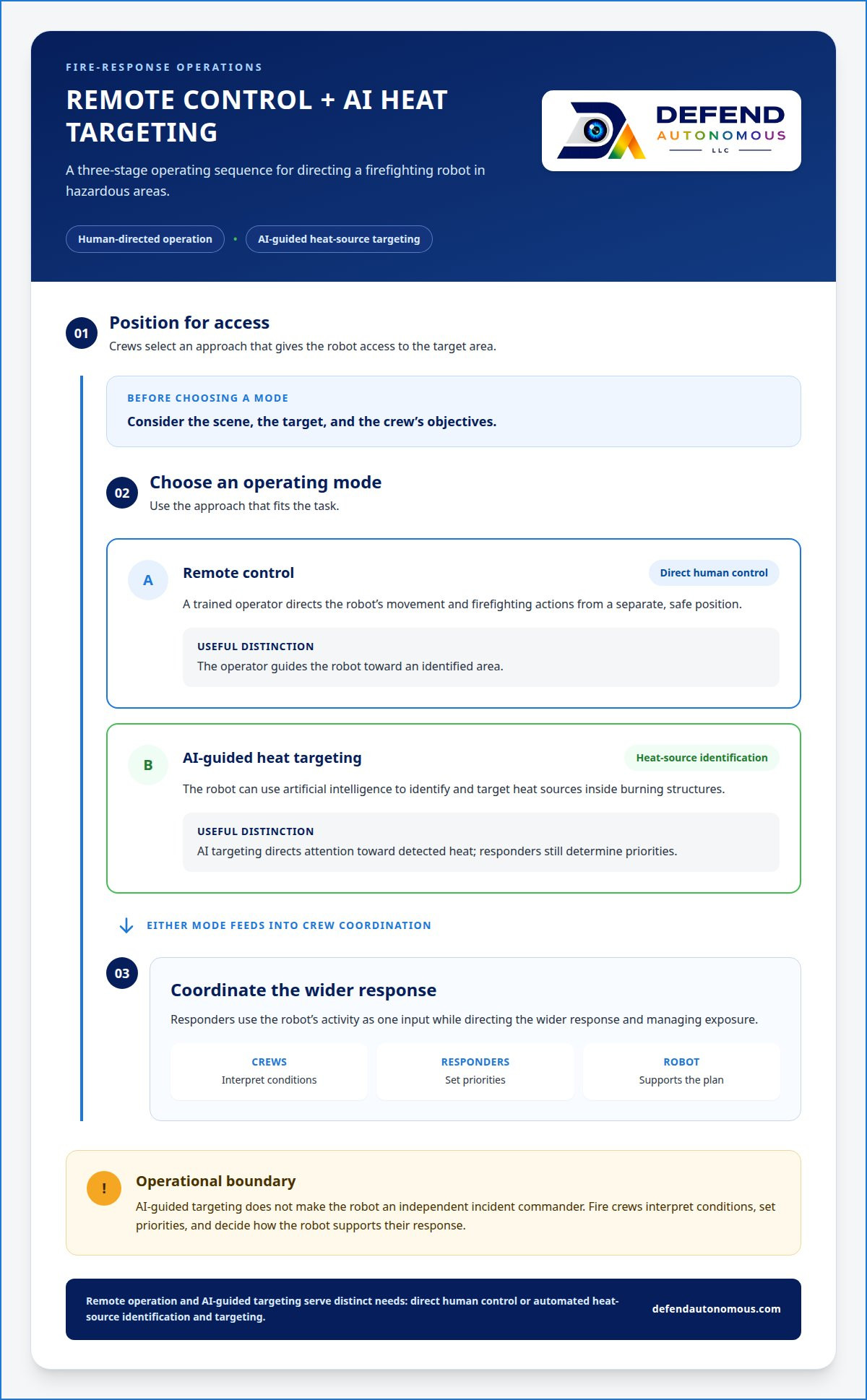
At a UAE fire scene, responders can deploy a robot toward a hazardous area and operate it remotely or use AI-guided targeting. Dubai Civil Defence’s firefighting robot dog can be remotely controlled or use artificial intelligence to identify and target heat sources inside burning structures.
Remote operation lets a trained operator direct the robot from a safe distance. The operator guides its movement and applies its firefighting function toward an identified area. In a burning structure, this can support crews as they manage exposure and coordinate their response.
AI-guided targeting adds another capability. The robot can identify heat sources and direct attention toward them, helping responders focus on areas of elevated heat. It does not act as an independent incident commander. Fire crews still interpret conditions, set priorities and decide how the robot supports their response.
A practical operating sequence can help align robot use with incident priorities:
- Position: Crews select an approach that gives the robot access to the target area.
- Choose a mode: The operator uses remote control or AI-guided heat-source targeting, depending on the task.
- Coordinate: Responders use the robot’s activity as one input when directing the wider response.
For example, if heat is detected inside a burning structure, AI targeting can direct attention toward that source. With remote control, the operator directs the robot’s actions from a separate position. Both approaches can support response in hazardous spaces, but they serve distinct needs: direct human control or automated heat-source identification and targeting.
Planning the operating approach around the scene, target, and crew objectives helps clarify the robot’s role before deployment. Teams exploring remote fire-response robotics can consider how these capabilities align with their incident requirements.
Fire-rescue robot reconnaissance and modular functions
Reconnaissance helps crews assess a site before entry. Similar robots have been used to check hazards and look for trapped people. At a commercial-complex fire drill, a reconnaissance robot dog was used. The information gathered can help responders understand conditions and plan their approach.
Tracked, wheeled and aerial robots suit different tasks. Tracks can help a ground robot cross uneven debris, while wheels suit smoother routes. Aerial robots provide an overhead view, while ground units can approach obstacles or carry firefighting equipment. The environment and mission determine which platform is appropriate.
UAE approval requirements depend on the intended deployment and relevant authority. Discuss the robot’s role, operating environment and integration with response procedures during approval planning. Do not assume one blanket rule covers every use.
Fire-rescue robot prices depend on the configuration, mobility, payload, and support included, with pricing provided after a quote request. Compare the mission requirements before assessing a system’s total cost.
Dubai Civil Defence is identified as using a firefighting robot dog. The available UAE examples do not establish a complete list of agencies or fire departments using robots.
Capabilities vary by configuration. A fire-rescue robot can ascend and descend front-facing steps up to 40 cm high. Reconnaissance, mobility, and firefighting functions should be assessed against the intended task.
UAE buyers should distinguish manufacturers from local suppliers and service providers. Assess how each supplier handles integration, operator instruction, maintenance and technical support.
Smoke, debris, obstacles and control or communication constraints can affect a robot at a fire scene. These conditions may restrict movement or visibility, so crews should account for them when planning deployment.
Operational readiness involves training operators to control the robot and coordinate its use with responders. A maintenance plan should cover inspections, mobility, controls and firefighting equipment, with support arrangements suited to the operating schedule.
Early reconnaissance puts information gathering ahead of crew entry: a robot can assess hazards and check for trapped people before responders go in. This keeps the task focused on what crews need to establish before entering, rather than treating the robot as a substitute for their subsequent response.
Fire-resistant and water-protection features
Heat exposure and water contact are separate design conditions for firefighting robots. A specification describing water protection does not, by itself, establish thermal resistance. For a warehouse incident, assess both conditions against the robot’s intended position and task.
Review equipment documentation by category. Look for stated limits and operating conditions rather than relying on broad terms such as “protected” or “fire-resistant.” A robot positioned near a heat source faces different exposure from one conducting reconnaissance farther away. The mission profile matters.
- Thermal exposure: Identify the expected heat conditions and the robot’s stated operating limits.
- Water contact: Review the documented protection conditions for spray, runoff, or firefighting streams.
- Critical components: Consider how the design addresses control systems, power components, mobility, and sensors.
- Operating duration: Check the specified limits for sustained use in the planned environment.
These categories distinguish material resistance from system-level protection. A housing, for example, may shield an internal component, while sensors or the movement system may have different operating constraints. Assess each function as part of the deployment, not as proof that the complete machine can withstand every fire condition.
Water delivery also creates operational demands. A firefighting robot may encounter spray, wet surfaces and runoff during use, so its intended operating conditions should match the planned task. For a tunnel response, assess the route and exposure together. For warehouse reconnaissance, consider the robot’s position relative to heat and water sources.
Before deployment, crews can compare the mission profile with the documented thermal and water-protection limits, then incorporate those limits into operating procedures. This makes the distinction between protection claims and usable capabilities clear. To discuss how a firefighting robot can support your operational requirements, connect the intended environment and task with the equipment capabilities.
The Falcon 6 aviation fire engine carries 12,500 litres of water, a capacity relevant to planning water delivery. The forest-fire drill used 1 units + 1 units: one water-cannon robot dog and one additional robot dog.
These examples describe water-delivery equipment and a drill configuration. They do not, on their own, establish a robot’s thermal limits or water-protection ratings. Before deployment, assess the machine’s documented operating conditions against its intended task and exposure.
Defend Autonomous Robotics Trading LLC: Fire Fighting Robot
Defend Autonomous Robotics Trading LLC offers a Fire Fighting Robot for organisations assessing robotic support for fire response. Consider it when evaluating how a firefighting robot could fit your operating environment, incident tasks and response procedures.
Define the intended role first: fire suppression, reconnaissance or support in hazardous areas. Then consider the site layout, access routes, operating conditions and how responders will coordinate the robot’s use. These factors shape the requirements for a practical solution. Defend Autonomous Robotics Trading LLC can discuss its Fire Fighting Robot in relation to your operational needs.
Contact Defend Autonomous Robotics Trading LLC to discuss your firefighting robot requirements.
Build a fire-response plan around operational needs
As a next planning step, define the role a robot should play in your response framework. Consider the environments where crews may deploy it, the tasks it must support and how operators will coordinate its use with existing procedures. Clear requirements keep discussions focused on operational fit rather than features in isolation.
For teams assessing firefighting and fire rescue robots in the UAE, the decision can also form part of a wider automation roadmap. Defend Autonomous Robotics Trading LLC offers AMR & AGV Automation Solutions, an AI Coffee & Beverage Robot, and CNC & advanced manufacturing solutions alongside its Fire Fighting Robot. Each addresses a different operational need, so focus on the solution relevant to your application.
Bring your fire-response objectives into the next conversation and identify the capabilities that matter to your environment. Discuss your fire-response requirements with Defend Autonomous Robotics Trading LLC and take a considered next step toward operational readiness.
Frequently Asked Questions
What firefighting and fire rescue robots are available in the UAE?
Defend Autonomous Robotics Trading LLC offers a Fire Fighting Robot. For UAE operations, assess the solution by its intended role and deployment environment, such as fire response in a warehouse, tunnel or car park. Define the task, access conditions and how responders will coordinate its use. These requirements focus the discussion on operational fit without assuming every robot has the same configuration.
How much do firefighting and fire rescue robots cost in the UAE?
Prices depend on the robot’s configuration, mobility, payload, and included support. Pricing is provided after a quote request.