Quadruped robots can make security patrols more adaptable across UAE facilities, navigating stairs and uneven terrain that can challenge wheeled platforms. Security patrol and quadruped robots in the UAE can suit routes with obstacles or hazardous areas. They can support patrol teams by observing, recording and sharing information, but they do not replace human oversight or guarantee uninterrupted patrols.
That distinction matters. The value comes from matching a robot’s capabilities to a defined patrol task, then integrating its operation with people, access procedures and existing security systems. Used this way, quadrupeds can extend visibility across complex sites while helping teams focus attention where human judgement is essential.
This guide explains why quadruped robots suit certain patrol environments, how they can support UAE facilities, and what to assess when planning deployment. You’ll also learn how route conditions, endurance, sensing and operational handoffs shape efficiency, so you can distinguish a useful patrol application from technology that doesn’t fit the site.
Key Takeaways
- Assess patrol endurance by both operating time and distance, then measure completed rounds and useful findings on a defined route.
- Learn how onboard AI can help detect unusual activity, record video and connect patrol observations with existing security networks.
- Plan route trials around normal site conditions, including people, furniture, access controls and the handoffs that keep patrol operations coordinated.
- Identify when industrial quadruped and autonomous patrol solutions can support facility security, and how to align deployment with operational needs.
Operational efficiency and cost-effectiveness
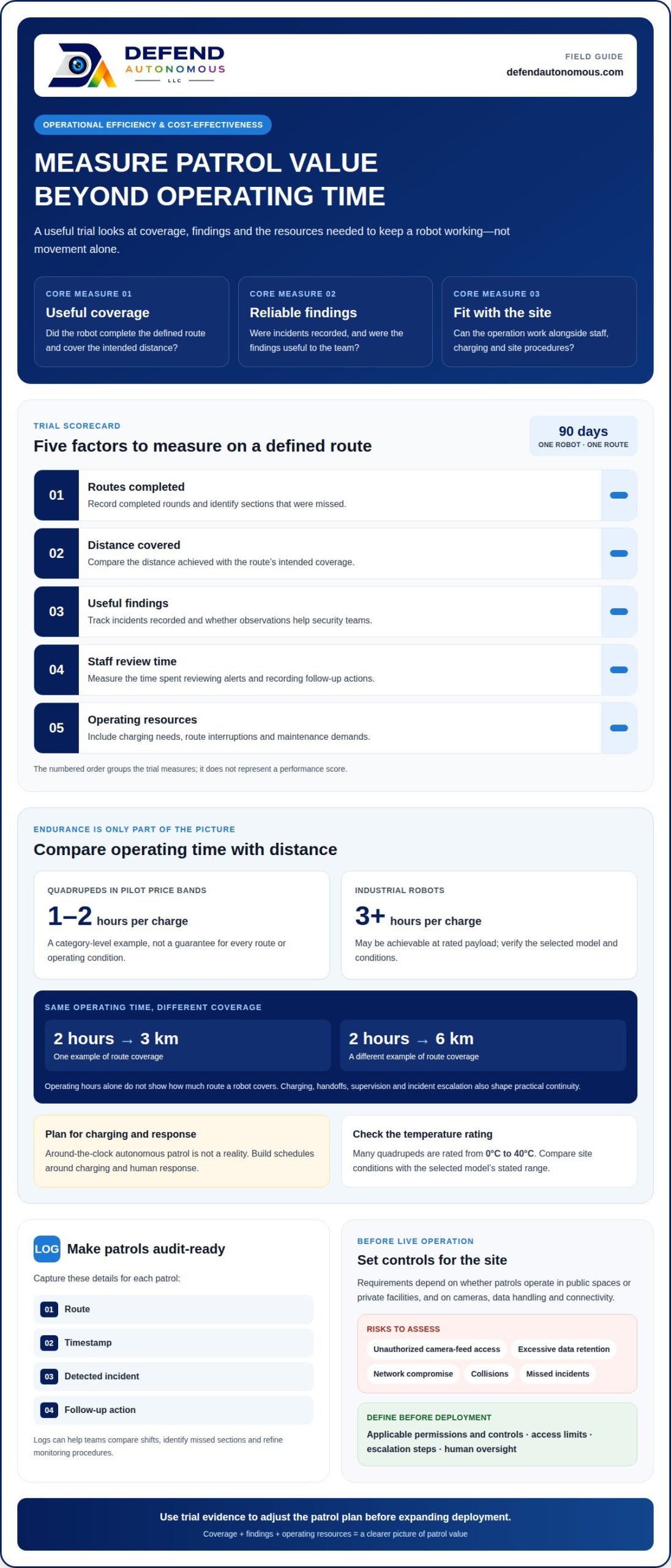
Efficiency depends on useful coverage, reliable findings and an operation that fits the site. A defined route trial can reveal completed patrols, incidents recorded and maintenance demands.
Operational Benefits and Audit-Ready Logs
Measure more than patrol hours. Record completed routes, distance covered, useful findings and the time staff spend reviewing alerts. For audit-ready logs, capture each patrol’s route, timestamp, detected incident and follow-up action. These records help security teams identify missed sections, compare shifts and refine monitoring procedures without treating movement alone as proof of value.
UAE deployment requirements depend on whether patrols operate in public spaces or private facilities, and on their cameras, data handling and connectivity. Assess the applicable permissions and controls for the specific location. Key risks include unauthorized access to camera feeds, excessive data retention, network compromise, collisions and missed incidents. Set access limits, escalation steps and human oversight before live operation.
For cost-effectiveness, compare operational output with the resources required to keep a unit working. Run one robot on a defined route for ninety days, then assess completed laps and useful findings. Include staff review time, charging needs, route interruptions, and maintenance in the assessment. This gives facility teams evidence for adjusting the patrol plan before expanding deployment.
Continuous Operation and Autonomy
Autonomy can reduce repetitive walking, but it does not mean uninterrupted patrol. Quadrupeds commonly run for one to two hours per charge in pilot price bands; industrial robots may run for three or more hours per charge at rated payload. Treat these as category-level examples, not a guarantee for every route, payload, or operating condition.
Compare endurance with distance: a two-hour robot covering 3 km provides different route coverage from one covering 6 km. Charging, handoffs, supervision, and incident escalation all shape practical continuity. Around-the-clock autonomous security patrol isn’t a reality; design operation schedules around charging and human response. For temperature, many quadrupeds are rated from 0°C to 40°C, so assess site conditions against the selected model’s stated range.
Connect cameras, thermal imaging, and monitoring workflows to the security operation where supported. Test alerts, access controls, and staff handoffs on the intended route. Unitree is one example of a quadruped brand; compare each platform’s documented capabilities with the site’s tasks, including hazardous environments.
Why Utilize Quadrupeds for Security?
Quadrupeds suit patrol routes where stairs, uneven terrain and changing environments challenge wheeled platforms. Their value depends on matching movement, sensing and alert workflows to the site.
Sensors, Cameras, and Detection
Camera placement and sensor coverage determine which areas a patrol can observe. Map sightlines around entrances, blind corners and outdoor transitions, then identify where walls, glare or moving people may interrupt detection. During inspection, test whether the robot can approach relevant viewpoints without obstructing staff or access routes. The aim is useful observation, not simply fitting more equipment onto a platform.
Quadruped and Wheeled Patrol Comparisons
Wheeled robots can suit smooth, level routes, while quadrupeds can navigate complex environments with greater agility and stability. Stairs, rough terrain and obstacles can make legged movement more suitable for some UAE facilities. Neither form fits every site. Compare the planned route, surface changes, access points and observation tasks before selecting a platform for outdoor or indoor operation.
AI-Assisted Anomaly Detection
Onboard AI can detect unusual activity and record video for security review. A practical development process defines what counts as an anomaly for each location, such as entry into a restricted area or an unexpected object on a route. Teams can then assess whether alerts provide relevant context. Human review remains important: an unusual event needs interpretation and an appropriate response, not just automated classification.
AI Detection and Security Network Integration
Connect robot-generated alerts with the security network’s existing review and escalation workflows. Define who receives an alert, how video is accessed, and how staff record follow-up actions. Test the complete sequence using realistic scenarios, including a missed detection and an incorrect alert. This reveals gaps between detection and response. For security and autonomous patrol applications, align these workflows with the facility’s operating procedures.
Autonomous quadruped patrols across UAE facilities
Autonomous patrols combine a mobile platform, sensors, route planning and staff response procedures. Their effectiveness depends on how those elements work across each facility’s real operating conditions.
Applications being explored include remote inspection of pipelines, storage yards, and restricted areas at oil and gas facilities and logistics hubs. Quadrupeds also feature in smart city plans in Dubai and Abu Dhabi. Capability descriptions cite coverage of 90% of complex terrain and obstacles up to 40 cm, but these are platform claims, not reported site-level results.
Autonomous Patrol Architecture
A patrol architecture connects the robot’s sensors, route instructions, monitoring interface and escalation process. Define which areas it observes, what events trigger alerts and which team receives each alert. This structure matters in a logistics hub, where a restricted zone may require a different response from a routine inspection route.
Also account for payload and handoffs. Cameras or other equipment affect the platform’s configuration, while staff need clear procedures for reviewing findings and responding to incidents. Treat the patrol as a coordinated operation, not a robot moving independently through a site.
All-Terrain Autonomy
Quadrupeds can climb stairs, cross rough terrain, and enter some hazardous environments. These capabilities can extend patrol routes beyond smooth corridors, especially where ramps, uneven surfaces, or obstacles interrupt movement. A cited obstacle capability of up to 40 cm should be understood as a platform description, not a guarantee across every surface or payload.
Route trials should include the people, furniture and access controls normally present. Test transitions between surfaces and check whether sensors maintain useful coverage. A clear route on an empty site may behave differently during a busy shift.
For useful results, define what the patrol must accomplish before deployment. Track completed route segments, blocked passages, useful findings and staff interventions. Repetitive inspection can be a strong use case when the route is predictable and findings have a clear review process. Adjust routes around observed constraints, then assess whether the robot adds coverage without disrupting facility operations.
Quadruped robots for UAE security patrols
Quadrupeds may suit patrol tasks at airports, large public venues and religious landmarks such as mosques. Their role depends on the site’s surveillance objectives, routes and operating conditions.
Permit requirements depend on the deployment location and use. For public-facing patrols, establish the relevant site authorization and applicable authority approvals before operation, particularly where cameras are used.
UAE Suppliers, Leasing, and Maintenance
Supplier arrangements can cover robot supply, commissioning, maintenance, and technical support. Leasing is a distinct procurement option; Defend Autonomous Robotics Trading LLC provides sales and support, not rentals. For remote facilities, define how faults are reported, who handles diagnosis, and how maintenance needs affect planned coverage.
Assess whether the proposed system suits the intended task, such as outdoor surveillance or thermal inspection. A route-based demonstration can show how the robot moves through actual access points and operating conditions. Evaluate vision, alert handoffs, and maintenance planning together, since each affects the practicality of a patrol deployment.
Buying, Importing, and Deploying Patrol Robots
Start by defining the patrol objective, route, environment and required payload. Then match the platform to site access, camera requirements, network integration and support needs. Before purchase, allocate responsibility for shipping, import documentation and delivery arrangements so logistics align with deployment planning.
During a controlled site trial, test normal access controls, staff movement and representative lighting. Establish how operators review alerts and escalate incidents. Document operating procedures, maintenance responsibilities and staff handoffs before expanding deployment to additional areas.
Security patrols with quadruped robots in the UAE should be planned around a specific task, site conditions, and operating procedures. Security patrol and quadruped robot options for UAE facilities are best assessed against those requirements, rather than by mobility alone. To discuss your facility’s needs, contact Defend Autonomous Robotics Trading LLC.
Defend Autonomous Robotics Trading LLC: Industrial quadruped robot solutions
Defend Autonomous Robotics Trading LLC provides industrial quadruped robot solutions and security and autonomous patrol robots for facilities evaluating robotic patrols. These solutions can suit security tasks involving defined routes, challenging terrain or remote observation.
Begin with the patrol objective. Identify the areas requiring observation, the conditions along each route and how security staff will use robot-generated findings. This aligns the platform with facility requirements rather than treating robot selection as a standalone purchase. For material movement needs, AMR and AGV automation solutions address a different operational task.
Contact Defend Autonomous Robotics Trading LLC to discuss your patrol requirements and robotic solutions for your facility.
Build the Next Stage of Your Security Operation
A security patrol and quadruped robot plan in the UAE can support more coordinated facility operations. Define the outcomes the patrol should support, then map how its findings connect to security teams, site procedures and future automation priorities. That operational roadmap helps decision-makers treat robotics as an integrated capability rather than a standalone deployment.
Defend Autonomous Robotics Trading LLC offers industrial quadruped robot solutions and Security & Autonomous Patrol Robots. Its wider portfolio also includes AMR & AGV Automation Solutions, an AI Coffee & Beverage Robot, and CNC & advanced manufacturing solutions. These offerings address distinct operational needs across facility and manufacturing environments.
Take the next step by discussing your patrol objectives and facility requirements with Defend Autonomous Robotics Trading LLC. Contact Defend Autonomous Robotics Trading LLC to start a practical conversation about your automation priorities.
Frequently Asked Questions
What security patrol robots are available in the UAE?
UAE security options include quadruped platforms for patrol and inspection, alongside autonomous mobile robots and automated guided vehicles designed for industrial logistics. Defend Autonomous Robotics Trading LLC offers industrial quadruped robot solutions and security and autonomous patrol robots. For example, a site assessing perimeter observation can consider a quadruped platform, while internal material transport calls for a different automation category.
Which quadruped robot models are used for security patrols in the UAE?
There isn’t a single model that fits every UAE patrol application. The suitable platform depends on the task, site layout, terrain, payload and required sensing functions. Rather than choosing by model name alone, define where the robot must travel and what information it needs to capture. This helps match an industrial quadruped to the patrol’s operational requirements.
What features do UAE security patrol robots offer, such as cameras, thermal imaging, and AI detection?
Capabilities can include onboard AI that detects unusual activity, records video, and integrates with existing security networks. Camera coverage should match the facility’s observation needs and review process. Thermal imaging should be treated as a distinct requirement, not an automatic feature of every patrol robot. Define the intended use, such as observing an area in low visibility, when specifying system capabilities.
What are the UAE regulations for deploying autonomous security robots in public or private spaces?
Requirements depend on whether the patrol is in a public space or private facility, as well as on cameras, data handling and connectivity. For public-facing patrols, establish site authorization and applicable authority approvals before operating, particularly when cameras are used, and set access limits, escalation steps and human oversight.
Which UAE sites use security patrol robots, and what results have they reported?
Potential settings include airports, large public venues, mosques, oil and gas facilities, and logistics hubs; these are described as suitable or under exploration, not as confirmed deployments. No site-level results are reported: the 90% terrain coverage and 40 cm obstacle capability are platform claims.