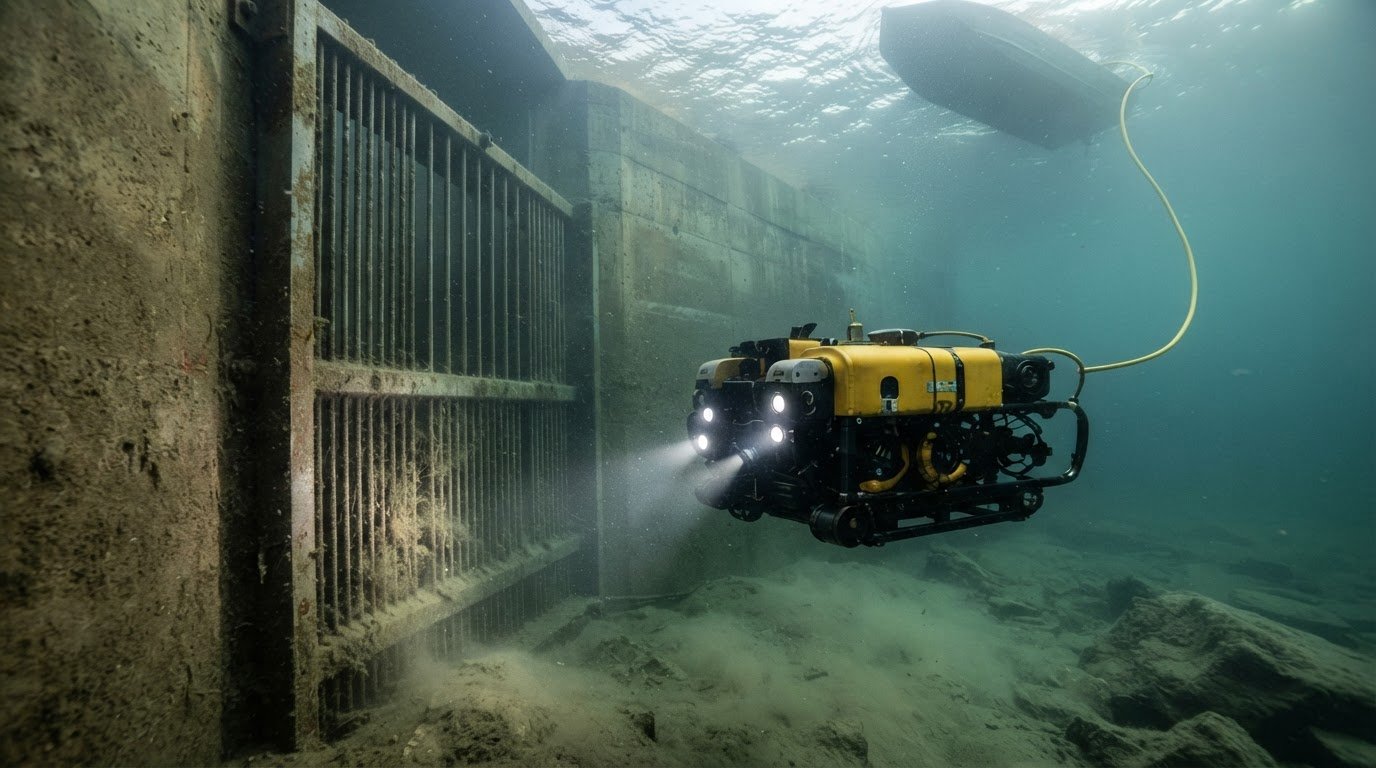
Underwater ROVs inspect submerged assets, transmit real-time visuals, and support hands-on work such as lifting or equipment repair. Choosing among marine autonomous systems and underwater ROV suppliers in the UAE starts with matching the system to the mission, not simply selecting the most powerful vehicle.
That distinction matters. Observation-class systems are suited to visual inspection, while work-class ROVs are designed for more demanding underwater tasks and may use robotic arms. Depth, currents, and payload requirements all shape the right configuration.
This guide explains what ROVs do and how to assess observation and work-class capabilities for your operation. You’ll learn how operating conditions influence vehicle selection, which payload and customization needs to define, and what to consider when moving from a mission requirement to a suitable marine robotics solution.
Key Takeaways
- Distinguish observation ROVs from work-class systems by the task each must perform, from visual inspection to hands-on intervention.
- Map ROV applications to the mission, including offshore operations, marine research, defense, and search and rescue.
- Define depth, current conditions, and payload needs together to narrow the system configuration that fits the operating environment.
- Identify where customization can align the vehicle and its capabilities with mission-specific requirements.
Observation and work-class ROV capabilities
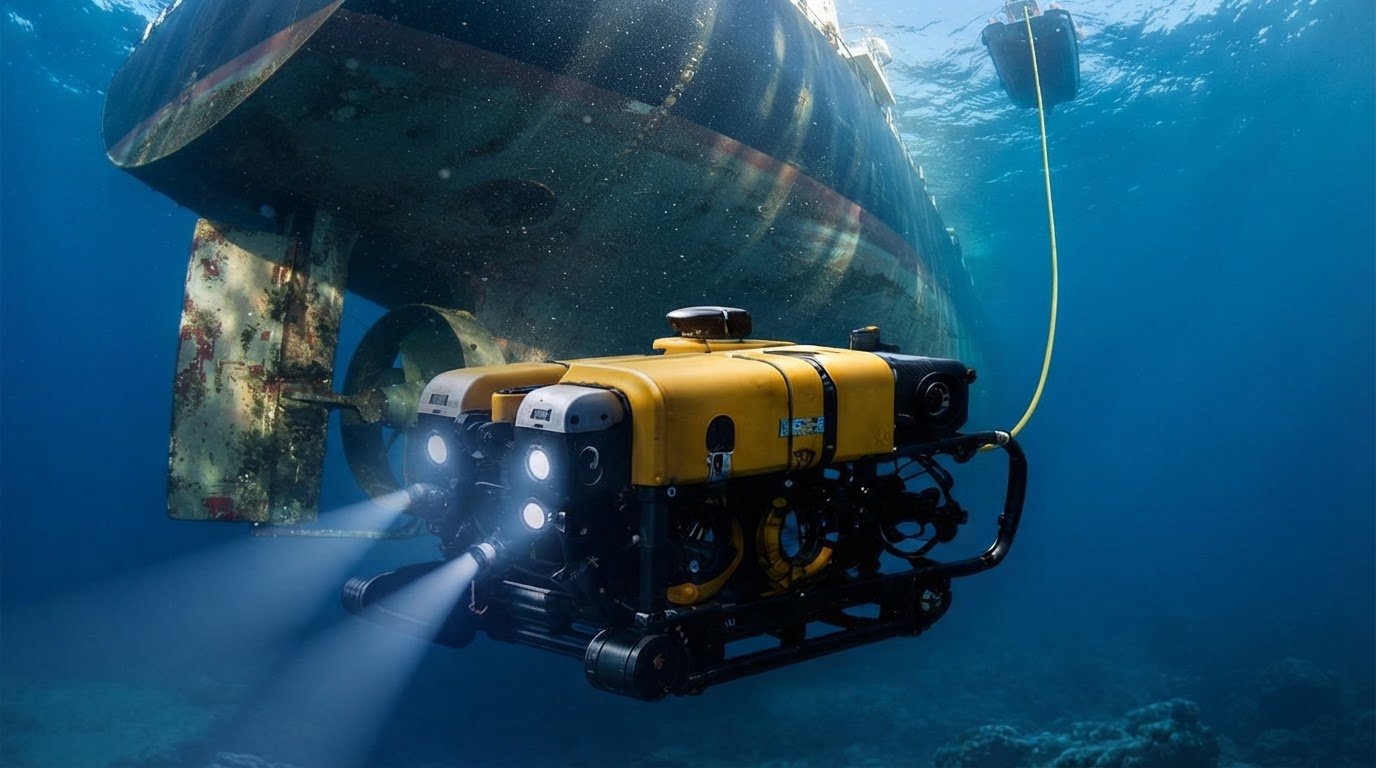
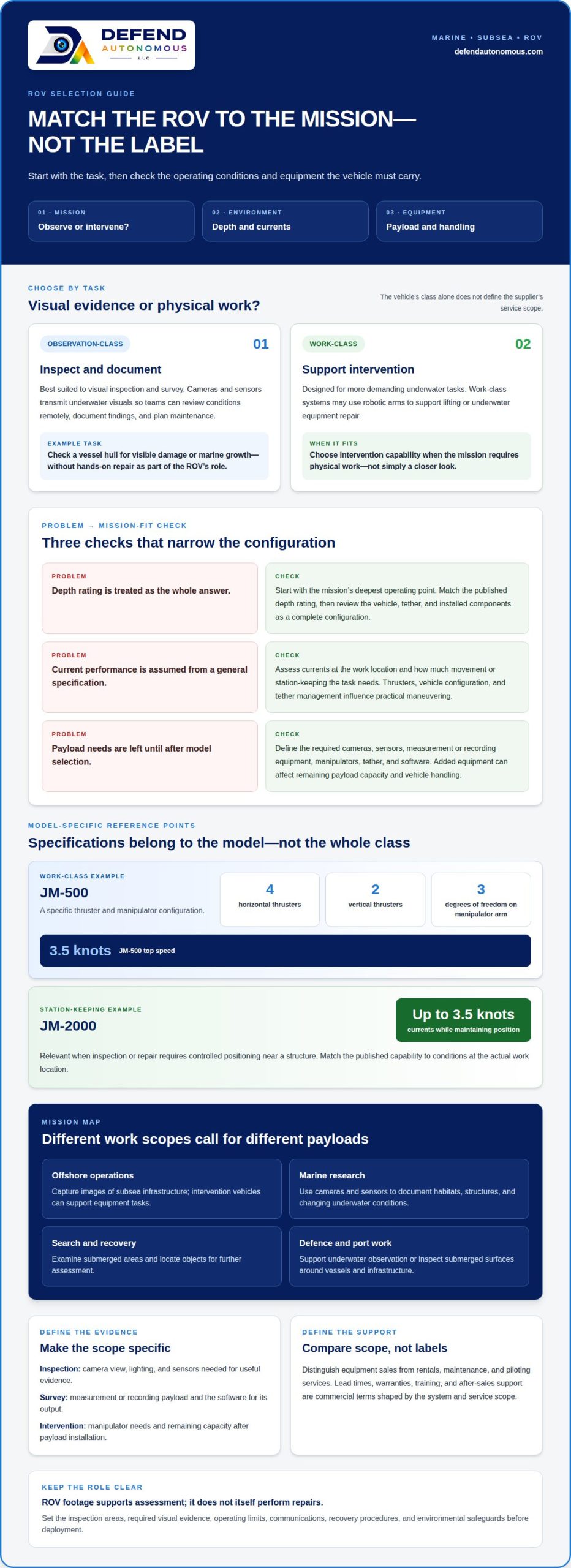
Observation-class ROVs transmit real-time underwater visuals for inspection, including vessel hull surveys and checks of submerged structures. Cameras and sensors help engineering teams review conditions remotely, document findings, and plan maintenance. For example, a hull inspection can focus on visible damage or marine growth without making hands-on repair part of the vehicle’s role.
Work-class ROVs support intervention tasks. They typically use multiple robotic arms for lifting or underwater equipment repair, and are normally powered hydraulically or electrically. The JM-500 illustrates a different configuration: it has four horizontal thrusters, two vertical thrusters, and a manipulator arm with three degrees of freedom. Its top speed is 3.5 knots. These specifications describe the JM-500, not every work-class system.
For station-keeping, the JM-2000 can maintain position in currents up to 3.5 knots. That capability is relevant when an inspection or repair requires controlled positioning near a structure. Hull and class inspections still need a defined scope: identify the areas to inspect, the visual evidence required, and whether the task calls for observation or physical intervention. ROV footage supports assessment; it does not itself perform repairs.
When comparing ROV suppliers, distinguish equipment sales from rentals, maintenance, and piloting services. An ROV’s class alone does not establish what services a supplier provides. Lead times, warranties, training, and after-sales support are commercial terms shaped by the system and service scope.
ROV pricing depends on the system configuration, sensors, manipulators, and support requirements. For marine robotics and underwater ROV suppliers in the UAE, compare capabilities against the inspection task, not class labels alone. Choose observation capabilities for visual evidence and intervention capabilities when the mission requires physical work.
What Are Underwater ROVs Used For?
A remotely operated vehicle can extend subsea visibility and intervention into places divers may find difficult to access. In offshore energy, observation systems can capture images of subsea infrastructure, while intervention vehicles can support equipment tasks. Marine research teams use cameras and sensors to document habitats, structures, and changing underwater conditions. The mission determines whether the priority is visual evidence, measurement, or physical work.
Search and recovery teams can use ROV cameras to examine submerged areas and locate objects for further assessment. Defence applications may include underwater observation and inspection around vessels or infrastructure. In port work, an ROV can inspect submerged surfaces without requiring a crew member to conduct the visual survey underwater. Each context has distinct operational needs, so the payload and deployment plan should reflect the task.
Which ROV models are best for inspection, survey, offshore, and port work? Observation-class models suit visual inspection and survey; work-class models suit subsea tasks requiring intervention. A model such as the JM-2000 may fit a work scope requiring station-keeping in currents, while the mission and configuration determine overall suitability.
Which companies supply marine robotics and underwater ROVs in the UAE? Marine engineering firms, subsea specialists, and robotics suppliers serve this market, with capabilities that vary by system and service scope. Defend Autonomous Robotics Trading LLC provides Marine, Subsea & ROV Solutions for underwater inspection and subsea operations.
What certifications and regulations apply to operating underwater ROVs in UAE waters? Certification needs depend on the equipment, vessel, and work scope, while operational permissions depend on the location and mission. What safety, environmental, and operational risks affect ROV work? Currents, poor visibility, tether entanglement, vessel movement, and contact with marine habitats or assets can affect deployment. A sound plan defines operating limits, communications, recovery procedures, and environmental safeguards before launch. For tailored mission requirements, explore subsea ROV capabilities.
ROV selection based on operating depth, currents, and payload
Start with the mission’s deepest operating point, then match the ROV’s published depth rating. That rating defines the vehicle’s intended operating envelope; it does not measure current capability or payload capacity. For surveys across several depths, the system must cover the full profile while carrying the required equipment. Review the manufacturer’s technical specifications for the vehicle, tether, and installed components as a complete configuration.
Currents affect control and station-keeping. The JM-2000 can maintain station in currents up to 3.5 knots, a useful reference when a task requires holding position near a structure. Assess the current conditions at the work location and the movement needed to perform the mission. Thrusters, vehicle configuration, and tether management all influence practical maneuvering. A global specification alone doesn’t replace matching operating conditions to the task.
- Inspection: Prioritize the camera view, lighting, and sensors needed to capture useful evidence.
- Survey: Define the measurement or recording payload and the software used to handle its output.
- Intervention: Account for manipulator requirements and the vehicle’s remaining capacity after payload installation.
What are the technical specifications and payload options of ROVs available in the UAE? Specifications vary by model and configuration. Compare depth rating, current performance, thrusters, camera and sensor payloads, manipulator capability, tether, and software against the mission. Added equipment can affect available payload capacity and vehicle handling, so assess the assembled system rather than a standalone vehicle specification.
Depth rating and cost are connected through the vehicle design and the equipment required for the operating environment. Payload type, sensor integration, manipulators, tether, control software, and support scope also influence project cost. Price depends on the case and is given after a quote request. A clear mission profile, including depth range, currents, required measurements, and intervention needs, helps define a suitable configuration without paying for capabilities the task won’t use.
Customized marine robot solutions
A customized marine robot starts with a defined job, not a catalogue feature. For a hull survey, the priority may be camera coverage and clear image capture. Subsea infrastructure inspection may call for a different sensor payload, vehicle configuration, or operating profile. Specify the required evidence or task first, then align the vehicle and payload with that outcome.
Use a practical design sequence. Define the target surface and operating conditions. Identify what the robot must capture, measure, or manipulate. Then match cameras, sensors, lighting, and other payload components to those requirements. A survey that needs visual documentation has different priorities from a task requiring equipment intervention. Payload selection also affects available capacity and how the assembled vehicle performs.
- Mission: Describe the asset, inspection objective, and output the team needs.
- Configuration: Match the vehicle, camera, sensors, and payload to the task.
- Deployment: Account for the launch point, tether handling, currents, and recovery plan.
- Integration: Align recorded data and software outputs with the engineering team’s review process.
These steps help distinguish essential customization from unnecessary complexity. A port inspection, for instance, may prioritize maneuvering near vessel surfaces and collecting usable footage. A broader infrastructure survey may need a different camera view or sensor package. The right design delivers the required information or intervention while fitting the site’s operational constraints.
As of October 18, 2026, UAE marine robotics listings include 74 company records in Dubai, 22 in Abu Dhabi, and 12 in Sharjah. Dubai accounts for 42.0% of listed providers. These records indicate where suppliers are listed, not the service area of each company. Project coverage depends on the deployment location, launch arrangements, and mission logistics; a Dubai listing alone doesn’t define where a supplier can operate.
For a project-specific ROV configuration, discuss your marine robotics requirements and align the vehicle design with the mission, payload, and operating environment.
Defend Autonomous Robotics Trading: AI Coffee & Beverage Robot
Defend Autonomous Robotics Trading provides Marine & Subsea Solutions, including ROV technology, for operations requiring underwater inspection or subsea capability. Turn to its marine offering when your project calls for a system aligned with a defined task, operating environment, and payload requirement. Clear mission objectives help frame the technical discussion, from the assets to inspect to the information or intervention the operation needs. The AI Coffee & Beverage Robot serves a separate automation need, while marine projects call for a marine-focused solution. Contact Defend Autonomous Robotics Trading to discuss your marine robotics requirements.
Turn Mission Requirements Into the Next Step
A marine robotics project moves forward when its operational need becomes a clear system brief. Define the asset, work objective, deployment environment, and required outputs. That brief gives engineering teams a practical basis for shaping a solution around the operation rather than adopting a generic configuration. When evaluating marine robotics and underwater ROV suppliers in the UAE, let alignment between mission requirements and system capability guide the discussion.
Defend Autonomous Robotics Trading LLC offers marine and subsea solutions alongside AMR & AGV Automation Solutions, AI Coffee & Beverage Robot Solutions, and CNC & Advanced Manufacturing Solutions. These offerings address distinct operational requirements across marine and industrial environments.
Bring your project objectives and operational priorities into the conversation. Contact Defend Autonomous Robotics Trading to discuss a marine robotics solution for your requirements. A defined mission is a strong starting point for purposeful engineering.
Frequently Asked Questions
How Much Does an Underwater ROV Cost?
An underwater ROV’s purchase cost depends on its class, depth rating, propulsion, and configured equipment. Cameras, sensors, manipulators, software, and support scope also shape the system specification. Define the mission and required payload first to frame the purchase discussion. A visual survey and a subsea intervention need different configurations, so a single figure would not represent every ROV.
How do I get contact information for these companies?
To contact Defend Autonomous Robotics Trading LLC, use the contact channel on this site. Include your project location, intended task, operating depth, current conditions, and required payload in your enquiry. Those details help frame the relevant marine and subsea requirements. For other supplier records, use each company’s official business contact information and identify the specific service or equipment you’re seeking.
How many marine robotics service providers are there based in the United Arab Emirates?
The listed city records total 108: Dubai has 74, Abu Dhabi has 22, and Sharjah has 12, as of October 18, 2026. These figures describe company records in those cities, not a complete census of every UAE provider. Use them as a location snapshot, then distinguish supplier headquarters from the areas served for a particular marine operation.
What types of underwater ROVs are available from UAE suppliers?
Common categories include mini and micro vehicles, observation-class ROVs, and work-class ROVs. Mini and micro ROVs are often designed to weigh under 25 kg. Observation vehicles suit visual data collection, while work-class configurations are designed for more demanding subsea tasks. Selection also depends on whether the mission needs a camera, sensors, or intervention equipment.
What are the prices to buy or rent an underwater ROV in the UAE?
Defend Autonomous Robotics Trading LLC sells systems directly and does not offer rentals. The purchase configuration depends on the selected system, depth rating, payload, and support requirements. For a purchase discussion, outline the intended operation and required configuration so the system can be scoped to the work rather than a generic class label.
What should buyers compare when choosing a UAE ROV supplier?
Compare how each proposed system maps to your mission, including its operating envelope, payload configuration, and data outputs. Review the project scope for deployment logistics, training, maintenance, and after-sales support. Consider whether recorded inspection data can be reviewed within your engineering workflow. A clear comparison separates required capabilities from optional equipment and keeps selection focused on operational needs.