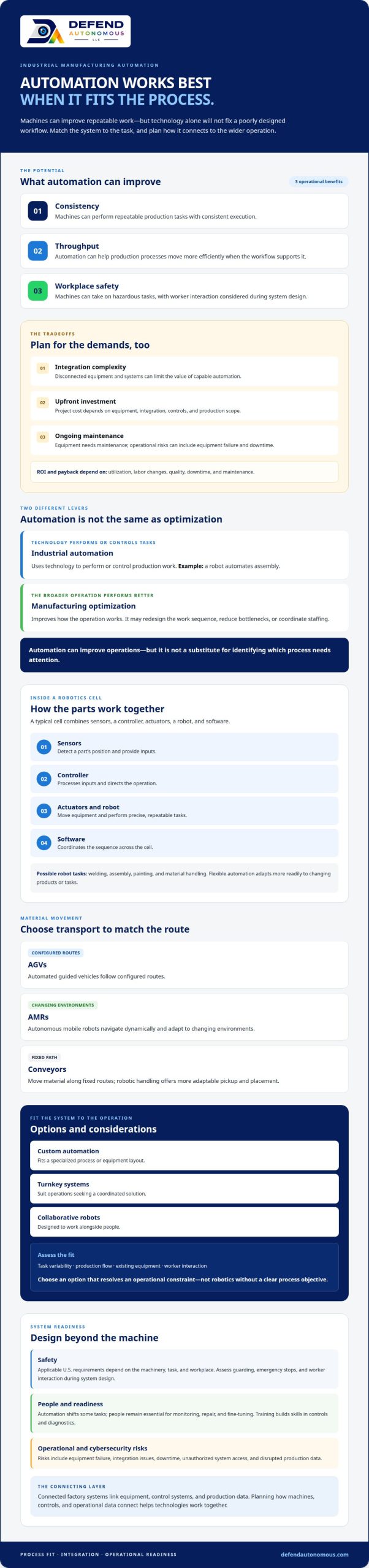
Automation is a capability, not a guarantee of better manufacturing. Industrial manufacturing automation can improve consistency, throughput, and workplace safety by assigning repeatable or hazardous tasks to machines. It also brings integration complexity, upfront investment, and ongoing maintenance needs. The strongest results come when automation fits the process, rather than forcing the process to fit the technology.
It makes sense to weigh these tradeoffs carefully: a faster machine will not fix a poorly designed workflow, and disconnected systems can limit the value of capable equipment. This article explains the advantages and disadvantages of industrial automation, distinguishes automation from manufacturing optimization, and shows how connected factory systems and integration help technologies work together. Planning how machines, controls, and operational data connect matters as much as choosing the automation itself.
Key Takeaways
- Assess automation by the process it improves, the work it shifts, and the maintenance it requires.
- Separate equipment automation from workflow optimization to identify where operational changes will create value.
- Understand how connected controls and factory information systems help production data move across operations.
- See why integration planning can make new automation work with existing equipment and systems.
What is Factory Automation?
Factory automation uses programmable controls, sensors, software, and machines to run or monitor production processes. Its value depends on matching each system to the task, whether inspecting parts, coordinating equipment, or moving materials.
AI and Machine Learning in Manufacturing
Artificial intelligence and machine learning analyze production data to identify patterns, detect anomalies, and support process decisions. For example, a system can examine machine readings for signs of changing performance, helping teams investigate potential issues before they disrupt production. The value depends on reliable data and a defined operational goal. Machine monitoring can also connect sensors to existing equipment, adding visibility without replacing an entire machine or production line.
PLC Control of Machinery and Processes
A programmable logic controller, or PLC, is a specialized digital computer that controls industrial machinery and processes. It receives sensor inputs, applies programmed logic, and sends commands to equipment such as motors or valves. This sequence coordinates repeatable operations and gives teams a clear point of control. PLCs can also work alongside other automation systems, allowing existing processes to be controlled without upgrading every machine separately.
Safety, Costs, and Workforce Effects
This planning combines worker protection, financial evaluation, and operational readiness, so automation supports production without creating unmanaged risks. In the United States, applicable safety requirements depend on the machinery, task, and workplace; assess guarding, emergency stops, and worker interaction during system design. Project cost depends on equipment, integration, controls, and production scope, and is given after a quote request. ROI and payback depend on utilization, labor changes, quality, downtime, and maintenance. Cybersecurity risks include unauthorized system access and disrupted production data. Operational risks include equipment failure, integration issues, and downtime. Automation shifts some tasks while people remain essential for monitoring, repair, and fine-tuning; training builds skills in controls and diagnostics. Current manufacturing trends include connected systems, AI-supported analysis, and more flexible robotic applications.
For quality inspection, machine vision combines cameras with image-processing algorithms to detect defects and anomalies. Automated dimensional inspection checks measurements against tolerances, while attribute inspection verifies that required features are present. These methods help standardize checks across production runs.
Packaging automation can use a dedicated case erector to form and seal cardboard boxes, or robotic equipment to handle packaging tasks. The right approach depends on the package, product flow, and flexibility the line needs. Both connect a specific production step to a repeatable machine process.
What’s the difference between industrial automation and manufacturing optimization?
Industrial automation uses technology to perform or control production tasks; manufacturing optimization improves the performance of the broader operation. A robot can automate assembly, while optimization may also redesign the work sequence, reduce bottlenecks, or coordinate staffing. Automation is one way to improve operations, not a substitute for identifying which process needs attention.
A typical robotics cell combines sensors, a controller, actuators, a robot, and software. Sensors detect a part’s position, the controller processes inputs, actuators move equipment, and software coordinates the sequence. Industrial robots can then perform precise, repeatable welding, assembly, painting, or material handling. This setup supports consistency, while flexible automation adapts more readily to changing products or tasks.
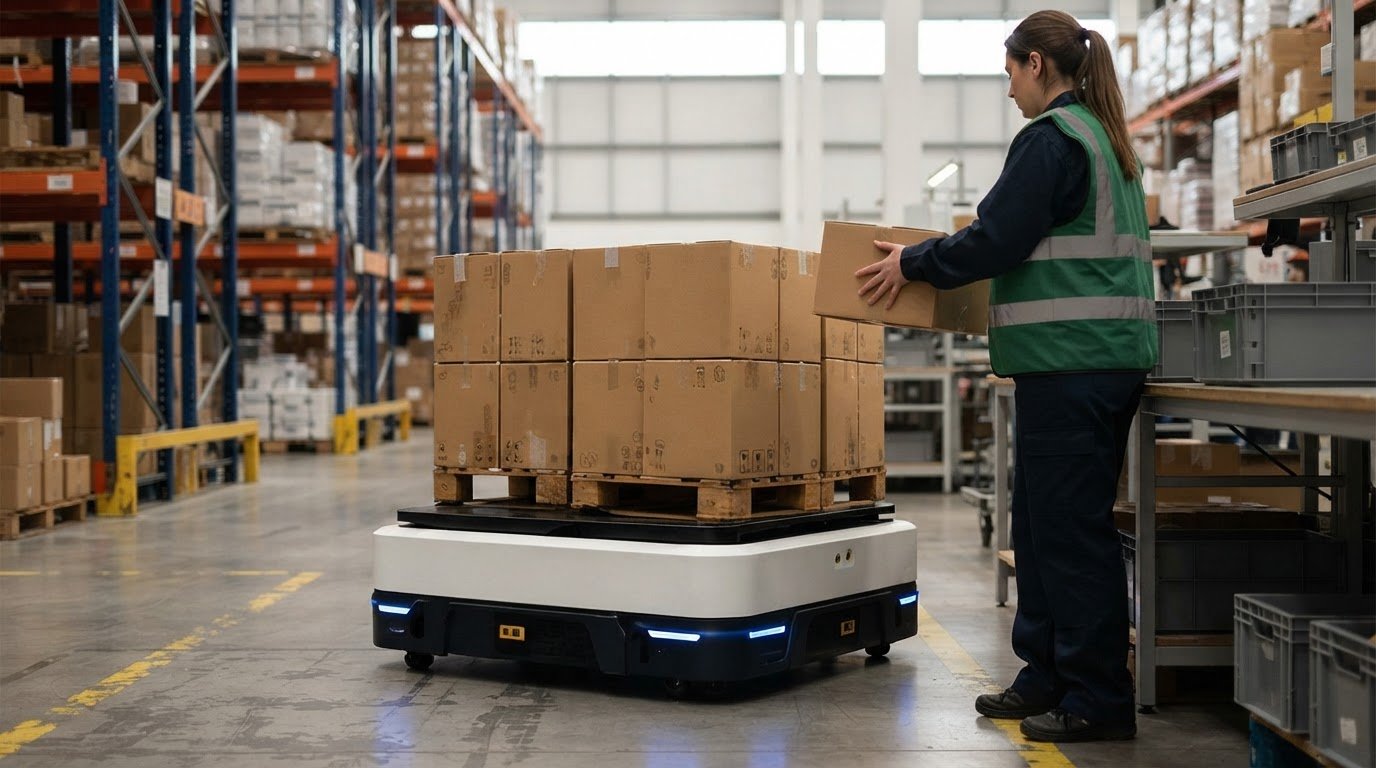
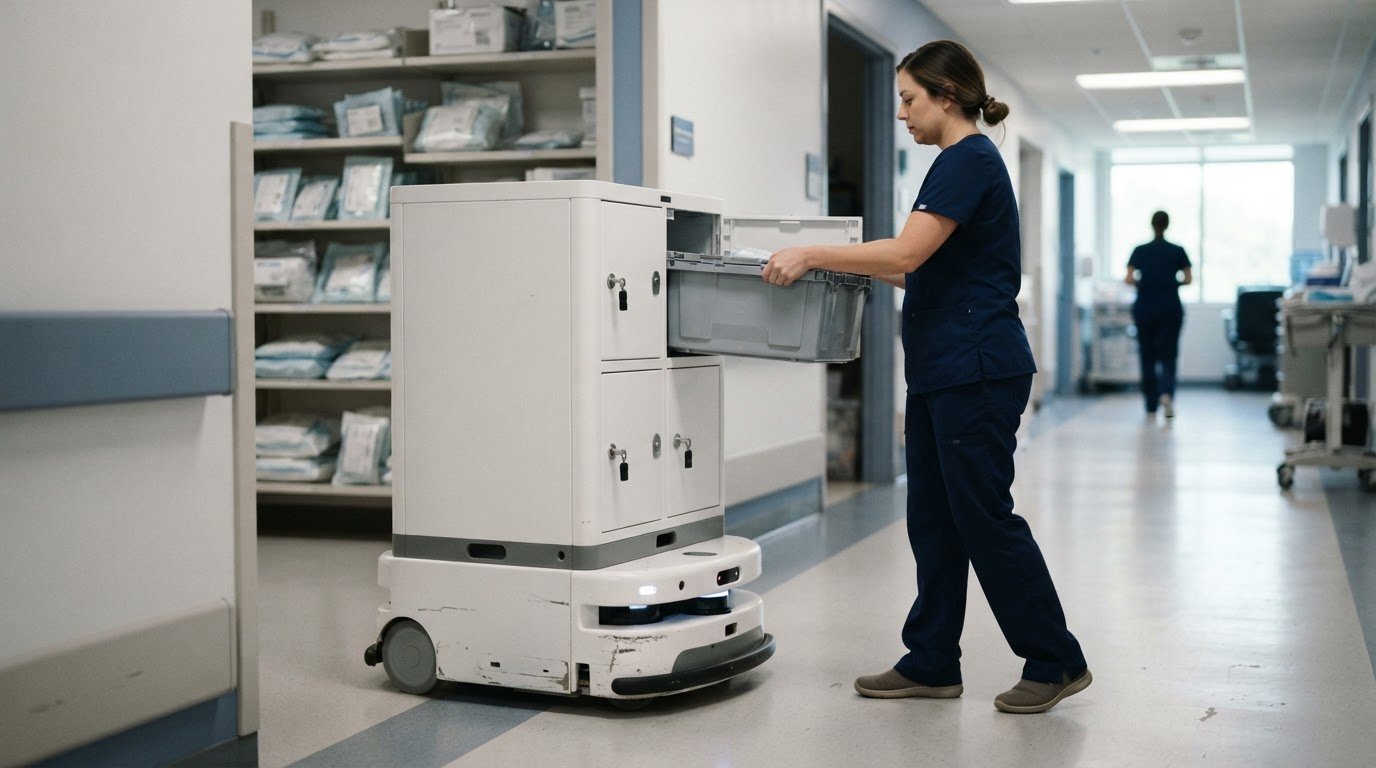
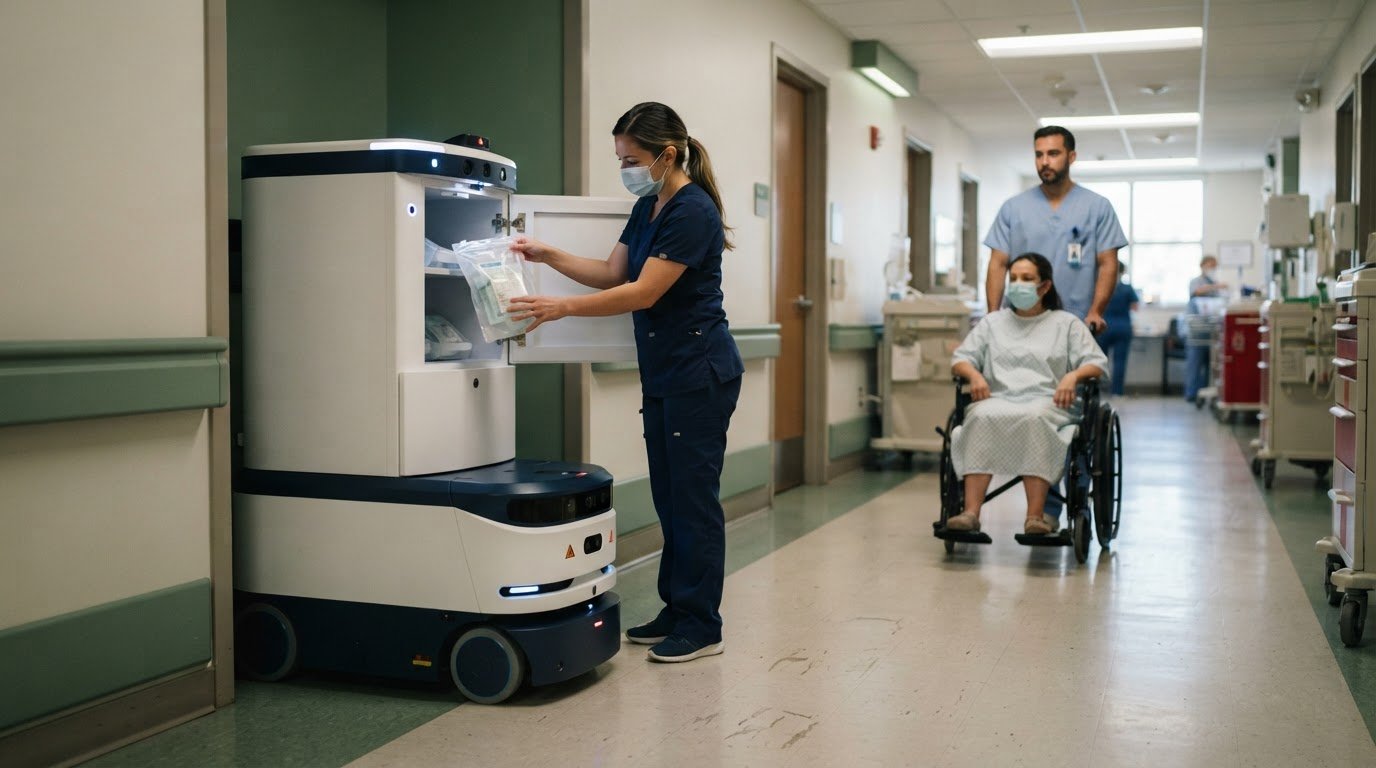
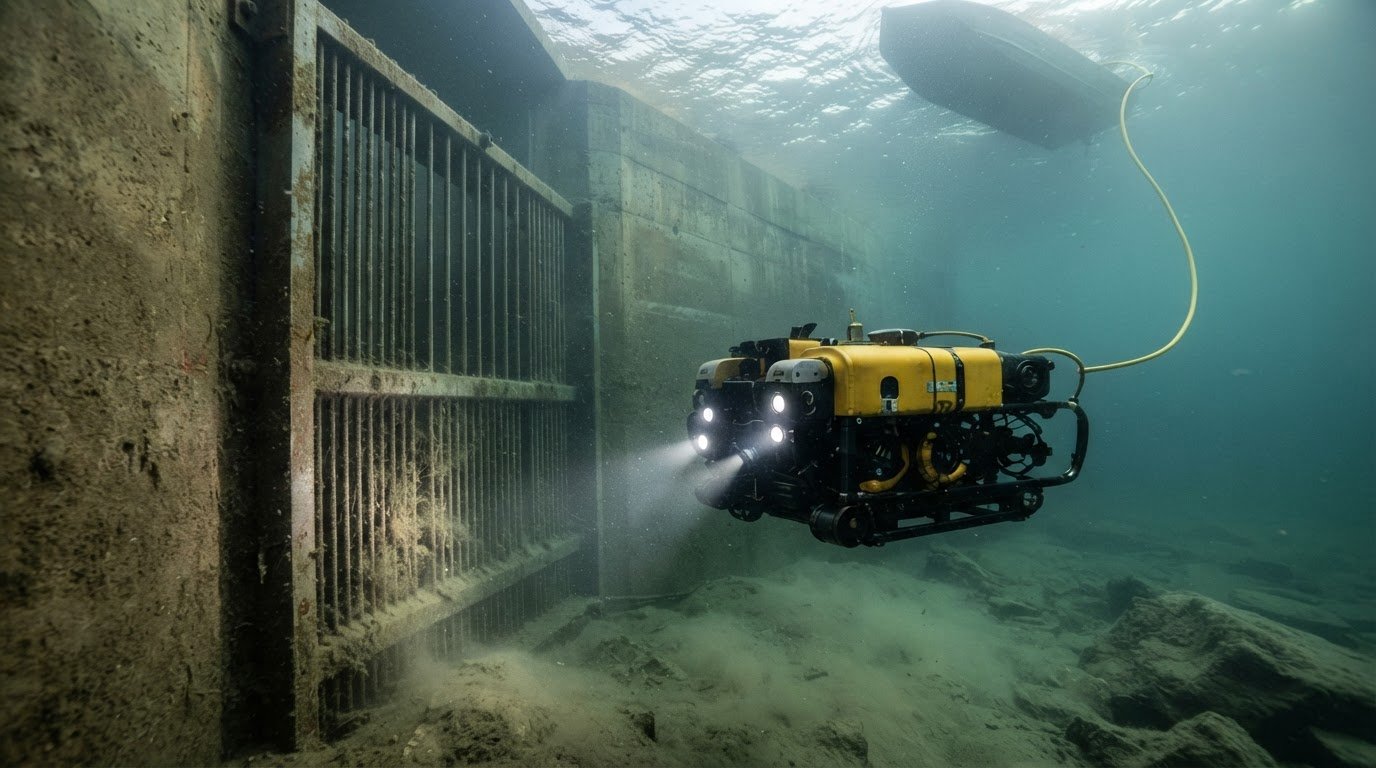
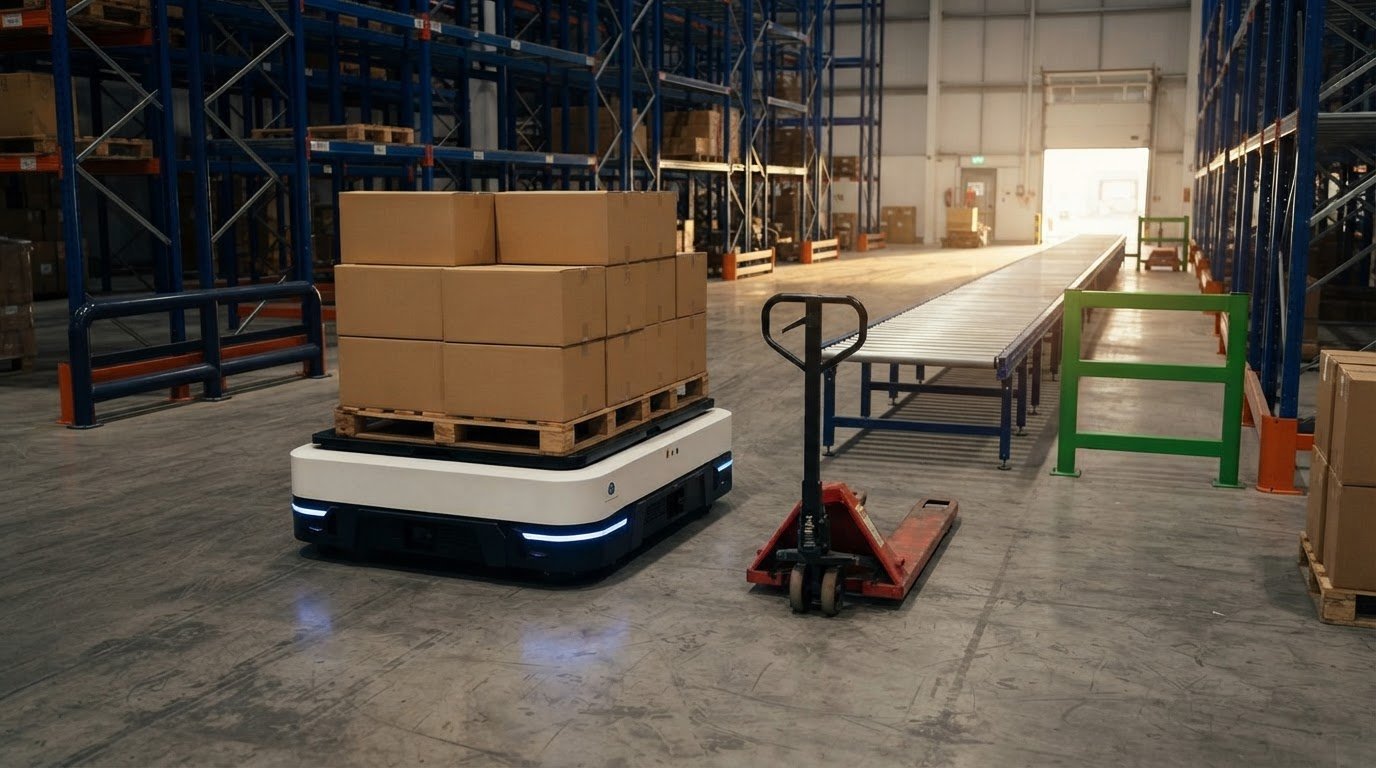
Applications span manufacturing, packaging, healthcare, and logistics. A robot can move components between production stations, handle packages on a line, or transport supplies within a healthcare facility. In logistics, automated guided vehicles (AGVs) follow configured routes, while autonomous mobile robots (AMRs) navigate dynamically and adapt to changing environments. Conveyors move material along fixed routes; robotic handling offers more adaptable pickup and placement.
Custom automation fits a specialized process or equipment layout. Turnkey systems suit operations seeking a coordinated solution, while collaborative robots are designed to work alongside people. Manufacturers can assess task variability, production flow, existing equipment, and worker interaction to decide what fits. Choose an option that resolves an operational constraint, rather than adding robotics without a clear process objective.
For facilities evaluating mobile material movement, AMR and AGV automation solutions are relevant when fixed routes or changing layouts shape transport needs. That distinction helps align vehicle selection with the way materials actually move through production and logistics.
Industrial Internet of Things and factory information systems
Connected factory systems link equipment, control systems, and production data. Their architecture shapes how operations monitor performance, respond to downtime, and coordinate continuous production.
Automated Manufacturing Systems
An automated manufacturing system coordinates machines and processes to produce goods with limited manual intervention. Factory sensors capture operating conditions, controllers direct equipment, and software manages production information. This connection helps teams see how a machine-level change affects the wider operation. For example, a line can combine machine data with production tracking to identify where work is slowing, instead of treating each machine as an isolated asset.
Layered Industrial Automation
Industrial automation uses control systems, sensors, robotics, drives, and software to run and monitor production processes. A layered architecture connects field devices and controls with supervisory systems, manufacturing execution systems (MES), and Industrial Internet of Things connectivity. The automation pyramid represents these connections, from machine-level control to production coordination and enterprise planning. Each layer has a distinct role, and reliable communication lets plant systems share operational information.
The International Electrotechnical Commission identifies IEC 61131 as a reference for programmable industrial controllers. At the plant level, ISA-95 describes how MES connects the factory floor with scheduling, work orders, and production tracking. This relationship helps translate production plans into work on the floor, then return status information to operations. Supervisory control and data acquisition (SCADA) systems add real-time monitoring, control, and data acquisition for industrial processes.
Choose cables according to movement and exposure. Robotic applications call for continuous-flex, torsion-resistant cables compatible with cable carriers. PLC connections may need protective shielding, reduced diameters, and compatibility with circular or rectangular connectors. SCADA cables may require TC-ER ratings, chemical resistance, and heat tolerance. CNC equipment benefits from cables resistant to abrasion and chips, with compatibility for motors and variable-frequency drives.
These physical and information connections shape system reliability. A sensor can report machine status, but useful monitoring depends on carrying its data through controls and software to the people managing production. Connecting field devices, SCADA, MES, and IIoT creates a clearer operational view and supports faster responses when production conditions change.
Industrial automation integration services
Integration connects sensors, controllers, machines, and software into a functioning production system. It can involve capturing machine data, sending it to an operations platform, and making it useful for production decisions. The key is fit: new technology must communicate with existing equipment and support a defined process objective.
Plan a project by defining the production problem, mapping current processes, selecting compatible equipment, connecting controls and data, then testing performance against the objective. For example, a machine-monitoring project can start with sensors on selected equipment, establish data flow, and expand when the results inform the next phase.
A staged approach can reduce disruption. Start with one process or machine, prove operational value, then scale without replacing existing systems. Sensor installation and data flow can be established in about 40 minutes; full sensor setups can be live within a day or two of receiving sensors. These timelines describe sensor setup, not the duration of an entire automation integration project.
Integration also connects a sensor, a programmable controller, and a computer or operations platform. A temperature sensor, for instance, may send readings through a controller to monitoring software. Teams can use the information to investigate changes in machine performance. Each connection needs a clear purpose, compatible interfaces, and a route for data to reach the people who use it.
Before expanding, assess whether the system captures useful information, whether operators can interpret it, and whether it supports the target production process. In a CNC operation, integration might connect machine status with production tracking, helping teams identify whether a delay stems from equipment or workflow. Linking data to operational decisions is the central value of integration.
For a production project involving CNC equipment, explore CNC and advanced manufacturing solutions as a relevant technology direction.
Defend Autonomous Robotics Trading: AMR & AGV Automation Solutions
Defend Autonomous Robotics Trading offers AMR & AGV Automation Solutions for operations assessing automated material movement. AGVs follow pre-programmed fixed paths, while AMRs navigate dynamically and adapt to changing environments. The distinction helps clarify which approach may better fit a facility’s routes, workflows, and changing production needs.
Consider these solutions when material transport is an automation priority or when evaluating mobile robotics alongside existing factory systems. For operations focused on machining rather than internal transport, CNC & advanced manufacturing solutions are also relevant. Matching the technology to the production objective keeps the next step practical and focused.
Contact Defend Autonomous Robotics Trading to discuss which automation solution fits your operational needs.
Set a Clear Direction for Your Next Automation Decision
Treat industrial manufacturing automation as an ongoing investment in operational capability, not a standalone equipment purchase. Choose a production priority, define how success will be assessed, and sequence changes around the systems and people already supporting the operation. This discipline keeps technology choices connected to business needs as processes evolve.
Defend Autonomous Robotics Trading offers AMR & AGV Automation Solutions, CNC & advanced manufacturing solutions, and an AI Coffee & Beverage Robot. These offerings address different automation needs, from material movement and manufacturing equipment to beverage preparation. A focused discussion can help identify the option that aligns with your priorities and a practical place to start.
Explore automation options with Defend Autonomous Robotics Trading and take the next step toward a more capable operation.
Frequently Asked Questions
What are the advantages and disadvantages of industrial automation?
Industrial automation can increase consistency, support higher throughput, and reduce workers’ exposure to repetitive or hazardous tasks. Tradeoffs include equipment investment, integration effort, maintenance, and new technical skill requirements. For example, automating a bottleneck may improve output while shifting the constraint to inspection or material supply. Assess the full production flow, not just the machine being automated.
How do PLCs, SCADA, MES, IIoT and FactoryOps fit together?
These systems connect machine control with production visibility and operational coordination. PLCs control equipment; SCADA supervises industrial processes; MES links production activity with work orders and tracking. IIoT connectivity can carry equipment data across systems, while FactoryOps describes an operations layer for using that information to coordinate decisions. For example, machine status can inform production planning when a line’s output changes.
What are the main types of industrial automation?
The main types are fixed, programmable, and flexible automation. Fixed automation suits stable, repetitive production, such as a dedicated assembly sequence. Programmable automation allows equipment instructions to change between product batches. Flexible automation supports product or task variation with less reconfiguration. The right category depends on product variety, changeover needs, and how often production requirements shift.
What is industrial manufacturing automation and how does it work?
Industrial manufacturing automation uses control technology and equipment to perform or monitor production work. A sensor can detect a part, a controller can process that input, and a machine can carry out the next operation. Software coordinates instructions and records relevant production information. This approach suits repeatable tasks, but its design must reflect the process, product, and operating environment.
What are the main types of industrial automation systems?
Industrial automation systems can be grouped by the scale of work they control: individual machines, coordinated production cells or lines, and plant-wide operations. A machine-level system may control one CNC operation, while a line system coordinates several production steps. Plant-wide systems connect information across areas. This distinction helps teams define project boundaries and identify which equipment and workflows need to communicate.
What technologies are used in manufacturing automation, including robotics, PLCs, and AI?
Manufacturing automation can combine industrial robots, programmable logic controllers, sensors, machine vision, drives, and production software. Robots perform physical tasks, PLCs execute control logic, and sensors provide machine or product inputs. AI and machine learning can analyze production data for patterns or anomalies. For instance, vision software can inspect a component while a robot handles it, linking inspection to a production action.