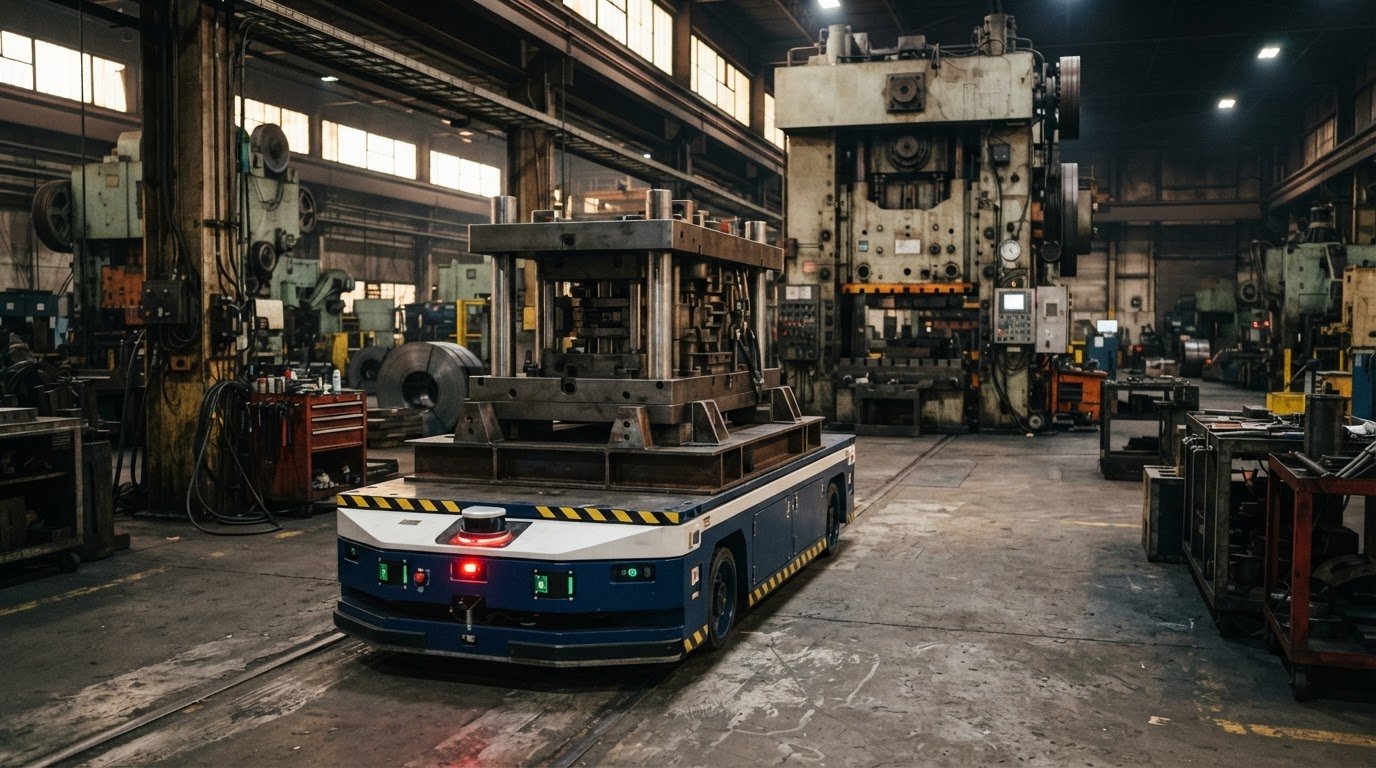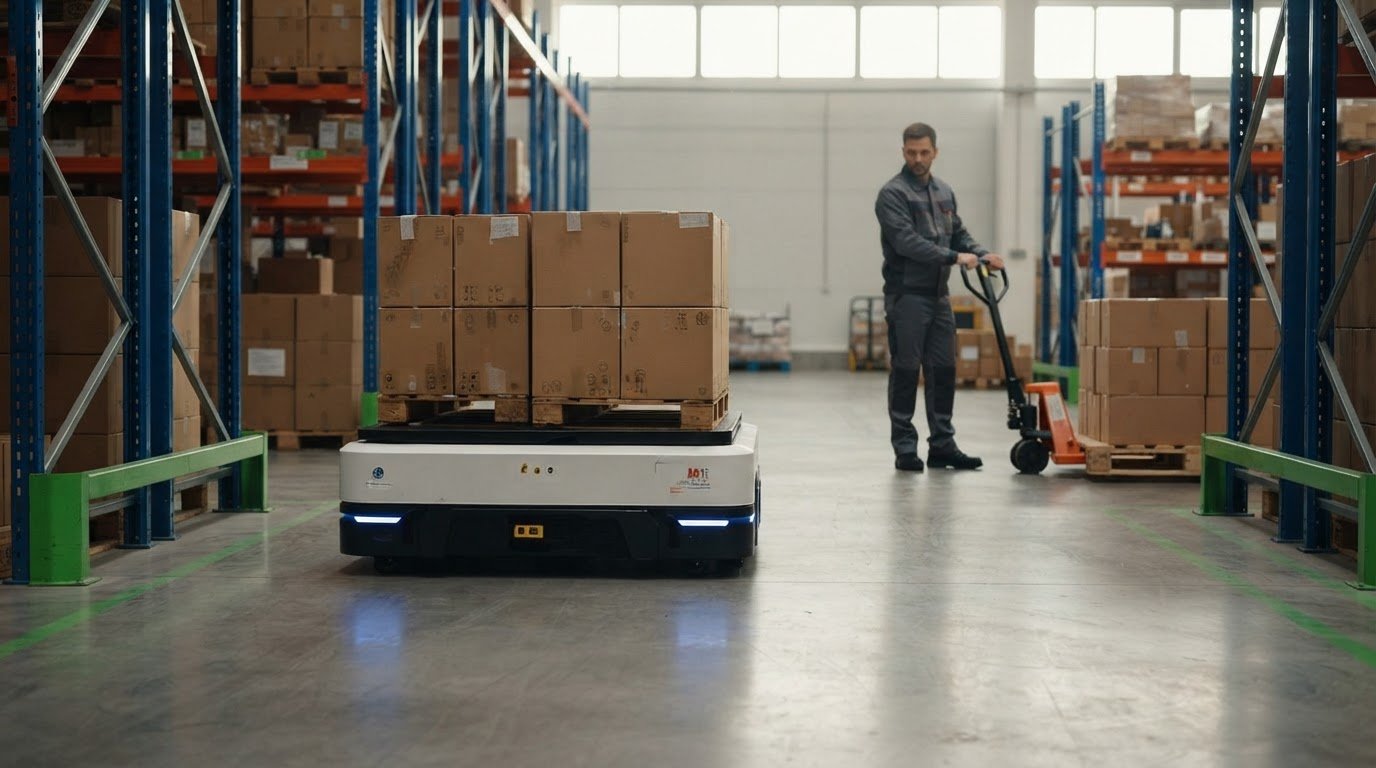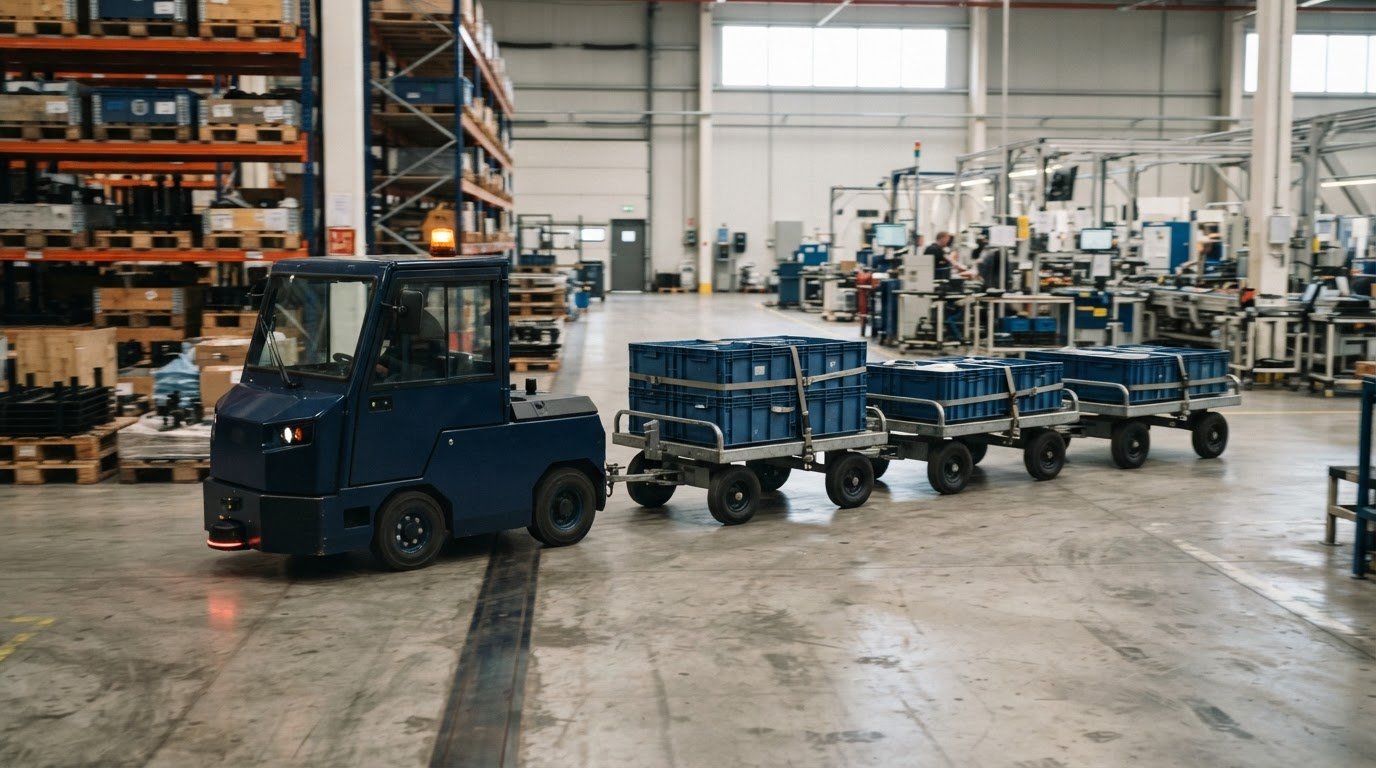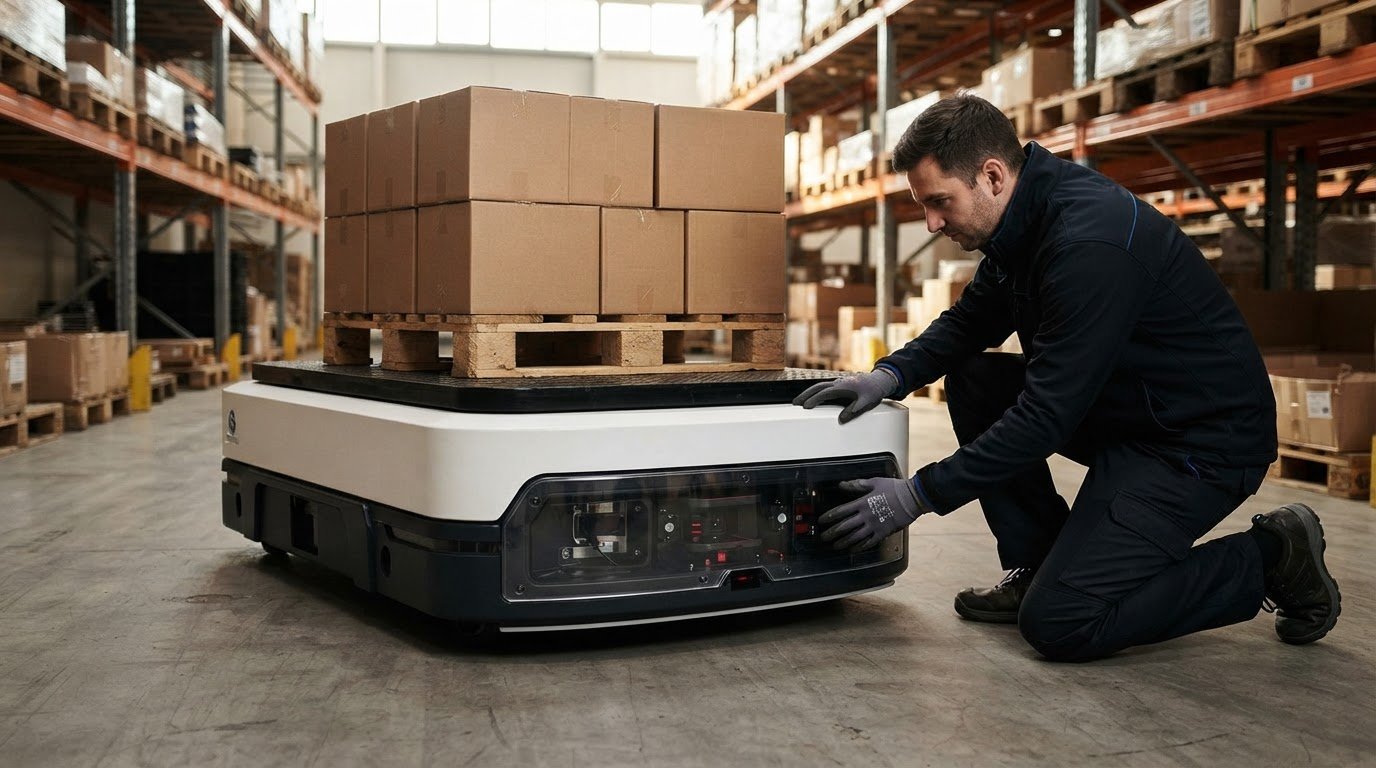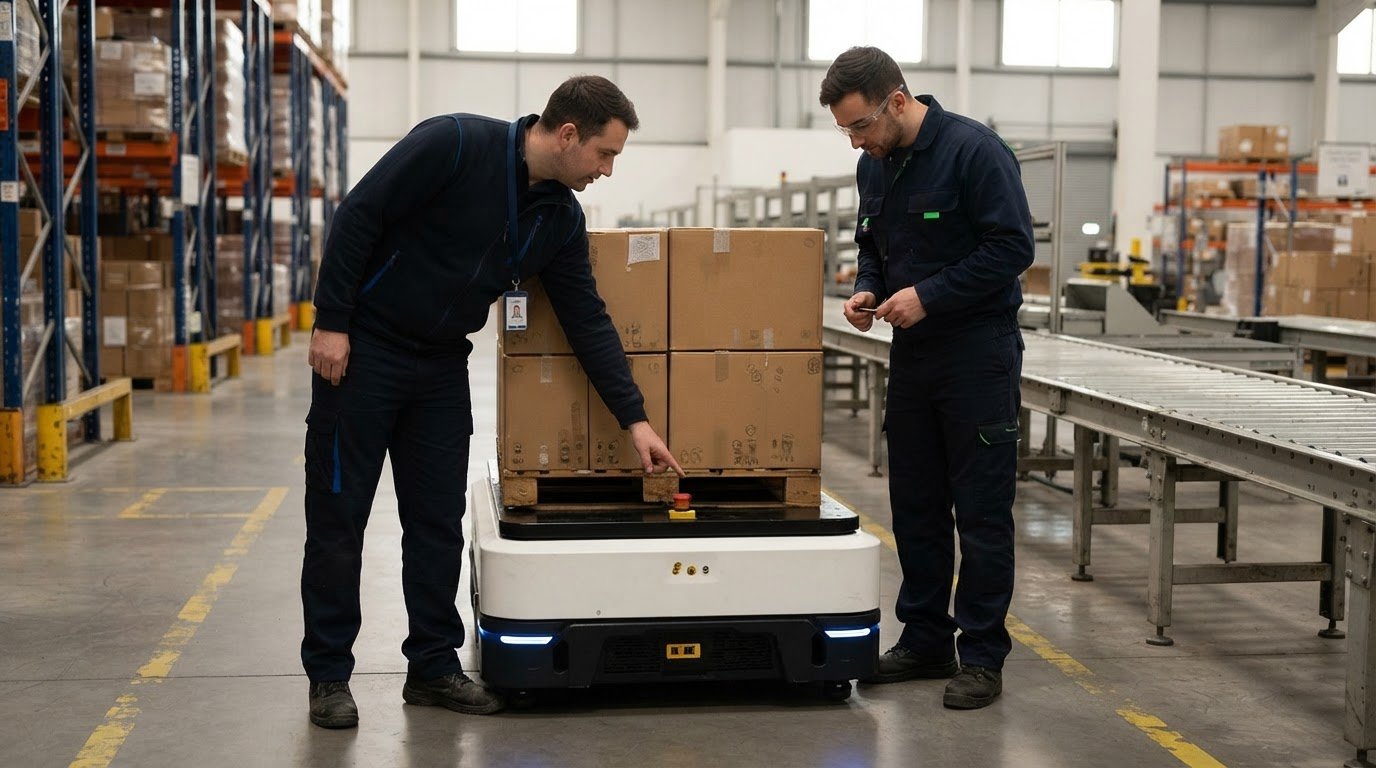
A shared interface can coordinate a mixed robot fleet without replacing each vehicle’s own control system. VDA 5050 protocol compliance for mixed robotics fleets means using a common communication framework between mobile robots and fleet management systems; the standard defines six message types, while each robot retains its own navigation and internal logic.
That distinction matters. A manufacturer’s API can expose functions specific to its robot, while VDA 5050 creates a common language for exchanging tasks and status across compatible vehicles and fleet software. It supports coordination across vendors, but it doesn’t make different robots operationally identical or decide how they move.
This guide explains what VDA 5050 does, how its interface differs from a maker’s API, and how it can support mixed-vendor coordination. It also examines the trade-offs between central and distributed approaches, so you can understand which operating model better fits your workflows, routes, and existing infrastructure.
Key Takeaways
- Separate the shared fleet communication layer from each robot maker’s API to see what interoperability can, and cannot, standardize.
- Use common status and task exchanges to coordinate different vendors while accounting for each vehicle’s capabilities.
- Choose centralized or distributed coordination according to workflow variability, route predictability, and existing infrastructure.
- Align fleet software and vehicles on a compatible VDA 5050 major version before planning deployment.
What is the difference between VDA 5050 and a maker’s own robot API?
VDA 5050 standardizes communication between mobile robots and fleet management systems; a maker’s API can expose controls specific to its robot. The distinction shapes how software coordinates tasks, traffic, and information across vendors.
Robot Communication Through Fleet Interfaces
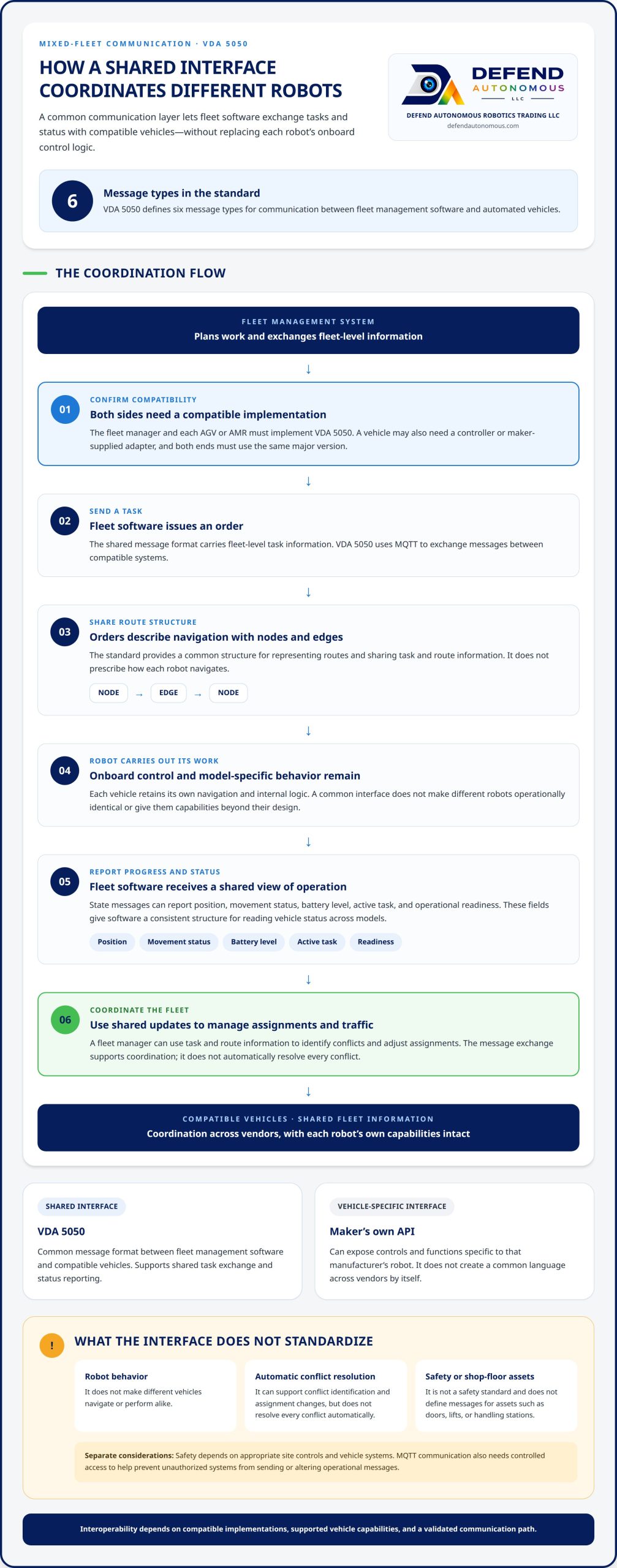
VDA 5050 is a shared message format for communication between fleet management software and automated vehicles. Its six message types support task exchange and status reporting, while a maker’s own API may use manufacturer-specific commands.
The VDA and VDMA Materials Handling and Intralogistics Association jointly coordinate the German-origin project. VDA 5050 uses MQTT to exchange messages, giving compatible systems a common communication channel without replacing each vehicle’s onboard control logic.
Traffic, Routes, and Conflict Resolution
Traffic coordination uses shared task and route information to help a central fleet manager assign work and manage vehicle movement. VDA 5050 navigation represents routes as nodes and edges, creating a common structure for orders.
A fleet manager can issue an order and receive vehicle progress and status updates. This exchange helps software identify route conflicts and adjust assignments, but it does not standardize each robot’s navigation or resolve every conflict automatically. That distinction matters when different vehicles share operating areas.
Support Across Makers and Fleet Managers
Interoperability requires VDA 5050 implementation on both sides: the fleet manager and each AGV or AMR. A vehicle also needs a controller or maker-supplied adapter, and both ends must use the same major version.
For M4 fleet management and third-party vehicles, the decisive question is whether the fleet software and vehicle implement compatible VDA 5050 versions. The standard alone doesn’t establish that a particular M4 setup supports every third-party robot; compatibility depends on those implementations.
Integration Requirements and Conformance
The current published specification is VDA 5050 version 3.0.0, released on 18 March 2026; version 2.1.0 was released on 19 August 2024. MQTT carries messages, but the specification facts here establish no separate broker sizing requirement. In the United States, the relevant adoption decision is technical compatibility, not a named legal mandate.
Integration costs and timelines depend on vehicle adapters, fleet software, and testing scope. Conformance work can test message exchange and version compatibility; no specific certification or plugfest option is established here. Select the newest major version all planned vehicles can run, then validate the complete communication path.
VDA5050 as a manufacturer-independent interface for mixed robot fleets
VDA 5050 gives fleet management software a common interface for coordinating vehicles from different manufacturers. Its value depends on compatible implementations and clear interpretation of each vehicle’s reported capabilities.
A Vendor-Neutral Fleet Interface
VDA 5050 is a shared communication interface intended to reduce manufacturer-specific integration between mobile robots and fleet management systems. For intralogistics teams, that can simplify coordination when a facility combines vehicles from different manufacturers.
It standardizes how vehicles and fleet software exchange operational information, not every function or behavior. A manufacturer can retain model-specific controls while exposing shared fleet data through the interface. This division helps preserve existing vehicle capabilities without requiring every robot to operate identically.
Interoperability Across Brands and Vehicle Types
Interoperability means compatible AGV and AMR models can exchange fleet-level orders and status information in a common format. A mixed fleet may include vehicles with different material-handling roles, while a fleet manager reads their shared status messages through one interface.
Compatibility still depends on each implementation and its supported capabilities. A shared format cannot make a vehicle perform tasks outside its design or ensure every model handles routes and loads alike. Integration planning must account for these differences when assigning work and coordinating traffic.
Interpreting Data Across Robot Models
Standardized data gives fleet management a consistent structure for reading vehicle status, while each model reports information about its own operation. For example, state messages can report position, movement status, battery level, active task, and operational readiness.
These fields help software compare operational status across models, but they do not erase differences in vehicle capability. A reported battery level does not promise equal range, and readiness does not mean every robot can perform the same task. The interface supports coordination; fleet logic must still account for each vehicle’s role.
Interoperability Limits and Risk Considerations
VDA 5050 supports vehicle coordination, but it is not a safety standard and doesn’t define commands and status messages for shop-floor assets such as doors, lifts, or handling stations. ISO 21423:2026 addresses communications and interoperability for industrial mobile robots, but likewise does not define those asset messages.
Safety depends on appropriate site controls and vehicle systems, not the interface alone. Security matters too: MQTT communication needs controlled access to prevent unauthorized systems from sending or altering operational messages. Treat shared data as a coordination layer, and manage safety and access protections separately.
Central or distributed coordination?
Coordination topology determines where fleet decisions happen and how vehicles share work. Choose an approach based on workflow variability, route patterns, and existing logistics infrastructure.
Fleet Control Topology and Master Selection
A central fleet manager assigns tasks and coordinates vehicles, while distributed control places more decisions within vehicle systems. Central coordination often suits standardized automotive or intralogistics operations with predictable routes, routine work, and shared traffic zones.
Select the master controller by assessing workflow variability, operational standardization, and existing infrastructure. The VDA and VDMA jointly coordinate the VDA 5050 project, giving protocol evolution an industry framework. Each release can affect compatibility, so align the controller’s supported version with the fleet’s vehicles.
Command-Based Mission Control
With command-based control, the fleet manager assigns missions and vehicles execute them while reporting progress. An order can specify a destination, movement sequence, priority, and execution flow, enabling central software to coordinate material movement across compatible robots.
For example, a logistics controller can assign a transport task and track its progress through vehicle messages. Instant actions can pause or resume movement, send a robot to charge, or cancel or modify a task. This approach suits operations where a central system needs a clear view of assignments.
Vehicles Outside VDA 5050 Control
A vehicle outside VDA 5050 control cannot exchange fleet commands through that interface unless a compatible controller or maker-supplied adapter connects it. Its position and task status may therefore remain outside the shared coordination loop.
That gap matters in shared aisles: a central fleet manager cannot coordinate traffic using information it doesn’t receive. Integration must account for the vehicle’s separate control path and how its movements affect VDA 5050 traffic. The protocol itself does not make a non-compatible vehicle interoperable.
Mixed-Fleet Integration and Validation
Planning VDA 5050 protocol compliance for mixed robotics fleets starts by mapping workflows, routes, infrastructure, and each vehicle’s capabilities. Then select the newest VDA 5050 major version that all planned vehicles can run, and confirm support in writing.
Next, connect compatible vehicles and fleet software, then test task assignment, status reporting, and route coordination in the intended operating environment. For VDA 5050 protocol compliance for mixed robotics fleets, assess whether reported position and progress support the required logistics flow. Evaluate workflow variability and shared traffic zones before choosing centralized or distributed control, and validate separately how vehicles outside the interface are handled.
VDA 5050’s role in mixed-vendor robot fleets
VDA 5050 gives compatible mobile robots and fleet software a shared coordination layer. Its value is not identical movement; it is more consistent task, state, and traffic exchange across autonomous vehicles.
That distinction matters in material transport. One vendor’s robot may move loads differently from another’s, yet a common interface can help fleet software coordinate assignments. VDA 5050 supports communication between vehicles and fleet management without taking over each robot’s navigation or internal logic. The result is a clearer division: the manager coordinates fleet activity, while each vehicle handles its own motion.
Navigation features can support this coordination. In VDA 5050, a route graph uses nodes and edges, while released nodes and edges are reserved exclusively for a robot. Farther-away horizon waypoints can be adjusted dynamically, helping the fleet manager consider traffic and coordinate multiple vehicles before they reach a shared area.
Version 3.0.0, released on 18 March 2026, added support for freely navigating mobile robots, planned path sharing, and a zone concept. Those additions extend the interface beyond fixed route execution. For example, planned path sharing can give fleet coordination software visibility into intended movement, while zones provide a way to represent areas relevant to free navigation.
The practical takeaway: VDA 5050 enables shared coordination, not universal vehicle equivalence. A fleet manager still needs to interpret vehicle capabilities, task requirements, and traffic conditions. A robot that reports its status through the standard does not automatically gain another model’s transport capacity or navigation behavior. This boundary is essential when designing mixed-vendor workflows and assigning work across different vehicles.
For operations planning around mixed-fleet transport coordination, align interface capabilities with the actual routes, tasks, and traffic patterns your facility needs to manage.
Defend Autonomous Robotics Trading LLC
Defend Autonomous Robotics Trading LLC helps organizations assess automation needs and align robotics solutions with operational requirements. For teams considering mixed-vendor coordination, its AMR & AGV Automation Solutions and warehouse autonomous systems offer relevant options for evaluating mobile-robot deployments alongside fleet workflows.
Turn to the company when planning a new automation project or assessing how autonomous vehicles could support material movement. The right configuration depends on task requirements, facility routes, existing systems, and how fleet coordination will work in practice. These considerations help connect the VDA 5050 interface discussion to the broader design of an operational robotics environment.
Contact Defend Autonomous Robotics Trading LLC to discuss your automation requirements.
Build the Next Stage of Fleet Coordination
Use your interoperability strategy as a design decision, not just a software choice. Map the operating priorities that matter most, then align vehicle capabilities, coordination methods, and integration planning around them. This gives engineering and operations teams a practical basis for progressing VDA 5050 protocol compliance for mixed robotics fleets.
Defend Autonomous Robotics Trading LLC offers AMR & AGV Automation Solutions, AI Coffee & Beverage Robots, and CNC & advanced manufacturing solutions, reflecting its wider focus on robotics and automation across different operational contexts. If you’re assessing a deployment or refining an automation plan, connect fleet requirements with the wider system design. Contact Defend Autonomous to discuss your automation needs.
Contact Defend Autonomous Robotics Trading LLC to discuss your automation requirements and define a clear next step. Make coordination a deliberate part of your operation’s future.
Frequently Asked Questions
What is VDA 5050?
VDA 5050 is a communication specification for coordinating automated mobile robots and fleet management systems. It gives compatible equipment a shared way to exchange operational messages, supporting fleet-level coordination across different vehicle models. For example, a facility can use its fleet software to manage work assignments across compatible robots without replacing each vehicle’s onboard control system.
Can one fleet manager run trucks from different makers?
Yes, one fleet manager can coordinate vehicles from different makers when the manager and vehicles support compatible VDA 5050 implementations and the same major version. For example, a warehouse might assign transport tasks to compatible vehicles from separate manufacturers. Their individual capabilities still matter: the fleet manager must assign work each vehicle can perform, rather than treating all trucks as interchangeable.
Is VDA 5050 a German-only standard?
No. VDA 5050 originated in Germany’s automotive and intralogistics industries, but its purpose is manufacturer-independent communication for mobile robot fleets. Its origin does not restrict its use to German facilities. An operation elsewhere can consider the interface when its vehicles and fleet management software support compatible implementations and the standard fits its coordination requirements.
Is VDA 5050 only for AGVs on fixed paths?
No. VDA 5050 version 3.0.0 added support for freely navigating mobile robots, planned path sharing, and a zone concept. This extends its relevance beyond vehicles following fixed paths. A facility evaluating autonomous robots should consider the supported version and the vehicle’s navigation capabilities, since the interface coordinates communication but does not determine how each robot navigates.
What does it cover, in general?
In general, VDA 5050 defines how mobile vehicles and fleet management systems exchange information for coordinated operations. It provides a common structure for conveying tasks and operational status, helping software work across compatible robot implementations. It does not standardize every vehicle function, replace maker-specific controls, or define safety behavior, so those areas remain part of the wider system design.
What does it cover, specifically?
Specifically, VDA 5050 messages can carry mission assignments, destinations, movement sequences, priorities, and execution flow. Instant actions provide a way to send operational requests to a vehicle, though the available actions depend on its implementation. Error messages can report conditions such as blocked paths, obstacles, low battery warnings, or emergency-stop events, giving fleet software operational context for coordination.