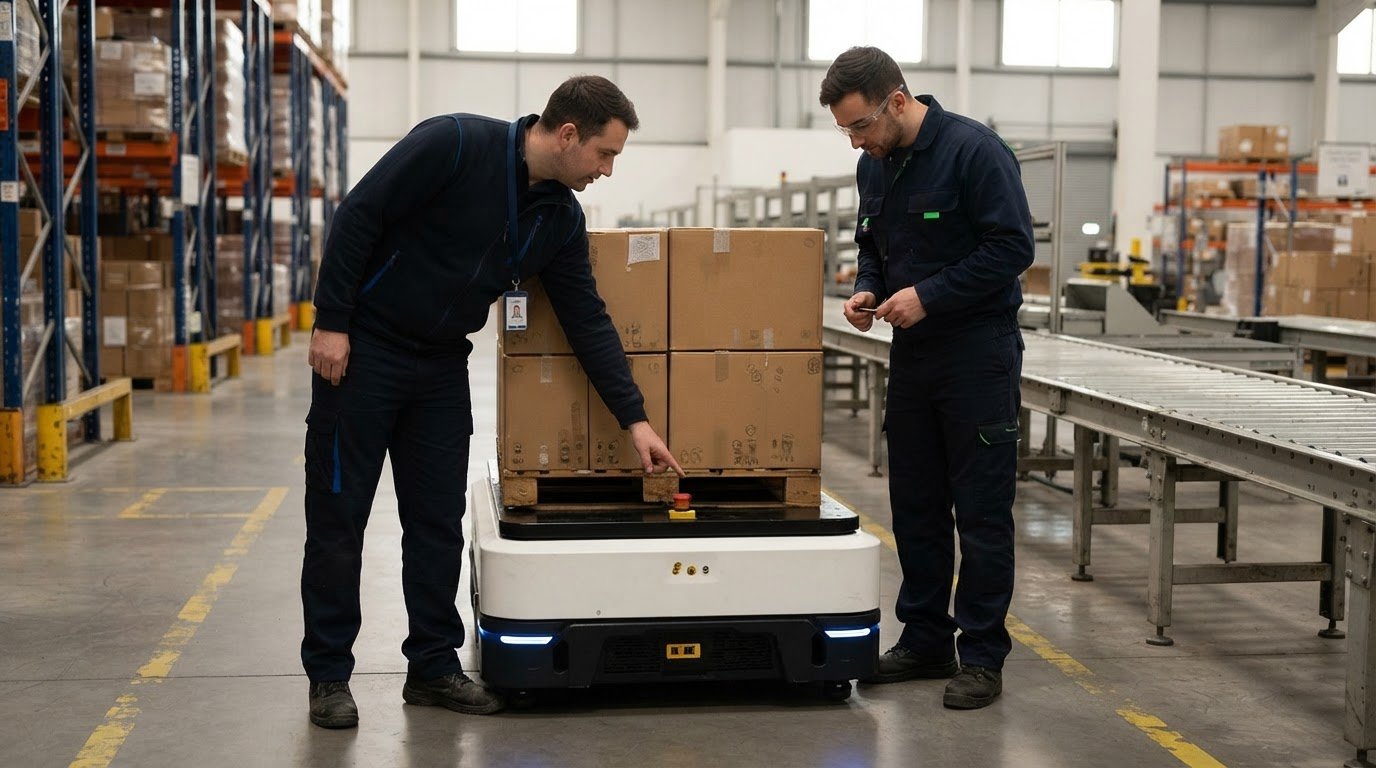
A 1,500 kg payload-rated AMR can move an industrial die within that capacity; the EMMA 1500L has a rated payload of 1,500 kg. Heavy payload AMR integration for 1500kg industrial dies involves more than matching a vehicle rating to a load. The die’s support and transfer points, route conditions, traffic flow, and safety controls all shape the system design.
Choosing between an AMR and a forklift depends on how dies move through the facility, how often they travel, and how transport fits into production. This article explains payload capacity in practice, compares AMRs with forklifts, and covers the route, throughput, and safety factors that shape die handling. It also shows how integration planning coordinates the load, vehicle, and workflow.
Key Takeaways
- Assess the die, its support points, and transfer method together to determine whether an AMR can handle the full transport task.
- Compare AMRs and forklifts against your facility’s traffic patterns, workflow, and need for repeatable movement.
- Map routes and production handoffs to identify the constraints that shape transport flow and throughput.
- Plan safety controls and load sensing around the payload and operating environment to support controlled die movement.
What Can AMR Material Handling Robots Actually Move?
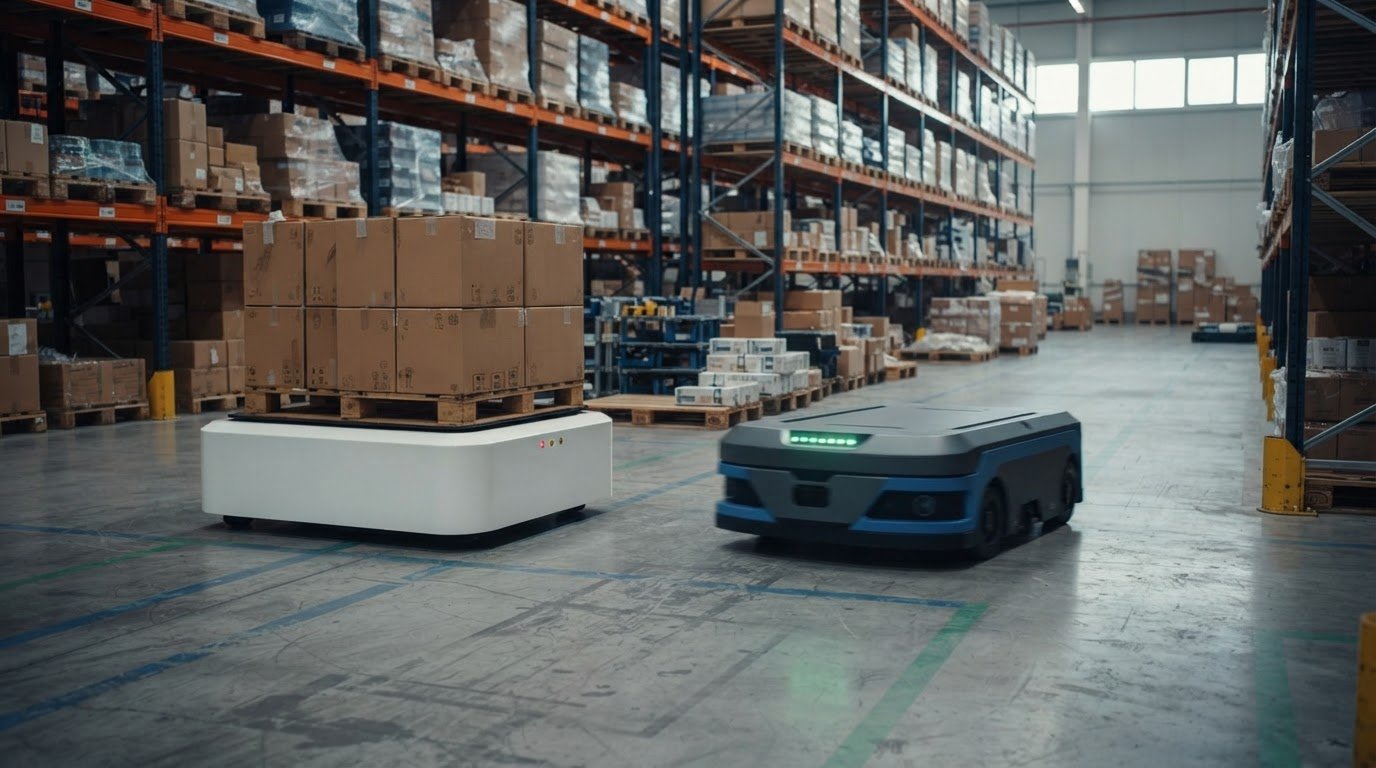
An AMR’s payload rating is one starting point for assessing industrial transport. The EMMA 1500L AMR has a rated payload capacity of 1,500 kg. That rating alone doesn’t establish whether a particular die can be transported safely; load shape, support points, and transfer conditions also matter.
Payload capacity, deck dimensions, and center-of-gravity limits must suit the die and its transport supports. For a 1,500 kg die, integration planning accounts for the complete load, including any pallet or fixture, and verifies how its weight is distributed across the AMR’s load surface.
Industrial material transport can move dies between storage, staging areas, and presses. A mobile robot can also carry components between manufacturing cells or replenish a production line from a warehouse. Each task has distinct load geometry, pickup arrangements, and drop-off requirements.
Assess each AMR model against the specific load application rather than choosing by series name alone. Key details include payload rating, deck dimensions, and positioning accuracy. For example, a die mounted on a custom fixture needs a compatible support surface and a repeatable transfer point.
An integrator coordinates AMRs with presses, conveyors, elevators, doors, and warehouse management systems by aligning transfer points, route requests, and equipment signals. The process maps each handoff, defines how equipment communicates, and tests the complete material flow in operating conditions.
In manufacturing, autonomous mobile robots can support repeatable movement between production steps, while warehouse applications focus on moving stored material to defined destinations. Heavy payload AMR integration for 1500kg industrial dies therefore depends on matching the AMR and load interface to the facility’s actual process. Clear route and handoff design turns a vehicle’s rated capacity into a practical transport application.
A 2025 Advanced Manufacturing Outlook survey found that 66% of manufacturers planned to invest in robotics and automation. That interest places mobile transport within a wider push to automate manufacturing work, while each material-handling project still needs to be evaluated against its particular loads, handoffs, and operating conditions.
AMRs compared with forklifts and other material-handling systems
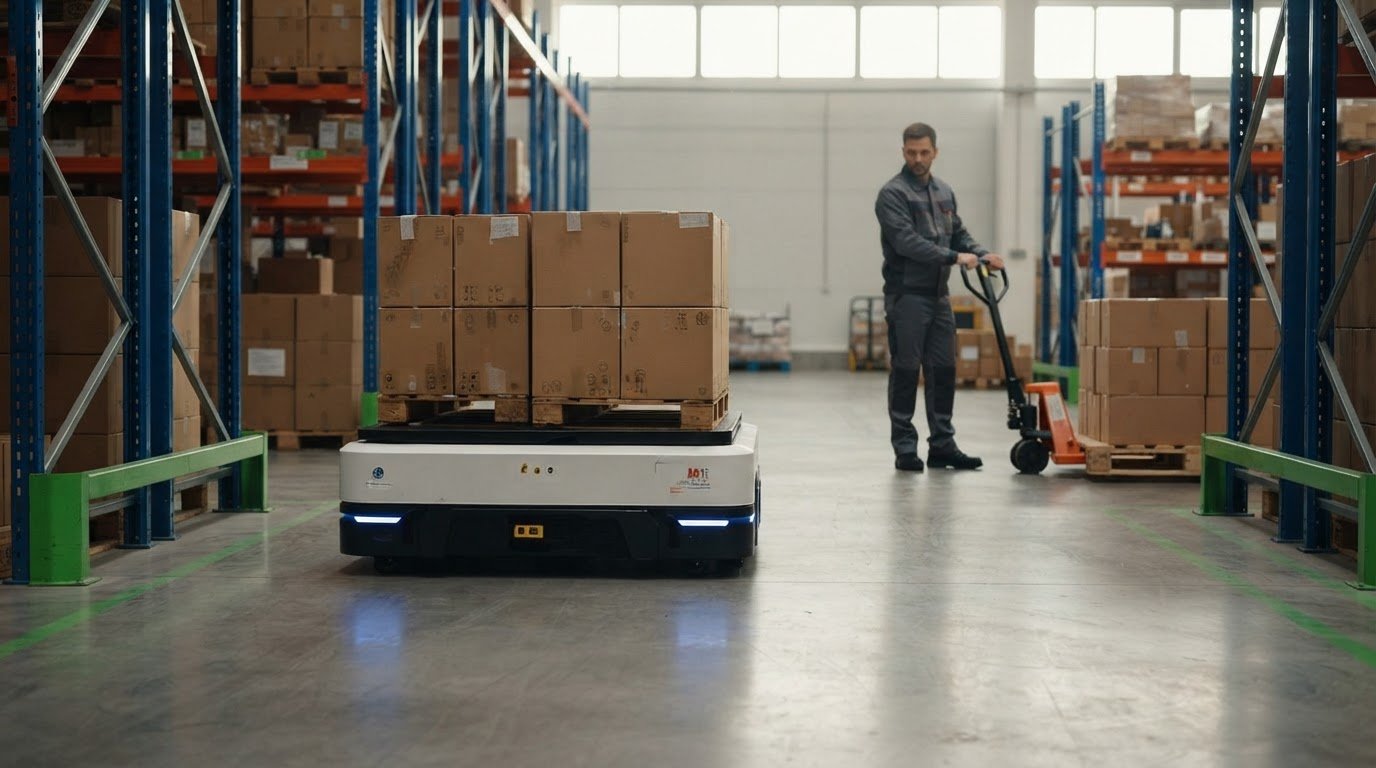
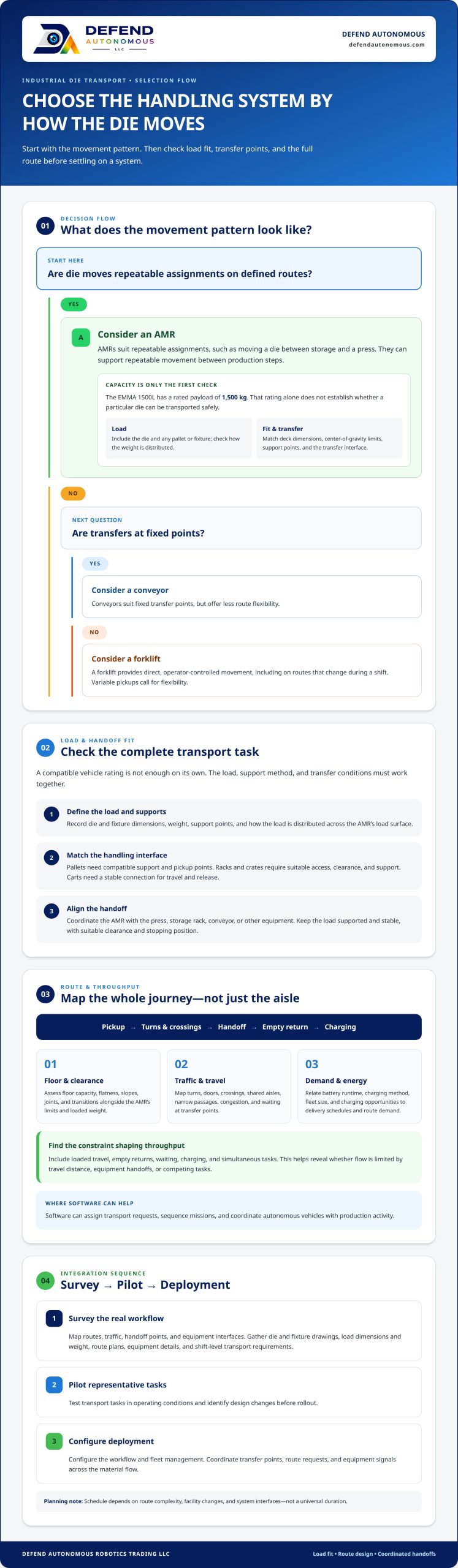
A forklift provides direct, operator-controlled movement between locations, including along routes that change during a shift. An AMR is suited to repeatable assignments, such as moving a die between storage and a press. The right choice depends on the task: variable pickups call for flexibility, while recurring routes can support automation and fleet management. Conveyors suit fixed transfer points but offer less route flexibility.
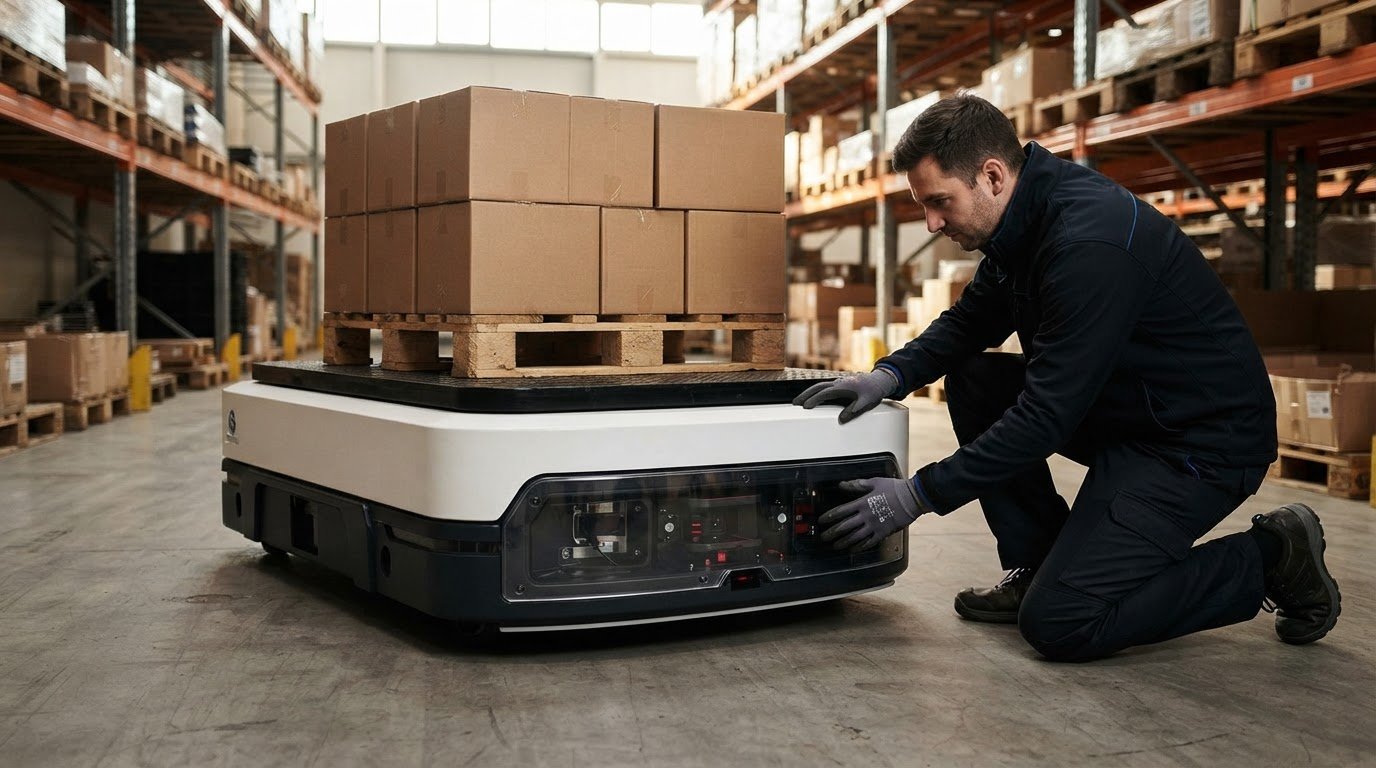
For a 1,500 kg die transfer, the integrator defines a compatible support interface, aligns the AMR with the press or storage rack, and coordinates the handoff. The transfer design must keep the load supported and stable throughout movement, with the fixture, clearance, and stopping position suited to the equipment.
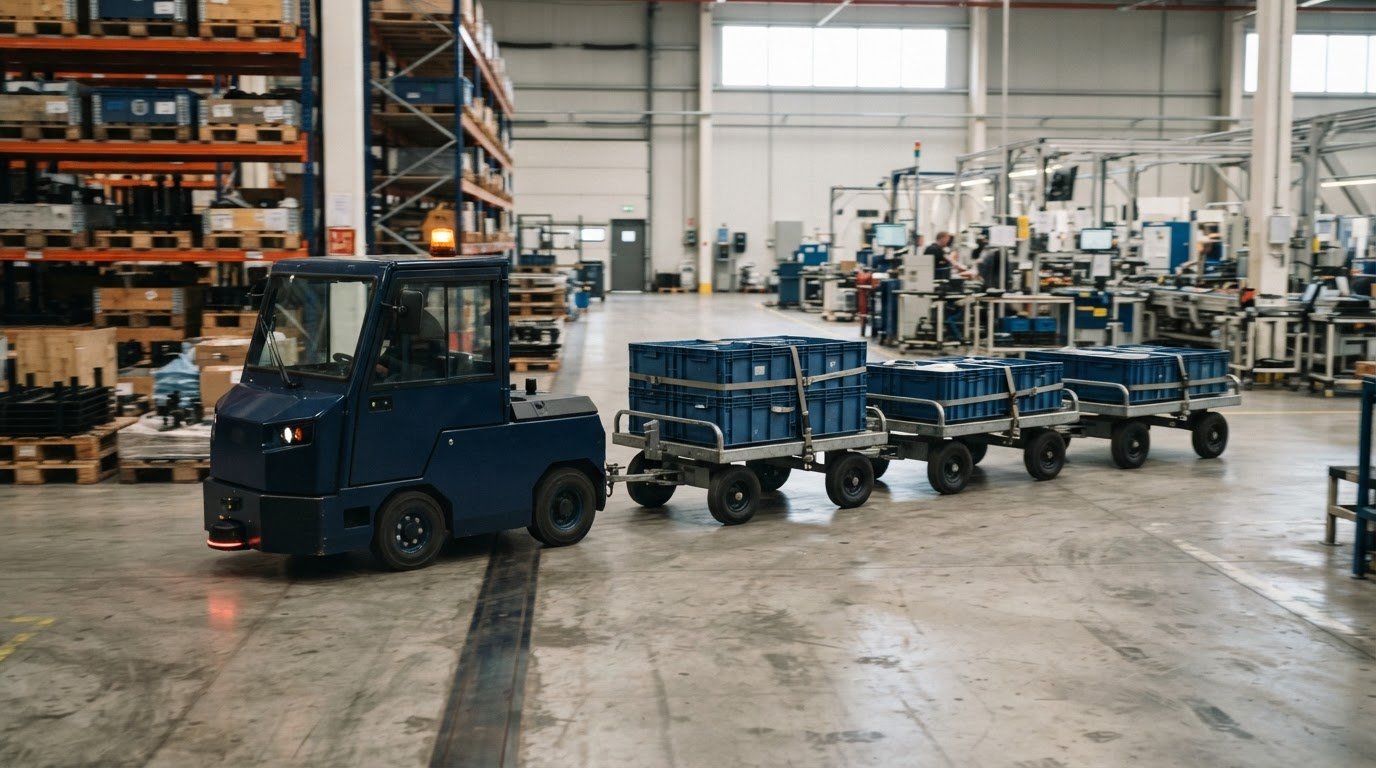
Pallets, containers, racks, crates, and carts each create different handling requirements. A pallet may provide a standard base, while a crate can enclose components and restrict access. Rack transfers need clear insertion and withdrawal paths, and a trolley must connect securely to the AMR before travel. These factors shape interface design, positioning accuracy, and movement around production equipment.
- Pallets: Confirm support and pickup points match the AMR interface.
- Racks and crates: Account for access, clearance, and the load’s support.
- Carts: Define a stable connection for travel and release.
A professional survey, pilot, and deployment follow a staged process. First, the integrator maps routes, handoff points, traffic, and equipment interfaces. A pilot then tests representative transport tasks and identifies design changes. Deployment configures the workflow and fleet management. The schedule depends on route complexity, facility changes, and system interfaces, not a universal duration.
Useful inputs include die and fixture drawings, load dimensions and weight, pickup and drop-off points, route plans, press or conveyor details, and shift-level transport requirements. These details help connect AMR and AGV automation solutions to the actual material-handling task.
Heavy-pallet transport routes and throughput
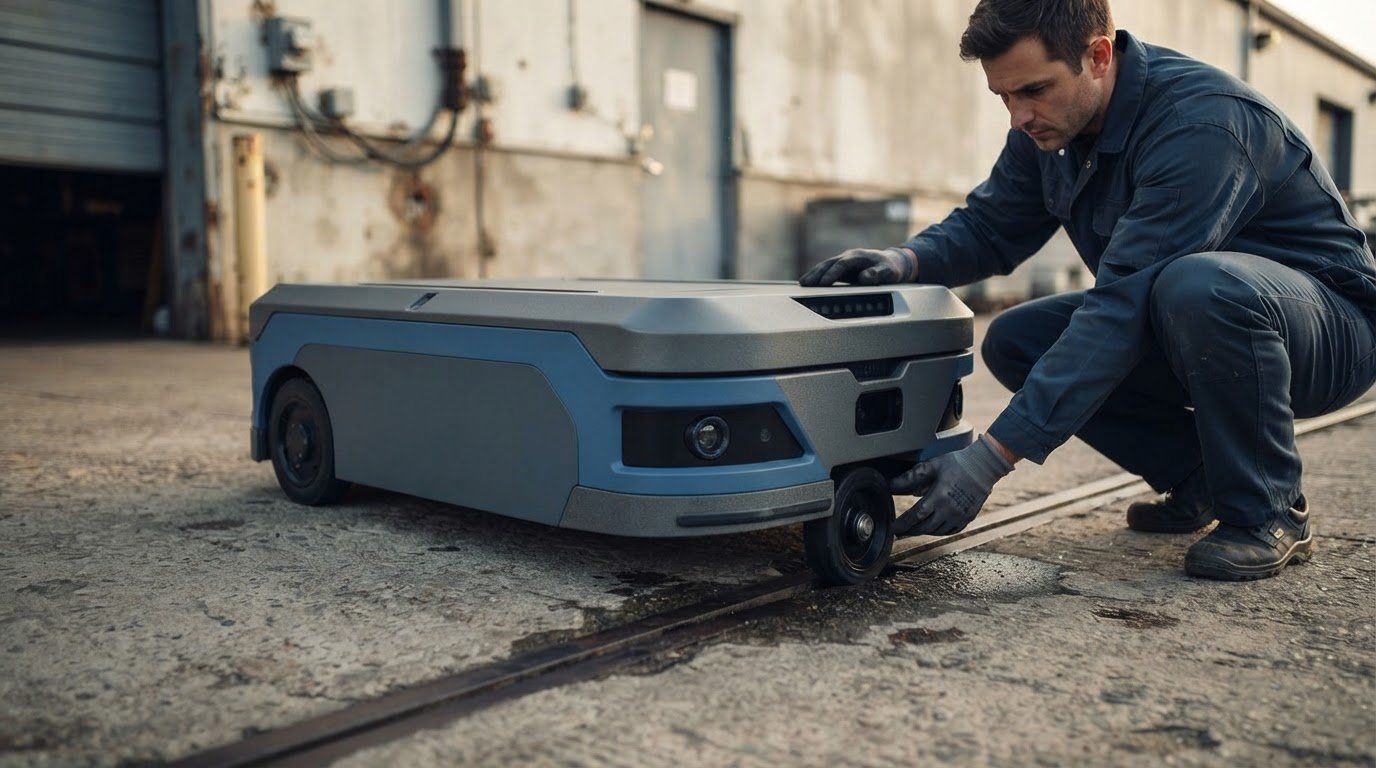
Floor requirements for a 1,500 kg die transfer depend on the AMR’s limits, loaded weight, and route. An integrator assesses floor capacity, flatness, slopes, joints, and transitions together, since uneven surfaces can affect stability and travel clearance.
Battery runtime, charging method, and fleet size depend on delivery schedules, route length, payload, and charging opportunities. An integrator models transport demand and available charging windows against the selected AMR’s operating profile and production requirements.
Plan the full journey, not just the aisle. Map pickup and delivery points, turns, crossings, doors, and handoffs, then identify congestion and narrow passages. For example, a route from die storage to a press may cross shared traffic lanes and require coordinated access at the press interface.
Software can assign transport requests, sequence missions, and coordinate autonomous vehicles with production activity. Route planning should include loaded travel, empty returns, waiting at transfer points, and charging. Considering each step helps show whether throughput is limited by travel distance, equipment handoffs, or simultaneous tasks.
- Route surface: Assess slopes, floor joints, thresholds, and the support available beneath the loaded vehicle.
- Traffic flow: Identify crossing points, shared aisles, and locations where vehicles may wait.
- Energy plan: Match charging opportunities to the duty cycle and planned transport windows.
A lifting or transfer module can affect route clearance and the space needed at each destination. Include its dimensions, travel position, and interface with a press or rack in the route model. In demanding environments, test representative journeys and handoffs, then refine software rules to reduce avoidable stops.
Size the fleet around concurrent transport calls, task timing, and charging availability to meet production flow requirements. One AMR may suit a dedicated route with staggered deliveries, while overlapping press requests can change the calculation. The resulting model connects facility conditions, vehicle capability, and material flow without relying on a generic throughput assumption.
Safety standards and integrated load sensing
Safety planning for a heavy die starts with the load, route, and operating environment. During deployment, assess hazards at pickup points, press interfaces, crossings, and shared logistics aisles. Applicable standards depend on the installation and jurisdiction, so identify relevant requirements before commissioning.
Common failure modes include an unstable or incorrectly positioned load, a blocked navigation path, and an unsafe handoff at a press or rack. Poorly coordinated traffic and unexpected floor obstructions can also interrupt transport and put workers or equipment at risk.
Load sensing can help determine whether an AMR is carrying a load and whether it is positioned appropriately for movement. Define how sensor inputs relate to operating states, such as starting, stopping, or completing a handoff. For example, a die that is not seated correctly on its transport fixture should not be treated as ready to move.
Safety controls must connect the robot, load interface, and facility workflow. Map stop conditions, access points, and equipment signals, then test both expected and abnormal scenarios. A press handoff, for example, needs a clear sequence for AMR arrival, load transfer, and vehicle departure. Electronics and control logic must support that sequence without conflicting commands.
- Load: Assess support, position, and stability before movement.
- Route: Identify crossings, obstructions, and areas shared with workers.
- Handoff: Define the safe operating sequence at each press or storage point.
- Response: Test how robots behave when a route or transfer condition changes.
Before production use, commissioning should exercise normal logistics tasks and foreseeable interruptions. The resulting review connects navigation, sensing, and equipment interfaces to the facility’s operating procedures. Plan an AMR safety integration review around your die routes and transfer points.
Defend Autonomous Robotics Trading LLC
Defend Autonomous Robotics Trading LLC provides AMR and AGV automation solutions for industrial material handling. Turn to the team when die transport requires coordinated planning for payload, transfer points, routes, and production flow. This systems-level approach aligns automation with facility conditions and handling requirements, rather than treating vehicle capacity as the only design factor.
To plan die movement, gather the load dimensions and support arrangement, pickup and delivery locations, route conditions, and press or storage interfaces. These details help define the requirements for a suitable automation solution. If you’re planning heavy-payload die transport, contact Defend Autonomous Robotics Trading LLC to discuss your project.
Move from planning to a defined project
A well-planned approach to heavy payload AMR integration for 1500kg industrial dies starts with a clear operational brief. Define the transport task, the production constraints, and the outcomes the system needs to support. That brief creates a practical basis for shaping an automation project around your facility, rather than relying on a generic solution.
Defend Autonomous Robotics Trading LLC also offers CNC and advanced manufacturing solutions, along with an AI Coffee & Beverage Robot. For die transport, the next step is a focused discussion of your handling requirements and system context.
Discuss your AMR project with Defend Autonomous Robotics Trading LLC and take the next step toward a more coordinated material-handling operation.
Frequently Asked Questions
Which heavy-payload AMRs can safely transport 1500 kg industrial dies?
An AMR rated for at least the complete transported load is a starting point, not a stand-alone safety decision. The EMMA 1500L has a rated payload capacity of 1,500 kg. The die’s fixture or support, load distribution, and transfer interface also matter. For example, a die mounted on a transport base must be assessed as a combined load against the AMR’s capabilities and operating conditions.
How do AMRs compare with AGVs, forklifts, and die carts for moving heavy tooling?
AMRs navigate autonomously, while AGVs use guidance methods such as laser, QR, or magnetic navigation, depending on the model. Forklifts provide operator-controlled movement, while die carts need a separate towing or pushing method. Autonomous dispatch may suit repeated die transport between production areas. Changing routes or occasional tooling moves may call for a different handling approach.
What safety standards and regulations apply to heavy industrial AMRs in the United States?
Applicable requirements depend on the AMR, its worksite, and its interfaces with machinery and people. For a US deployment, identify relevant standards and regulations during project design, then include them in the system risk assessment and commissioning process. The safety review should cover vehicle movement, load retention, stopping behavior, operator access, and press or rack handoffs, with controls documented for the installed system.
What payload capacity, deck dimensions, and center-of-gravity limits are needed for die transport?
The EMMA 1500L is rated for a 1,500 kg payload. Deck dimensions and center-of-gravity limits must suit the die, its fixture, and how the load is distributed; the article gives no specific dimensions or limits.