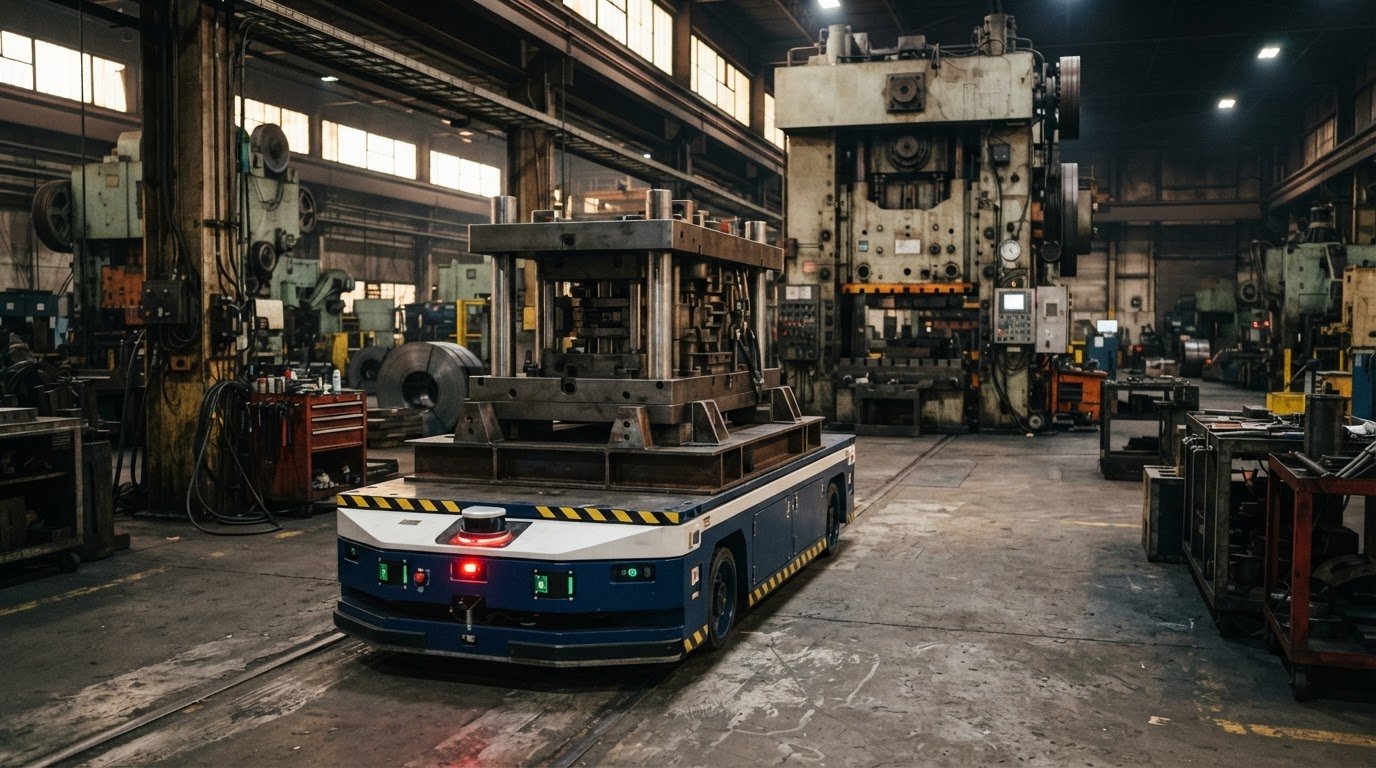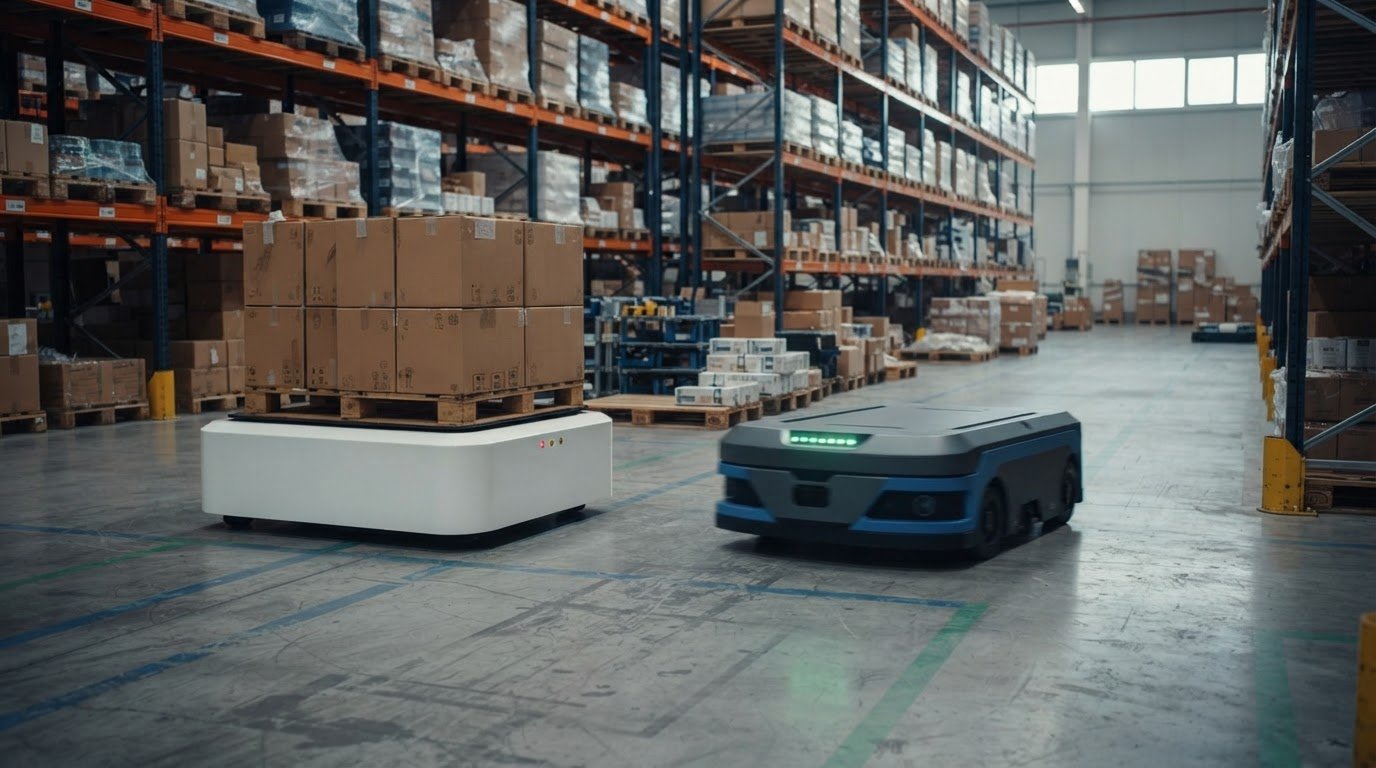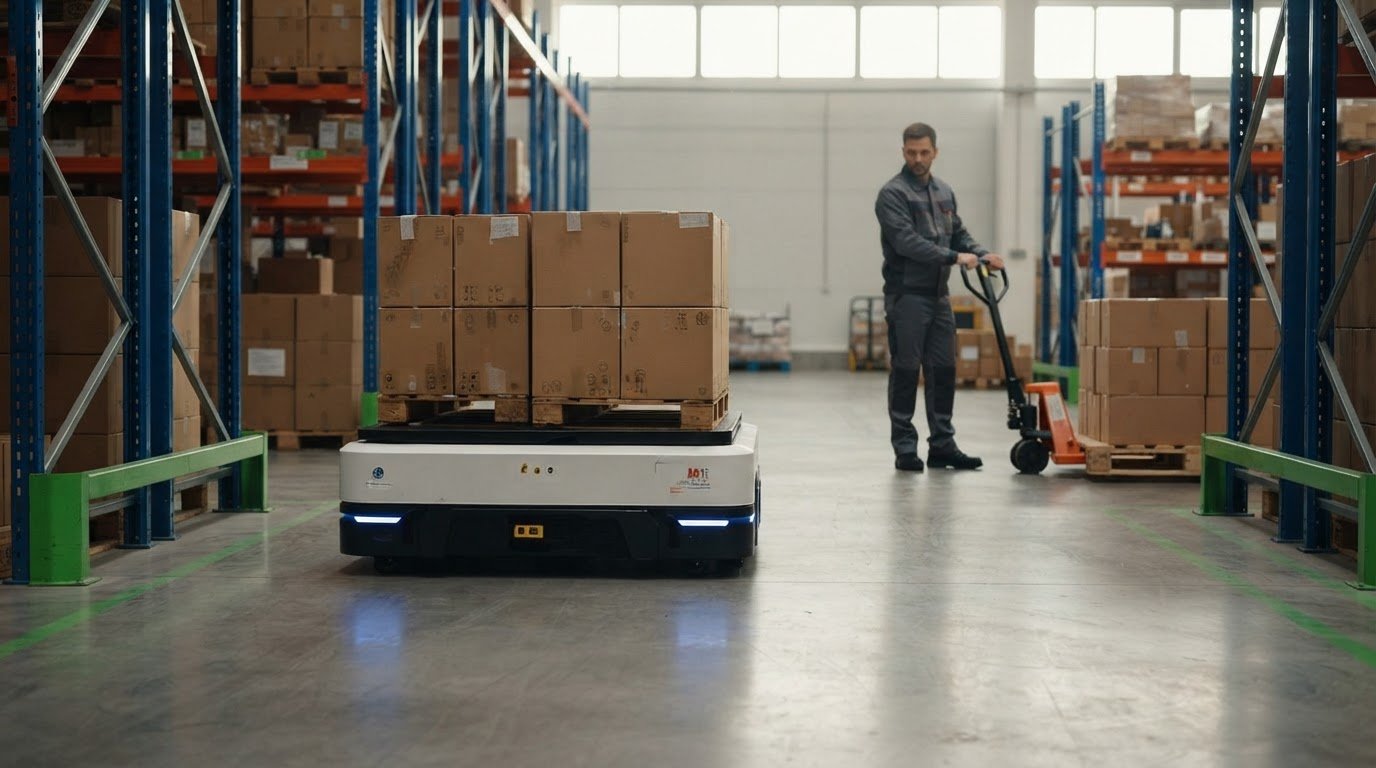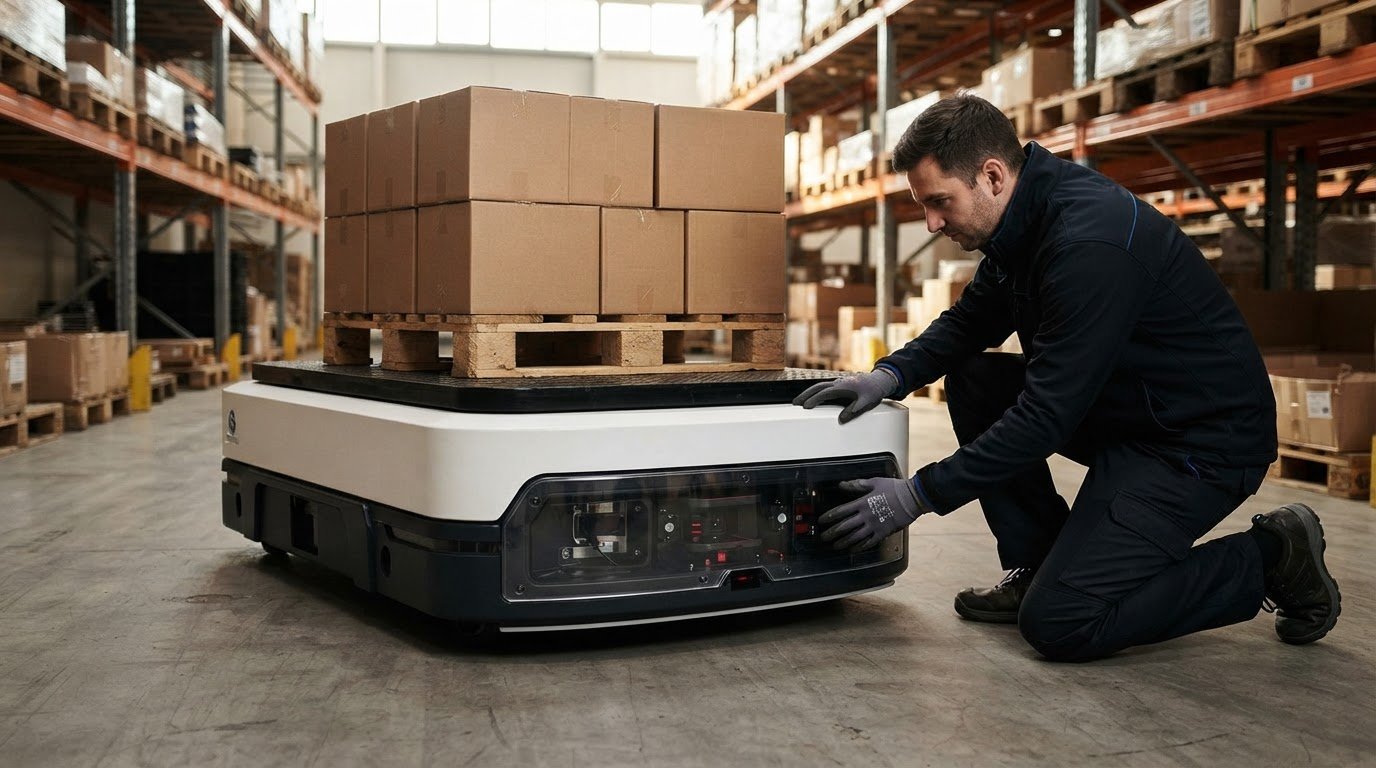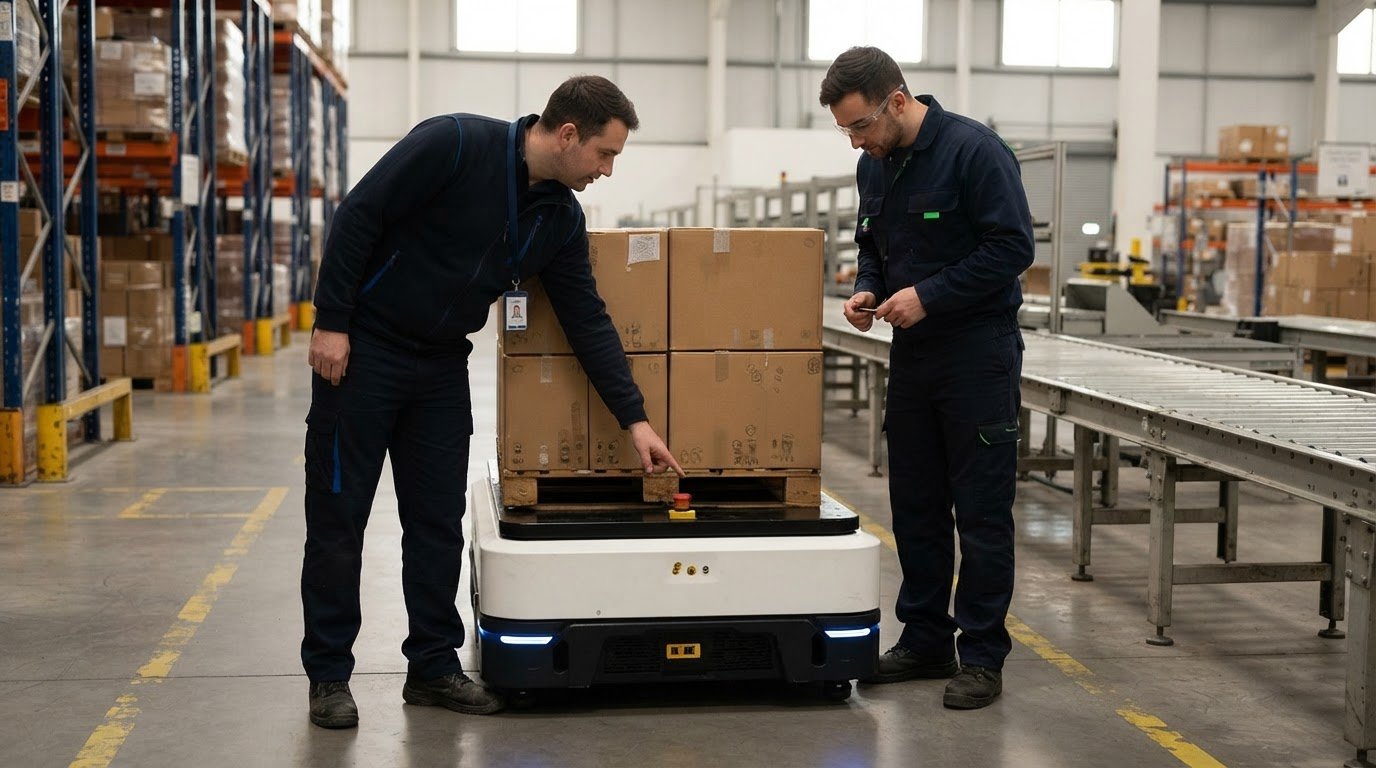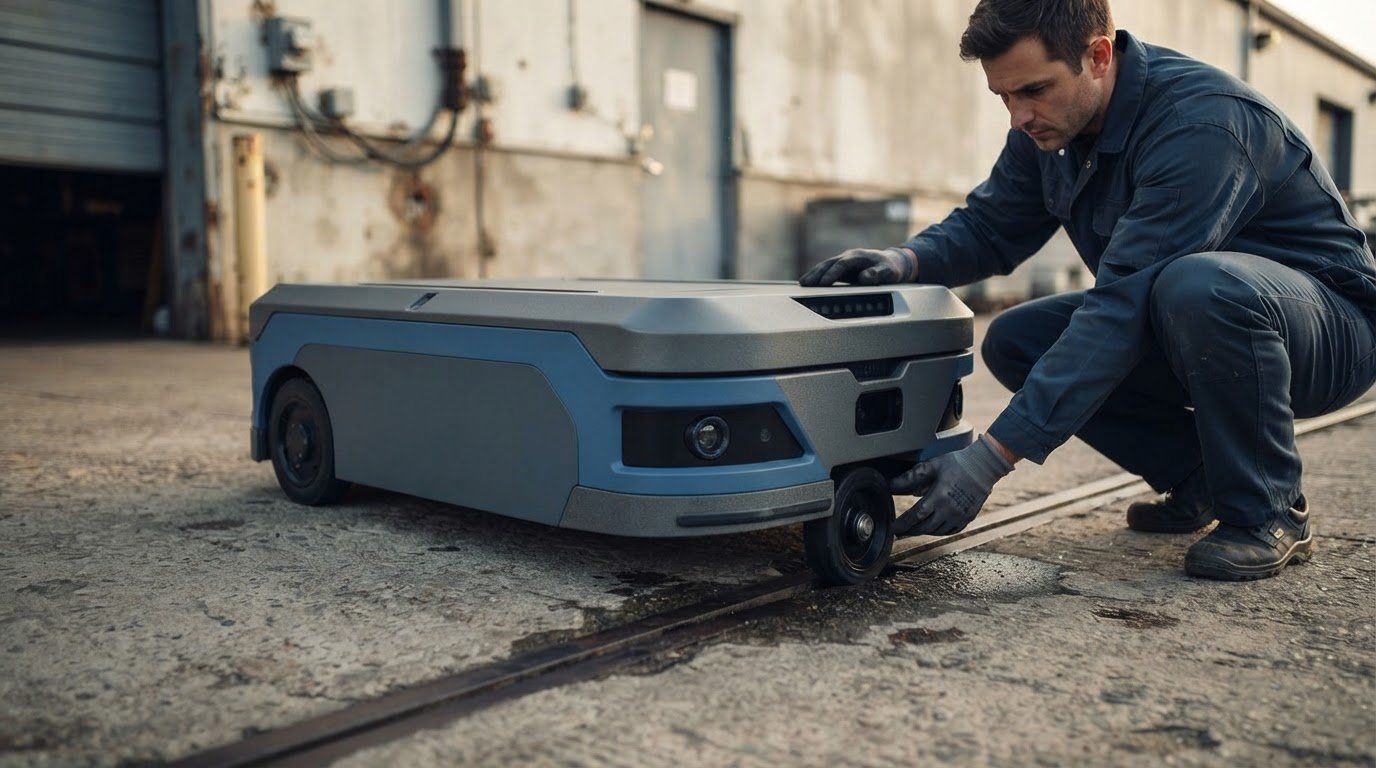
AGVs and AMRs are not interchangeable: the key difference is how they navigate their operating environment. An AGV towing vehicle follows a predetermined route to move wheeled loads, while an AMR can navigate more flexibly around a site. That distinction affects how each option fits factory and warehouse material flows.
Both can automate transport, but the right choice depends on the task: the loads, route, and how often the movement repeats. For regular deliveries along established paths, a towing vehicle can pull several carts in a train, helping maintain a steady flow between operations.
This guide explains how AGVs differ from AMRs, where towing vehicles fit among other AGV types, and which operational factors matter when choosing a solution. Route layout, load handling, and movement patterns all influence which approach best suits your material-handling needs.
Key Takeaways
- Match the vehicle to the route: AGVs follow predetermined paths, while AMRs offer greater flexibility in how they navigate.
- Assess load weight and how carts connect to the vehicle to identify whether towing suits your material flow.
- Repetitive deliveries along established routes can support a steady supply of materials to production and assembly operations.
- Distinguish low-level cart transport from warehouse tasks that require lifting, stacking, or moving unitized loads.
How can a provider determine the right type of Automatic Guided Vehicle for your operation?
A suitable vehicle depends on the load, trailer train, route, and task frequency. For repeat movements, an AGV towing vehicle can pull wheeled carts along a planned route.
Battery Capacity and Vehicle Weight
Battery capacity and vehicle weight affect how well a tractor can handle its planned workload and towing load. Consider operating duration, cart-train weight, route conditions, and the vehicle’s own mass together. A heavier tractor may suit demanding towing tasks, while battery needs depend on the vehicle’s operating cycle. These factors influence vehicle selection, charging arrangements, and integration with site traffic.
Tow Tractor Types and Manufacturers
AGV tow tractors include towing vehicles, tow tractors, and underride designs that connect through tow pins or lift modules. Manufacturers should be compared by rated capacity, trailer compatibility, navigation method, and integration requirements. Those criteria clarify which automated guided vehicle fits the operation, rather than relying on a brand name alone.
Trailer choice also affects train capacity: carts need secure connections and must move as a coordinated load. Assess cart dimensions, couplings, turning space, and delivery sequence before configuring the train. Typical towing vehicles do not reverse, so the route may need a loop. Safety sensors can stop movement when they detect a risk.
Costs and Operating Limitations
In the United States, purchase cost depends on vehicle capacity, battery configuration, navigation, trailers, and integration scope; no single price fits every system. Installation includes fitting routes and coordinating the vehicle with site processes, while maintenance planning accounts for batteries, sensors, and towing components. US safety requirements should be assessed for the specific operation; available facts don’t establish a named regulation. Route constraints, limited reversing, and manual intervention needs are practical limitations to plan around.
AGV efficiency and material handling
Efficiency depends on keeping material movement in sync with production. On an assembly line, an electric tugger can deliver several loaded carts together, then return with empty ones. This repeatable cycle reduces separate handling trips and helps maintain steady flow between supply points and workstations.
Autonomous robots are most useful when transport tasks follow predictable patterns. A towing vehicle can follow its assigned route, collect a cart train, and deliver it to a defined location. This makes movement easier to coordinate with production schedules. Route design, pickup timing, and cart availability all affect how reliably materials reach each process.
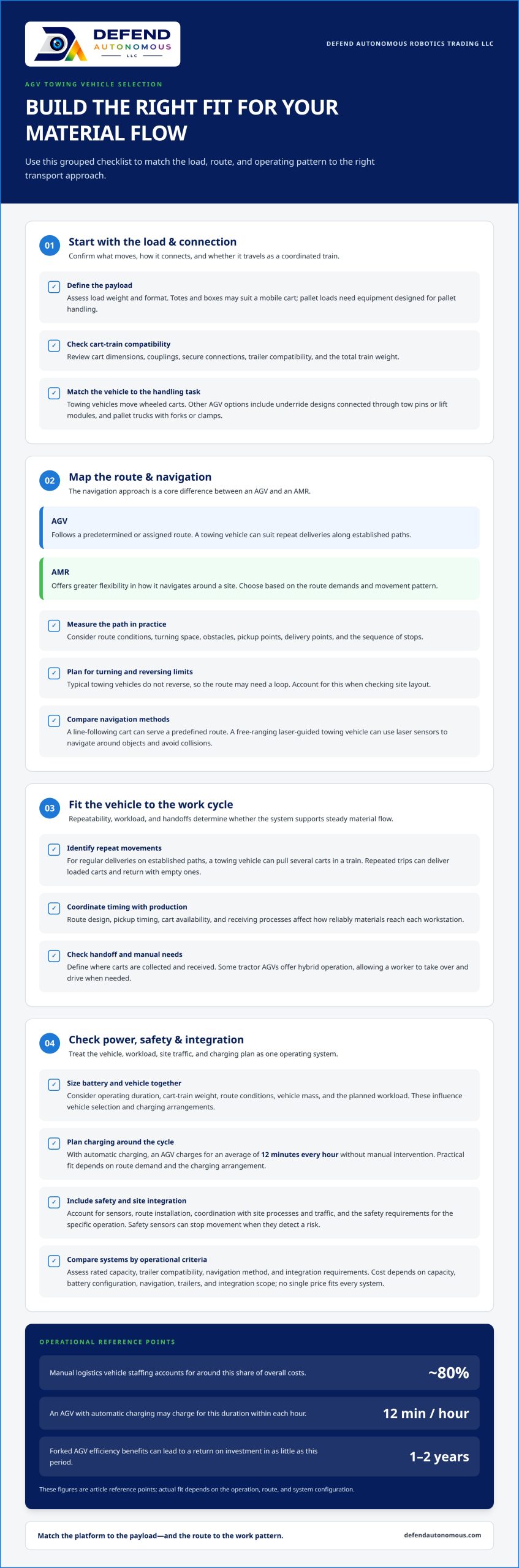
Charging strategy also influences productive operating time. With automatic charging, an AGV charges for an average of 12 minutes every hour without manual intervention. This approach can keep charging within the operating cycle, rather than requiring an operator to swap batteries. The practical fit depends on route demand and the system’s charging arrangement.
Labor allocation is another consideration in material handling. With manually controlled logistics vehicles, staffing accounts for around 80% of overall costs. Automating repetitive transport can shift staff effort toward other operational tasks, while the AGV performs scheduled movements. Forked AGV efficiency benefits can lead to a return on investment in as little as one or two years.
Measure performance through delivery consistency, completed runs, and interruptions to production. For example, a plant supplying two assembly areas can examine whether scheduled cart trains arrive when each area needs replenishment. A towing system supports efficiency when its route, load sequence, charging plan, and receiving process work together. If you’re assessing automated material handling, explore smart warehouse robotics and material handling as part of the wider operational picture.
Mobile platforms for low-level transport
Low-level mobile platforms handle compact loads close to the floor. Automated guided carts move bins, totes, or boxes around industrial facilities. For example, a cart can carry totes from storage to a production workstation, making this approach suitable when smaller items need regular replenishment.
Cart design determines the transport method. A line-following automated guided cart travels along a predefined route for repeated transfers between fixed points. Automated pallet trucks use specialized forks or clamps to grip and move pallets. Totes and boxes may suit a cart, while pallet loads need equipment designed for pallet handling.
For a short, fixed route, line-following navigation can provide predictable movement. A free-ranging laser-guided towing vehicle can use laser sensors to navigate around objects and avoid collisions, which may suit areas where obstacles affect the travel path. The route and load still need to match the platform’s intended role.
Some tractor AGVs offer hybrid operation, allowing a worker to take over and drive when needed. This can suit operations where autonomous transport handles routine movement but a particular task requires manual driving. It differs from an AMR designed for more flexible navigation, so the operating pattern helps determine which platform is appropriate.
In manufacturing, a mobile cart could carry boxes to a production cell while a pallet truck handles palletized materials. Consider the load format, pickup and delivery points, and route conditions together. These factors determine whether the task calls for a cart, a pallet-handling platform, or a towing vehicle. Match the platform to the payload rather than choosing by vehicle type alone.
Low-level transport works best when the receiving process can reliably accept each delivery. A defined handoff point, suitable cart, and repeatable route help connect movement to production needs. In facilities handling both totes and pallets, separating those transport tasks can make material flow easier to organize and automate.
Factory and warehouse material transport
Factory and warehouse applications differ in load format, route, and handling needs. A towing vehicle moves heavy wheeled loads through tight spaces, connecting production areas with storage or dispatch. A warehouse route might include repeated transfers between receiving, staging, and assembly. The key question is whether cargo travels on carts, pallets, or directly on a mobile platform.
For wheeled loads, a guided towing vehicle can move connected trailers through a facility. This suits logistics flows where several carts follow the same delivery sequence. Route planning matters because typical towing vehicles do not reverse, so the path may need a loop. In constrained factory aisles, account for turning space and how trailers track behind the tractor.
Automated forklifts are designed to lift, move, and stack heavy loads without human intervention. They serve a different purpose from cart-towing vehicles. For example, a forklift can move a pallet into storage, while a towing system transports wheeled production supplies between work areas. Choose according to the task to avoid a mismatch between vehicle function and cargo handling.
Unit-load AGVs carry heavy, unitized cargo in warehouses and production facilities. They transport loads on the vehicle, while conveyors or lift platforms can support handoffs. This setup may suit a defined pickup point and a receiving station arranged for direct transfer. By contrast, mobile robots towing trailers need compatible wheeled loads and suitable couplings.
Compare the full material flow, not just an individual transport leg: receiving, storage, replenishment, and delivery to production. If pallets need vertical placement, an automated forklift may fit. If carts carry recurring supplies, towing may better suit the route. If cargo transfers directly between stations, a unit-load system may be more appropriate. Discuss warehouse transport automation to align vehicle type with your factory or warehouse applications.
Defend Autonomous Robotics Trading LLC
Defend Autonomous Robotics Trading LLC provides AMR & AGV Automation Solutions for operations planning automated material movement. The right fit depends on the load, route, cart arrangement, and how deliveries connect with production or warehouse processes.
Bring these operating requirements into the decision between a towing vehicle and another automated approach. Defend Autonomous Robotics Trading LLC can help align a solution with your material flow, whether you are planning a new system or evaluating automation for an existing operation.
For a broader modernization plan, the portfolio also includes CNC & advanced manufacturing solutions and EV charging & sustainable energy solutions. Contact Defend Autonomous Robotics Trading LLC to discuss your automation requirements.
Build the Next Stage of Material Flow
Material transport decisions affect more than vehicle choice. They shape how production priorities, warehouse movement, and future automation plans work together. Treat an AGV towing vehicle as part of a wider operational design: define the task’s current requirements and consider how workflows may change.
Defend Autonomous Robotics Trading LLC combines AMR & AGV Automation Solutions with capabilities in AI beverage robotics and advanced manufacturing. This broader perspective can help connect a transport requirement to your operation’s wider automation plans, rather than treating each system as an isolated decision.
Share the material flow challenge, operating context, and outcomes you’re aiming for. Contact Defend Autonomous Robotics Trading LLC to discuss the next step for your operation and move forward with a clearer automation plan.
Frequently Asked Questions
Are AGVs different to AMRs?
Yes. AGVs typically follow predetermined routes, while AMRs navigate their operating environments more flexibly. A facility with stable, recurring routes may suit guided vehicle movement, while changing workflows may call for more flexible navigation. The distinction is how each vehicle moves through the site, not simply whether it operates automatically.
How does an AGV work?
An AGV follows predetermined instructions, cues, or signals to move around a site and perform assigned tasks autonomously. Its navigation system guides it along its intended route, and safety sensors can stop the vehicle when they detect a risk. In a distribution facility, for example, a vehicle might collect a load at one station and deliver it to another.
Who Uses Towing AGVs?
Manufacturing, automotive, and logistics distribution operations use towing AGVs for material handling. They are especially useful when a facility repeats the same movement between supply points and work areas. For example, a production operation may use a tractor to move wheeled carts from material staging to workstations. The strongest fit is a recurring transport task with compatible carts and a defined route.
What is an AGV towing vehicle and how does it work?
An AGV towing vehicle is a powered mobile robot that pulls one or more non-powered, wheel-based carts attached behind it. The vehicle moves the connected train along its assigned route, transporting goods without carrying them directly on its own platform. This arrangement can consolidate repeated cart movements into a single trip, provided the carts and route suit the towing system.
What payload and towing capacities do AGV towing vehicles offer?
Capacity depends on vehicle type and whether the system carries or tows the load. These figures describe different vehicle categories, so distinguish a direct payload from a trailer train’s towing load when defining the task.
How do AGV towing vehicles navigate and connect to warehouse systems?
Navigation options include laser, camera, optical, inertial, and wire guidance. AGVs may also follow lines or use natural navigation that maps the surroundings during installation. Warehouse integration coordinates vehicle tasks with material flows, such as dispatching a pickup or registering a delivery. The required connection depends on facility workflows and how existing systems assign and receive transport tasks.