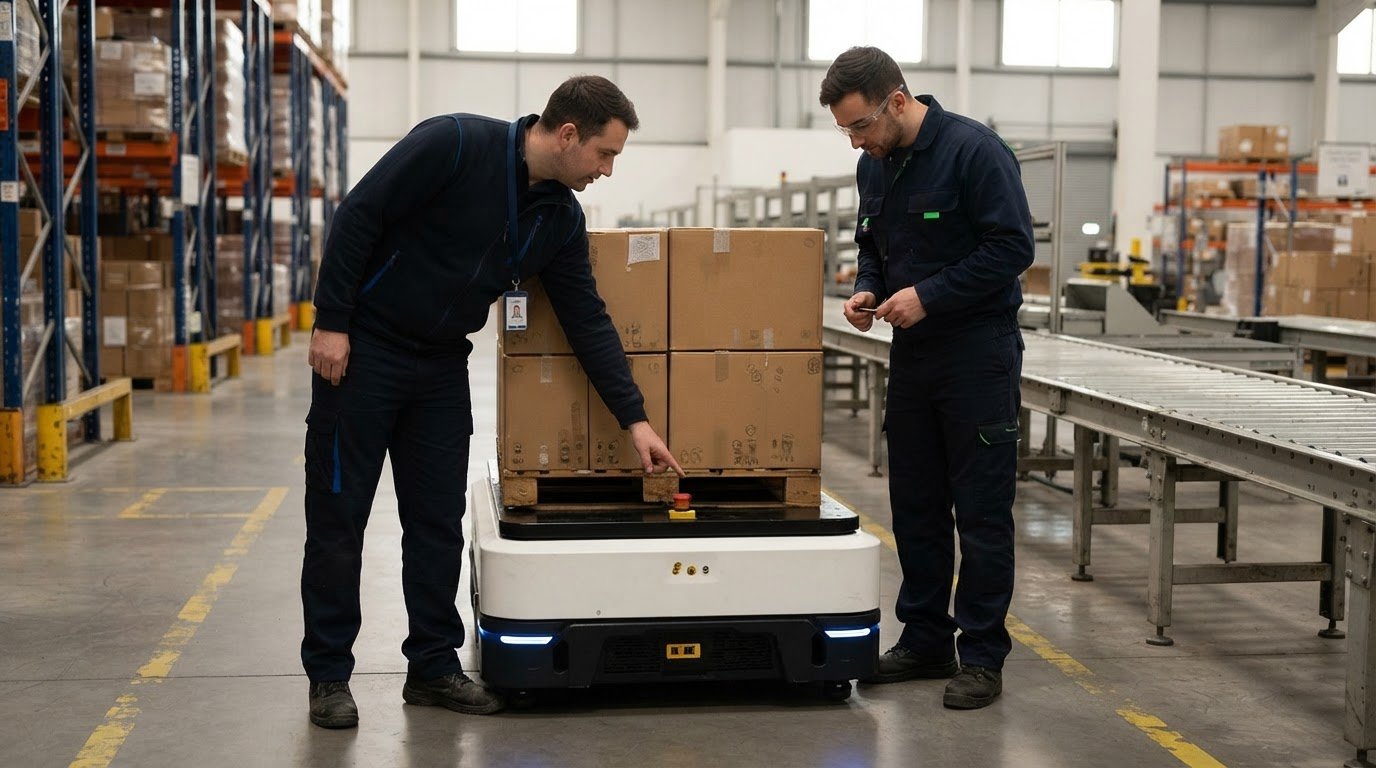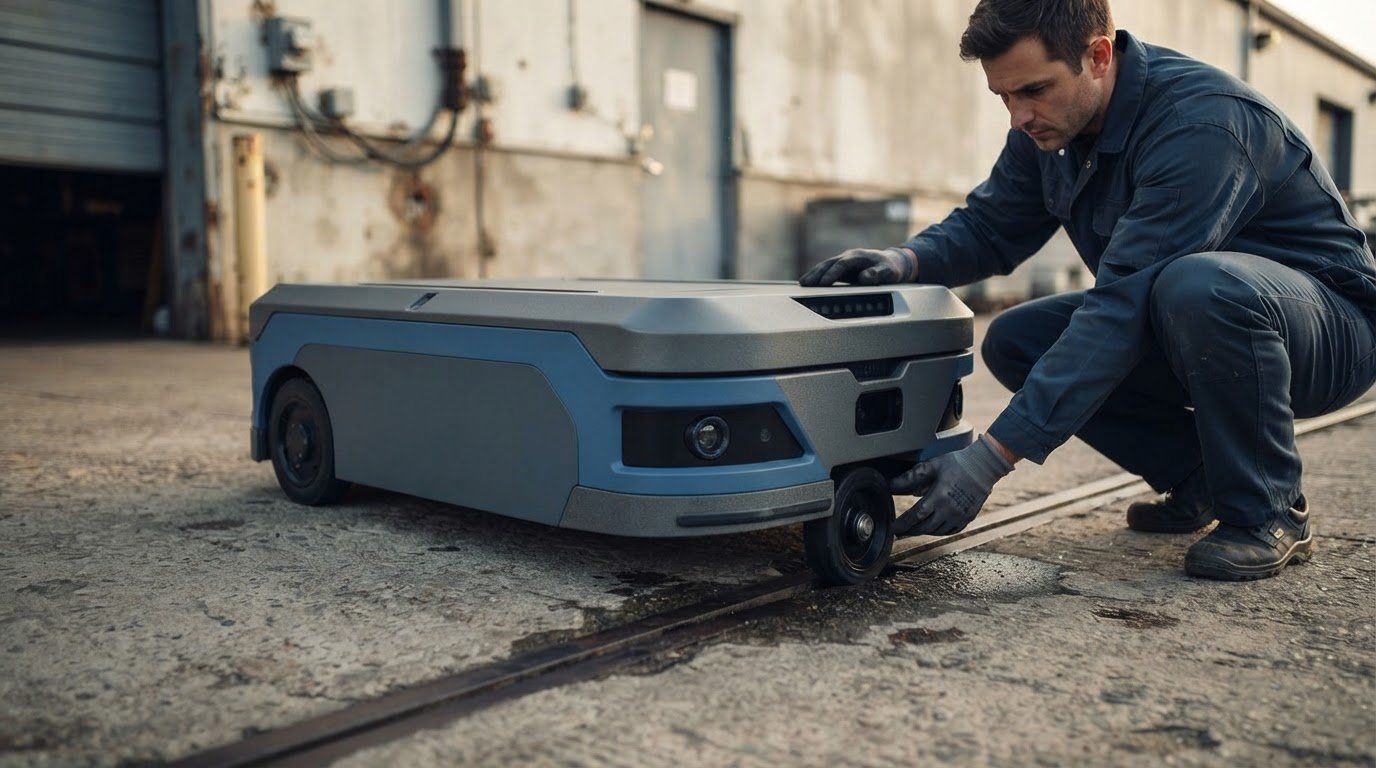
The fastest pallet jack isn’t automatically the most efficient choice. The efficiency of an autonomous pallet jack versus a manual pallet truck depends on the work: manual pallet jacks are commonly recommended for fewer than 50 pallets per day and transport distances under 100 feet, while repetitive, sustained movement can make autonomy more relevant.
Manual trucks remain practical for short runs and straightforward repositioning. But warehouse volume, travel distance, load handling, and throughput can shift the balance. This article explains how each factor affects autonomous pallet jack vs manual pallet truck efficiency, where manual equipment remains effective, and when autonomous material handling can support a more consistent warehouse flow.
Key Takeaways
- Match equipment to daily pallet volume and route length to keep short, simple moves efficient and identify where automation may add value.
- Assess whether repetitive transport routes could benefit from autonomous handling and more consistent warehouse flow.
- Consider load capacity and weight distribution alongside travel demands when planning pallet movement.
- Use throughput limits to identify where manual handling may constrain operations, then explore automation options suited to the task.
1. Applications by warehouse volume and transport distance
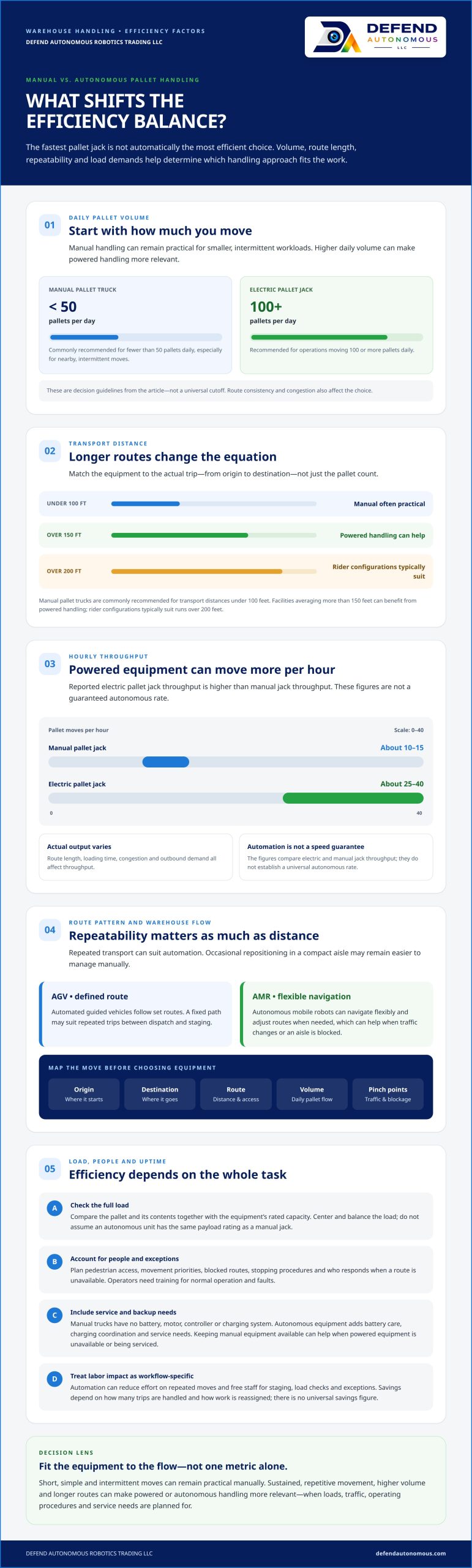
Daily pallet volume and route length help determine whether manual handling remains practical or automation adds value. Manual pallet trucks are commonly recommended for fewer than 50 pallets per day and transport distances under 100 feet. They suit smaller warehouses where workers reposition loads or move pallets between nearby storage and staging areas. On short runs, manual trucks can be faster and more practical than larger equipment, especially when movements are intermittent.
Higher volumes and longer routes change the operational equation. Electric pallet jacks are recommended for operations moving 100 or more pallets daily, while facilities with average transport distances exceeding 150 feet can benefit from powered handling. Rider configurations typically suit transport runs exceeding 200 feet. These thresholds help frame the autonomous pallet jack versus manual pallet truck efficiency decision, but route consistency and congestion also matter.
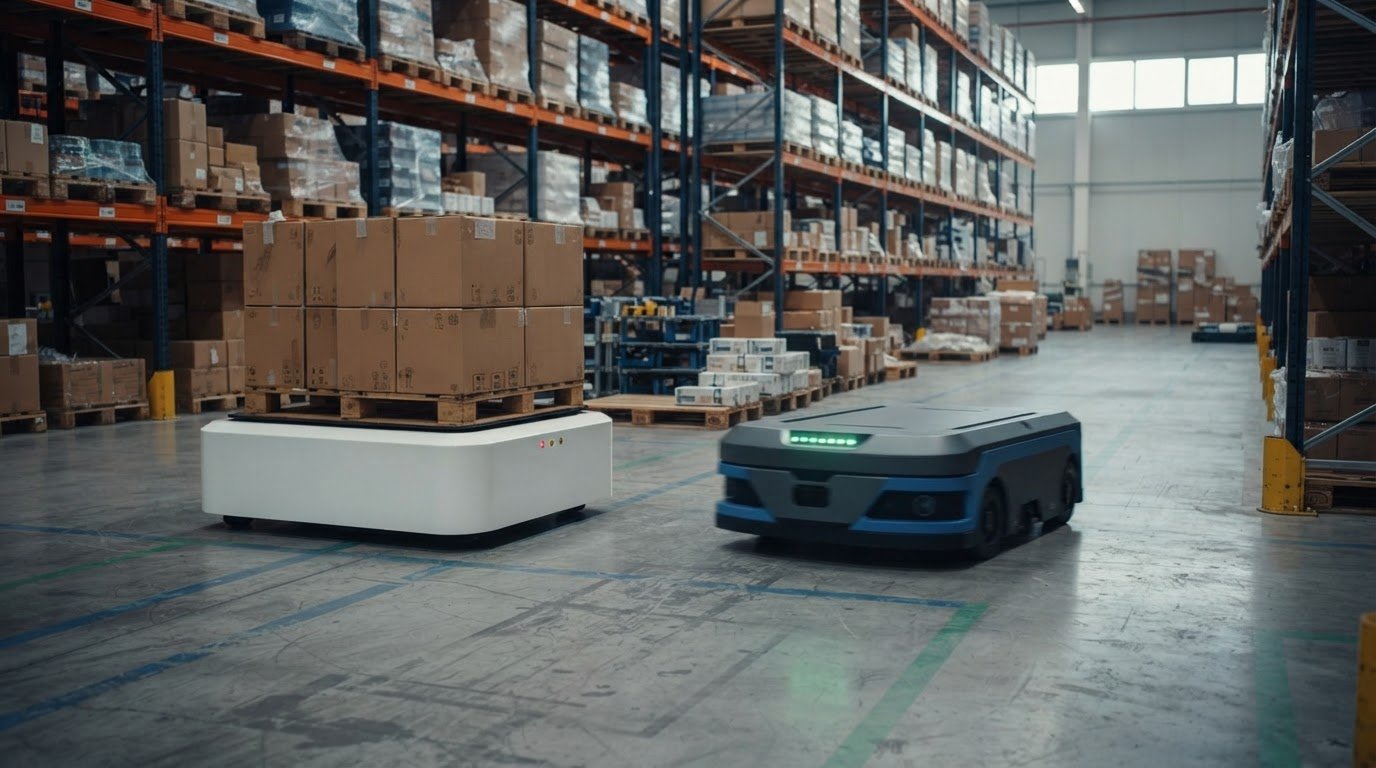
Navigation affects how automation performs in a warehouse. Automated guided vehicles (AGVs) follow defined routes, while autonomous mobile robots (AMRs) can navigate flexibly and adjust their routes when needed. A fixed path may suit repeated trips between dispatch and staging. An AMR’s adaptive routing can better accommodate changing traffic or a blocked aisle, helping reduce bottlenecks at busy transfer points.
Tight warehouse spaces call for a different assessment. Manual pallet trucks are useful for short moves and repositioning loads where workers need direct control in confined areas. Before choosing equipment, map the origin, destination, route, daily pallet volume, and traffic pinch points. Repeated trips from receiving to staging may suit automation, while occasional repositioning in a compact aisle may remain practical manually. This step-by-step review ties equipment choice to actual warehouse flow, not volume alone.
2. How Do Autonomous Pallet Trucks Improve Warehouse Efficiency?
Autonomous pallet trucks improve material handling by repeating planned movements without continuous manual pushing. At Level 1, a unit can follow set routes throughout warehouse shifts. Higher autonomy can support operations toward 24/7 activity, provided the workflow and operating schedule support it.
How much faster are they? There’s no single speed comparison for autonomous and manual trucks. Electric pallet jacks handle about 25-40 pallet moves per hour, compared with about 10-15 for manual jacks; those figures indicate powered throughput, not a guaranteed autonomous rate. Actual output depends on route length, loading time, congestion, and outbound demand.
Automation can reduce the physical effort operators spend on repeated moves. That can free staff to focus on staging, load checks, and exceptions instead of pushing every pallet. Labor savings depend on how many trips the system handles and how work is reassigned; there is no universal savings figure.
Dynamic warehouses still need careful operating design. Mixed loads, changing staging locations, and blocked aisles can disrupt planned routes. Before deployment, define movement priorities, pedestrian access, exception handling, and who responds when a route is unavailable. Operators need training on normal operation, stopping the unit, and escalating faults. Clear procedures matter more than assuming a system can handle every change without oversight.
For US workplaces, safety planning should cover operator instruction, pedestrian separation, route access, load-handling procedures, and emergency response. Applicable OSHA obligations depend on the equipment and workplace, so operating procedures should align with the rules for the specific deployment.
Manual trucks have no battery, motor, controller, or charging system. Autonomous equipment adds battery care, charging coordination, and related service needs; replacement costs depend on the system and its duty cycle. Other risks include blocked routes, workflow disruption, and downtime. Keeping manual equipment available as backup can help maintain pallet movement when powered equipment is unavailable or being serviced.
3. Load capacity and weight distribution
A pallet jack’s rated capacity is the maximum load it can handle, not a target for every trip. In a receiving area, for example, a dense pallet of components may approach that limit, while lighter cartons leave more capacity unused. Check the rating for the specific equipment before assigning loads.
Weight distribution matters as much as total weight. A pallet with its heaviest cartons on one edge can put uneven force on the forks. Center the load, balance its weight, and make sure the pallet sits securely on both forks. These steps support stable handling through turns, narrow aisles, and transitions between receiving and storage.
Assess payload capacity against the complete transport task. Count the pallet and its contents together, then consider the route, floor transitions, and clearance at the destination. Do not assume an autonomous unit’s payload rating matches a manual jack’s. Select robots for the actual load and operating environment, not simply the highest advertised figure.
For an EXP15 designation, assess payload capacity separately from route storage. A model name alone does not establish either limit. Route storage concerns the routes or movement instructions a system can retain; payload describes the load it can carry. Keep those specifications distinct when planning a facility deployment, and avoid treating route capacity as permission to exceed the load rating.
Use the same review before assigning equipment: weigh the full pallet, check how its contents are distributed, and compare the total with the rated capacity. Then assess whether the selected unit can move it along the intended route and into the required staging position. This helps match manual trucks or autonomous equipment to each job, from outbound transfers to receiving, without confusing payload with overall warehouse throughput.
4. Manual pallet jack throughput and limitations
A manual pallet jack typically handles about 10-15 pallet moves per hour. That rate helps assess fit, but each move includes more than travel. Workers position the forks, pump the handle, move the load, and align it for unloading. A sequence of short transfers between receiving, storage, and loading can therefore demand substantial repeated effort. Manual equipment is most effective when trips are occasional, routes are direct, and movement stays close to the work area.
Simplicity is a practical advantage of a manual truck. With no battery, motor, controller, or charging system, it can remain available without a charging cycle. Operators can reposition it as tasks change, such as moving a pallet from a dock to nearby staging. That flexibility can help when daily demand shifts or powered equipment is occupied, unavailable, charging, or being serviced.
Throughput can become a constraint when loading and transport compete for the same operators. For example, if a receiving team must move pallets while unloading deliveries, each manual trip takes time and effort away from other tasks. A forklift may handle another stage of material flow, but handoffs between equipment can still cause waiting. Map the route, count recurring transfers, and identify where pallets queue before deciding whether manual handling meets the required pace.
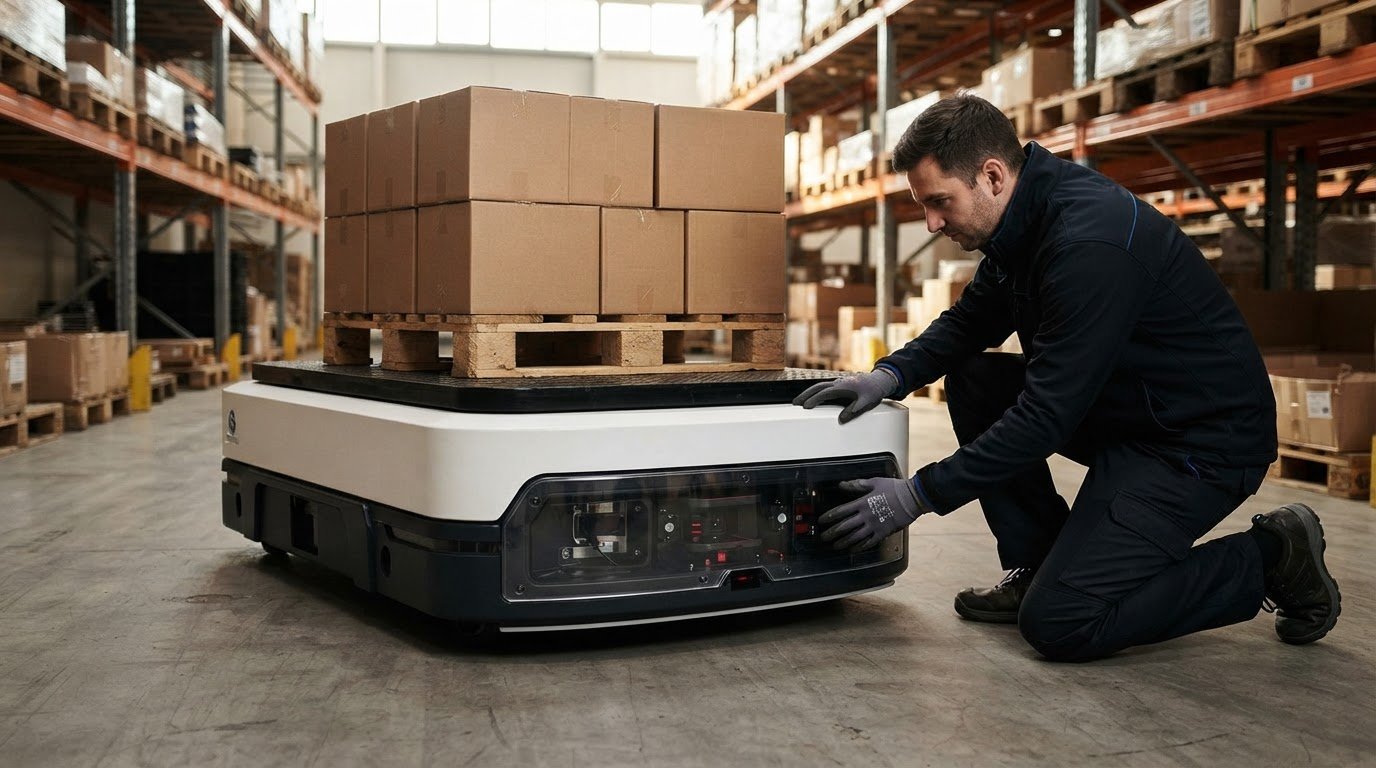
Keep manual units serviceable with routine checks: inspect wheel wear, the hydraulic system, moving parts, and fork condition. Lubricate moving parts and address wear before it interrupts operations. These checks support dependable use, but they do not remove the physical effort required for each move. In practice, manual jacks suit adaptable, infrequent transfers; consider automation when repeated pallet movement limits the wider workflow. Make equipment decisions alongside loading schedules, forklift handoffs, and staging needs, not throughput alone.
Defend Autonomous Robotics Trading: Robotic Palletizing, Sorting & Pick-and-Place Systems
Defend Autonomous Robotics Trading offers Robotic Palletizing, Sorting & Pick-and-Place Systems for facilities looking to automate repetitive pallet workflows beyond transport. These systems can address constraints in palletizing, sorting, or pick-and-place tasks alongside internal movement. For route-based pallet transport, AMR & AGV Automation Solutions offer a related automation path. The right fit depends on the task: pallet movement, load arrangement, and sorting have different operational requirements. Map the workflow, identify the repeated handling step, and define how equipment integration should support existing warehouse processes. This keeps the next decision focused on the bottleneck, rather than automation for its own sake. To discuss warehouse automation needs, contact Defend Autonomous Robotics Trading.
Build the Next Stage of Warehouse Flow
Treat equipment selection as part of a broader workflow decision. Consider how material movement connects with staging, order preparation, and downstream handling. Targeting one recurring process can give operations teams a clearer basis for planning wider automation.
Decisions about autonomous pallet jack vs manual pallet truck efficiency should reflect the facility’s operating priorities, not technology alone. If repetitive transport is one of several constraints, consider how it fits with other material-handling needs. Defend Autonomous Robotics Trading LLC offers AMR & AGV Automation Solutions for warehouse automation planning. Connect equipment choices to specific workflow requirements rather than adding automation without a defined operational purpose.
Bring your warehouse priorities into the next planning conversation. Contact Defend Autonomous Robotics Trading LLC to discuss a practical path forward.
Frequently Asked Questions
How Do Autonomous Pallet Trucks Improve Warehouse Efficiency?
Autonomous pallet jacks can improve efficiency by handling repeatable pallet moves with less continuous manual effort. For example, a scheduled transfer from reserve storage to a production line can follow a defined workflow, leaving operators to focus on replenishment exceptions or order preparation. The operational benefit depends on how well tasks, routes, and handoffs fit the facility’s existing processes.
How many pallets per hour can autonomous and manual pallet trucks move?
Manual pallet jacks handle about 10-15 pallet moves per hour, while electric pallet jacks handle about 25-40. These figures aren’t an autonomous truck rate: actual autonomous throughput depends on its system, route, load, and time spent waiting or transferring pallets. For planning, distinguish equipment type and measure a complete cycle, including loading, travel, unloading, and any handoff.
How much does an autonomous pallet jack cost compared with a manual pallet truck?
The price of an autonomous pallet jack depends on the system and project requirements. Cost factors include the selected system, required integration, workflow complexity, and operating environment. Manual trucks generally involve a simpler purchasing decision, but a fair comparison considers the work each option handles, not just its purchase price. General market prices may not reflect the cost of a specific automation project.
What is the total cost of ownership for autonomous pallet jacks versus manual trucks?
Total cost of ownership goes beyond purchase price. For an autonomous system, account for integration, energy use, maintenance, support, and downtime, alongside the tasks it can handle. For manual trucks, include routine upkeep and the labor required for repeated moves. Compare both options over the same operating period and workload, then assess whether the handling time saved offsets the added system costs.
Which warehouse tasks are suitable for autonomous pallet jacks?
Autonomous pallet jacks suit recurring, clearly defined transport tasks, such as moving replenishment pallets from storage to production-line points or transferring completed loads to outbound staging. They are less suited to workflows with irregular destinations or frequent manual intervention. Identify repeated trips, handoff points, and exceptions first to see whether autonomous movement addresses a genuine process constraint.
What aisle width, floor conditions, and layout do autonomous pallet jacks require?
Requirements depend on the selected system and planned routes, so there is no universal aisle-width figure. Layout planning should account for turning and stopping space, pedestrian and equipment traffic, floor transitions, and access to pickup and drop-off points. For example, a route through a busy loading area needs clear movement rules. Floor condition and route geometry both affect practical operation.