A robot manufacturer’s authorization alone does not establish whether its solution fits your operation. After installation, support should cover the system’s life cycle, including trained assistance, maintenance planning, spare-parts support, and operator training. A useful robotics system integrator comparison weighs this support alongside application expertise, customization, and the difference between an integrator’s complete system and a manufacturer’s hardware.
Choosing an automation partner means looking beyond the robot. The system must suit your process, work with existing equipment, and remain supportable after commissioning. This comparison explains how to assess service, relevant project experience, and customization, and when an integrator’s end-to-end role may better suit your needs than a hardware-focused offering.
Key Takeaways
- Assess post-install support by looking beyond commissioning to maintenance, operator training, and production optimization.
- Match an integrator’s application experience to your process, project complexity, and plans for future variants.
- Evaluate how proposed tooling and fixtures will work with existing equipment while supporting repeatable positioning and safe operation.
- Compare an integrator’s end-to-end system responsibilities with a robot manufacturer’s hardware focus to identify the best fit for your project.
1. What kind of post-install support should I expect from a robotics integrator?
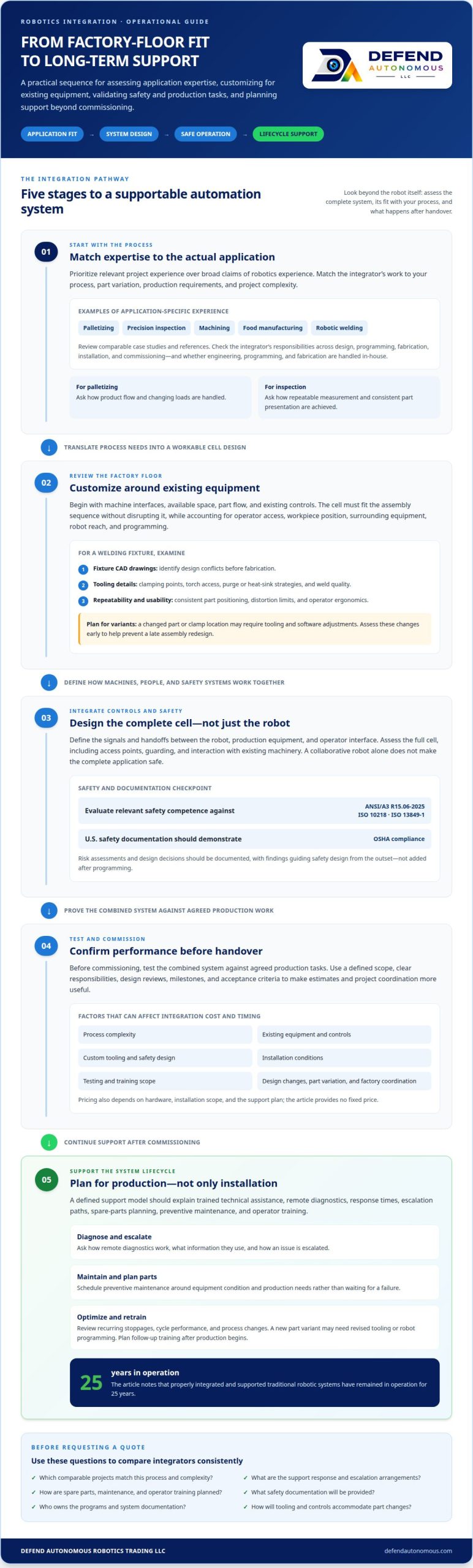
Expect support beyond installation: trained technical assistance, preventive maintenance, spare-parts planning, and operator training. Properly integrated and supported traditional robotic systems have remained in operation for 25 years. Long-term support protects production by addressing wear, faults, and process changes before they disrupt factory output.
Ask how remote diagnostics work, what information they use, and how an issue is escalated. A defined support model should explain response times, escalation paths, remote tools, and spare-parts planning. Preventive maintenance can then be scheduled around equipment condition and production needs, rather than waiting for a failure.
Production optimization should continue after commissioning. An integrator can review recurring stoppages, cycle performance, and process changes, then recommend system adjustments. For example, a new part variant may require revised tooling or robot programming. Plan follow-up training after the system enters production so operators can reinforce what they learned during handover.
Which certifications and safety standards should a U.S. robotics integrator meet? Evaluate relevant safety competence against ANSI/A3 R15.06-2025, ISO 10218, and ISO 13849-1; the International Organization for Standardization identifies ISO 13849-1 as a machinery-safety standard. U.S. safety documentation should demonstrate OSHA compliance, with risk assessments and design decisions documented.
How much does robotic automation integration cost? Pricing depends on the application, hardware, tooling, controls, installation scope, and support plan. The price is provided after a quote request.
Which robotics system integrators serve the United States? U.S. manufacturers can look for integrators with experience in applications such as palletizing, inspection, machining, or food manufacturing. Choose relevant expertise rather than a generic match.
What are the risks of choosing the wrong integrator? Poor process fit, weak safety documentation, or limited post-sale support can lead to production disruption, redesign, or difficult maintenance.
What should you ask before requesting a quote? Ask about comparable projects, support response and escalation, spare-parts planning, maintenance, training, safety documentation, and ownership of programs and system documentation.
2. Integrator application expertise and track record
Application fit matters more than broad claims of robotics experience. Palletizing, precision inspection, aerospace machining, and food manufacturing demand different engineering decisions. A palletizing cell must handle product flow and changing loads; inspection automation depends on repeatable measurement and consistent part presentation. Match the integrator’s project history to your process, part variation, and production requirements.
Look for case studies and references with comparable scope and complexity. A useful example describes the application, the integrator’s responsibilities, and how the system progressed through design, programming, installation, and commissioning. Determine whether engineering, programming, and fabrication are handled in-house. Direct ownership can help maintain continuity when design changes affect tooling, controls, or schedules.
Cross-industry work can bring useful technical perspective, but it does not replace sector-specific knowledge. A welding cell requires different process decisions from a warehouse material-handling system. Ask how the integrator has addressed your application’s tooling, part changeovers, safety, and quality requirements. For robotic welding, ask how collision checks, torch angles, and future part variants are handled. Training and commissioning plans should reflect your operators’ roles and equipment.
What factors affect the cost and timeline of a robotics integration? Key drivers include process complexity, existing equipment and controls, custom tooling, safety design, installation conditions, and the scope of testing and training. Design changes, part variation, and coordination with factory operations can also affect timing. A defined scope, clear responsibilities, design reviews, milestones, and acceptance criteria make estimates more useful.
For industrial projects that need application-specific automation, explore industrial robotics solutions as a relevant next step.
3. Customizing systems for existing equipment
Integration starts with the equipment already on the factory floor. Engineering reviews machine interfaces, available space, part flow, and existing controls. A custom cell must fit the assembly sequence without disrupting it. For example, a robotic welding system may need to share space with an established fixture and operator station. The design must account for access, workpiece position, and surrounding equipment, all of which shape tooling, robot reach, and programming.
For welding applications, fixture CAD drawings can reveal design conflicts before fabrication. Engineers assess clamping points, torch access, purge or heat-sink strategies, and weld quality. A fixture that positions each part consistently supports repeatable robot paths. Its design should also limit distortion and preserve operator ergonomics. If a part variant changes the clamp location, the integrator can assess how tooling and software need to adapt, helping prevent a late assembly redesign.
Existing controls and software affect how the robot communicates with production equipment. The integration design should define the signals and handoffs between the robot, machine, and operator interface. A risk assessment considers the full cell, including access points, guarding, and interaction with existing machinery. A collaborative robot alone does not make the complete application safe. Documented findings should guide safety design from the outset, not be added after programming.
Before commissioning, engineering should test the combined system against agreed production tasks. For a welding cell, checks can assess bead quality, cycle time, and repeatability using representative parts. The integrator can resolve interference, reach, or sequencing issues before production handover. Clear ownership of robot programs, control logic, and documentation supports future maintenance and expansion, particularly when equipment changes or new assemblies enter the process.
4. Integrators compared with robot manufacturers
A robot manufacturer supplies hardware and expertise around its own platform. A system integrator takes responsibility for combining equipment, tooling, controls, and process requirements into a working production system. For example, an aerospace machining cell may need coordinated robot movement, machine interfaces, part handling, and safety design. The manufacturer’s robot is one component; the integrator addresses how the complete application operates.
This distinction matters when existing controls, safety systems, or equipment must work together. A manufacturer’s authorization can indicate a relationship with the robot maker, but it does not guarantee project timelines, integration with other systems, or post-commissioning support. A strong partner considers process fit instead of defaulting to one brand. The right robot platform depends on reach, payload, cycle requirements, and its role in the complete cell.
Compare each provider’s scope of responsibility. A distributor generally focuses on selecting and supplying robotic hardware. An integrator evaluates the process, designs the complete system, engineers tooling and controls, manages commissioning, and supports production. That broader scope can help when a project involves custom fixtures, multiple equipment interfaces, or changes to factory workflows. Spare-parts planning and system documentation also affect how maintainable the installed solution will be.
RIA/A3 certification and OEM authorization are useful credibility markers, not substitutes for application evidence. Certification assessment can include an onsite audit, practical assessment of key personnel, and safety training. Evaluate these credentials alongside relevant project references, defined responsibilities, and a clear support plan. A manufacturer may be a suitable route when an established in-house automation team can manage integration details. A robotics system integrator comparison is more useful when it distinguishes hardware supply from end-to-end project ownership.
Choose the delivery model that matches your internal capacity and system complexity. For an integrated robotics project, discuss your automation requirements.
Defend Autonomous Robotics Trading
Defend Autonomous Robotics Trading LLC helps operations teams connect automation needs with robotics and advanced manufacturing solutions. When evaluating a project, consider your process, existing equipment, and production support requirements. The company offers AMR & AGV Automation Solutions, an AI Coffee & Beverage Robot, CNC & advanced manufacturing solutions, and EV charging & sustainable energy solutions. These distinct offerings can help focus the discussion on the technology your operation needs, rather than treating a robot as a standalone purchase.
If you’re assessing an automation project and want to discuss which solution fits your operational requirements, contact Defend Autonomous Robotics Trading LLC.
Turn Your Automation Priorities Into a Clear Next Step
Use your robotics system integrator comparison to focus on operational fit, not just equipment. Define the production challenge, the role of existing machinery, and the capabilities your operation needs. This gives a potential partner a stronger basis for discussing a suitable direction.
Defend Autonomous Robotics Trading LLC offers AMR & AGV Automation Solutions, an AI Coffee & Beverage Robot, and CNC & advanced manufacturing solutions. These offerings address different automation needs, from autonomous movement to specialized equipment. Start the conversation with your process requirements and desired outcome, rather than assuming one technology fits every application.
Bring your operational priorities into the discussion and identify the next practical step for your project. Contact Defend Autonomous Robotics Trading LLC to discuss your automation needs and move forward with clarity.
Frequently Asked Questions
What kind of post-install support should I expect from a robotics integrator?
Choose a support arrangement that clarifies fault response, troubleshooting, and recovery responsibilities. Before production starts, agree on how operators report alarms, what diagnostic records they capture, and who coordinates technical escalation. For example, a recurring robot fault should lead to a documented cause and corrective action, not just a reset. Those records help maintenance teams identify patterns and plan interventions.
Should I choose a single-platform or a multi-platform robotics integrator?
Choose based on your installed assets, application requirements, and expansion plans. A single-platform approach may simplify coordination across repeated cells, while experience with multiple platforms can provide flexibility for varied tasks and existing equipment. A factory standardizing similar production lines may prioritize consistent controls. A site combining legacy machines and distinct processes may value broader platform expertise. Define essential interfaces before comparing technical fit.
What questions should I ask a robotics integrator’s references?
Ask references how the integrator handled changes after design approval, communicated schedule impacts, and resolved issues during production ramp-up. Find out whether the delivered system matched the agreed scope and whether staff could operate it effectively after handover. A useful reference describes a specific challenge, the integrator’s response, and lessons for later automation projects.
How do I compare robotics system integrators?
Give each integrator the same process description, production goals, and details about existing equipment. Compare proposals by scope, responsibilities, design reviews, milestone assumptions, training, and post-installation support. Then separate technical fit from presentation quality: a clear proposal explains how the system addresses your process and interfaces. Using the same basis makes differences in project approach easier to identify.
What industries and applications do robotics integrators specialize in?
Integrators often focus on particular processes, such as palletizing, precision inspection, aerospace machining, or food manufacturing. Other applications include robotic welding, warehouse material handling, and machine tending. Each has different engineering priorities: welding centers on process execution, while material handling depends on reliable movement between work areas. Match the integrator’s relevant experience to your production task, not just your industry label.
How do I evaluate an integrator’s experience, references, and technical capabilities?
Assess evidence across project delivery, technical architecture, and data connectivity. Ask how the proposed system will exchange information with your MES or ERP, and whether it uses interfaces such as OPC UA or MQTT. Discuss database and edge-computing needs, along with cybersecurity measures for operational data. Compare these technical details with relevant project references to understand how the integrator applies its capabilities in production environments.